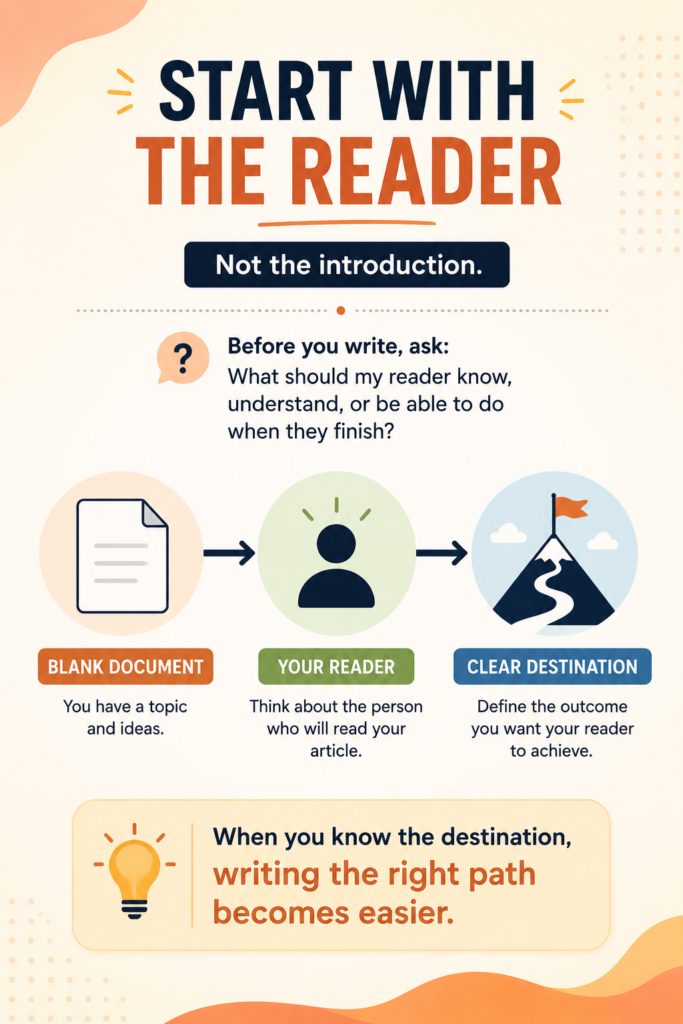
How do you usually begin writing a blog post? You choose a topic, check the keyword, do your research, prepare an outline, and then face the blank document. Yet, despite all that preparation, there are days when the opening just doesn’t come together. I’ve been there. The research is done and I know what I want to say, but I write a few lines, delete them, and start again.
Table of Contents
ToggleRecently, an Instagram post by copywriter Kristin made me look at this differently. Her advice was meant for social media: start with the CTA and reverse engineer the content from there. That got me thinking about blog writing. I wouldn’t start every blog with a sales CTA, but the idea of working backward made sense. Instead of asking, “What should I write?” what if we asked, “What should my reader get from this article?”
That’s the thinking behind my Reader-First Blog Framework.
Why a Topic Alone Doesn't Give Your Article Direction
Suppose you’ve decided to write an article about Meta Descriptions. You have your keyword, you’ve checked what people are searching for, and you’ve decided the article will be around 1,500 words. Technically, you’re ready to write. But what exactly are those 1,500 words supposed to accomplish? This is where writers, particularly those still learning how to structure long-form content, can get caught in the research trap. You begin reading about meta descriptions and soon have tabs open about character limits, click-through rates, Google’s guidelines, keywords, search results, SEO plugins, and whether Google rewrites descriptions.
I’ve done this myself. Research has a strange way of convincing us that because something is related to our topic, it deserves a place in the article.
Actually, it doesn’t. A reader searching for “how to write a meta description” probably isn’t asking us to tell them everything we know about meta descriptions. They want to know how to write one. They may want examples. They may want to know how long it should be or whether they should include their keyword. That difference may sound small, but it changes the direction of the article.
Instead of telling myself, “I’m writing 1,500 words about meta descriptions,” I could decide:
By the end of this article, my reader should be able to write a clear and useful meta description for their next blog post.
Now I know where I’m going. More importantly, I know where I need to take the reader. That’s the starting point of the Reader-First Blog Framework.
What Is the Reader-First Blog Framework
The Reader-First Blog Framework has five parts:
Outcome → Problem → Intent → Journey → Action
I don’t see these as five boxes that must appear in the finished article. They’re questions I would answer before creating the outline.
The idea is to understand the reader first and structure the article around what that person needs. Once you know that, it becomes much easier to decide what belongs in the article, what needs more explanation, and what can safely be left out.
1. Outcome: What Should the Reader Leave With
Before worrying about your introduction, ask yourself what the reader should know, understand, or be able to do when they reach the end of the article.
Try not to settle for a broad answer.
If I’m writing about meta descriptions, saying “the reader should understand meta descriptions” doesn’t help me much. But saying “the reader should be able to write a meta description for their next article” gives me something concrete to work toward. The outcome will naturally change depending on what you’re writing. A how-to guide should help someone complete a task. A comparison article should give them enough information to make a choice. An explanatory article may help them understand a subject that previously confused them.
A thought piece is different again. You may not be teaching the reader to do anything. Perhaps you want them to consider a familiar subject from another point of view. And this is worth remembering, particularly when you’re writing for a business website: not every reader outcome has to be a conversion. Sometimes a reader comes looking for an answer. Giving them a good answer is a perfectly valid outcome.
2. Problem: Why Did This Person Come Looking for an Answer?
Once I know the outcome, I want to understand what happened before the reader arrived at my article. Why did they search for this?
A person looking for help with meta descriptions might be confused about what to write. Someone else may be wondering why their SEO plugin keeps flagging the description. Another writer may have heard that Google sometimes rewrites meta descriptions and is questioning whether writing one is worth the effort.
Those readers have arrived at the same broad topic from slightly different places. When we understand the problem, writing the introduction often becomes easier too. We no longer have to manufacture an opening simply because every article needs one. We can begin with a situation the reader recognizes.
I find that far more natural than trying too hard to create a clever hook. Think about the articles you’ve continued reading because the first few paragraphs described exactly what you were dealing with. There’s a small moment of recognition: Yes, this is what I came here to find out.
As writers, that’s a useful connection to create.
3. Intent: What Does the Reader Really Want?
Writers who work with SEO hear about search intent all the time. But I think we sometimes treat it as another SEO item to tick off before writing. I prefer to think of it more simply: What does this person actually want from me?
Someone who searches “how to write a meta description” is likely to have practical questions. How long should it be? Should the keyword be included? What should the description say? What makes one description better than another? Can they see a few examples? They probably don’t need a lengthy history of the meta tag before you answer those questions.
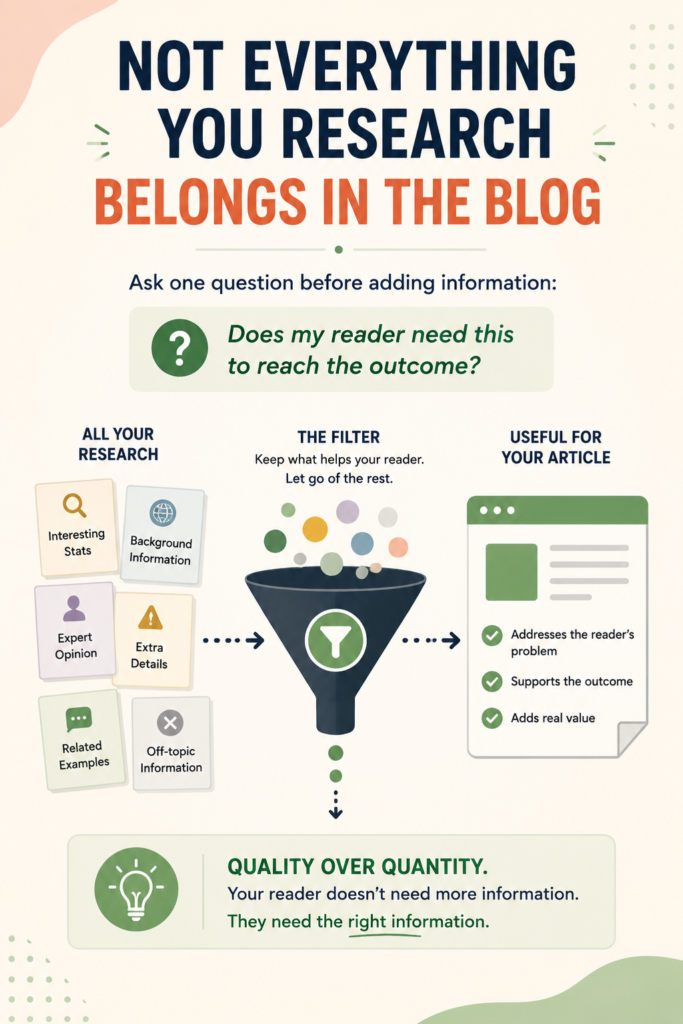
This is something I’ve learned to remind myself while writing. Research can make you want to include everything you’ve discovered, especially when you’ve spent considerable time finding it. You may have found an interesting statistic, an expert opinion, or an entire side topic that seems relevant. But our research effort isn’t the reader’s concern.
The reader needs the information that helps them solve the problem. Knowing what to leave out is as much a part of good content writing as knowing what to include.
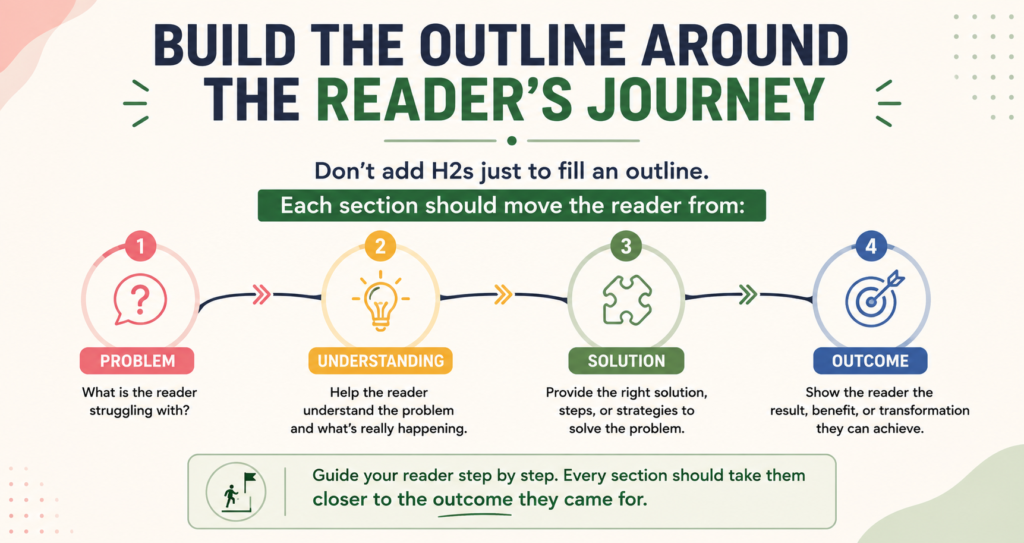
4. Journey: How Do I Get the Reader From the Problem to the Outcome?
Only at this point would I start thinking seriously about the outline. For me, this is where the Reader-First Blog Framework becomes especially useful.
Instead of asking “What H2s should I add?”, I’m asking “What does my reader need to understand first, and what should come after that?” Take an article such as How to Write Conversational Content for Voice Search.
If my outcome is to help readers make their writing sound more natural, I first need to show them what conversational search looks like. Then I might compare typed and spoken searches, explain how those differences affect writing, show a few before-and-after examples, and finally give them something they can try with their own content.
There’s my outline. It hasn’t been created just to reach a word count or because the top-ranking articles happen to use those headings. It follows the reader’s learning process.
This also gives me a useful question whenever I’m tempted to add another section: Does my reader need this to get where I’m taking them?
If the answer is no, I need a good reason for keeping it. Seasoned writers will know how easily articles grow during research. A 1,500-word assignment quietly becomes 2,500 words because every related point starts looking important. I’ve found that one of the harder parts of writing isn’t finding more information. It’s knowing when you already have enough. More information doesn’t automatically mean more value. Sometimes removing what the reader doesn’t need is what makes an article useful.
5. Action: What Should Happen After the Reader Finishes?
This is where my adaptation differs most from the Instagram post that inspired it. The original approach begins with a CTA because the content is designed to lead toward a particular business action. Blogs can certainly do that too, but I don’t think every article should end with “Book a call,” “Buy now,” or “Contact us.”
The next action should depend on what the reader has just learned. After reading a writing tutorial, I may ask them to try the technique on one of their own paragraphs. A beginner who has just understood content strategy might benefit from another article that explains how to create a content calendar. Someone researching a professional service may genuinely be ready to contact the writer. And sometimes there doesn’t need to be a commercial action at all. The reader has their answer, knows what to do next, and can go and do it. The action needs to make sense at that point in the reader’s journey. When it doesn’t, readers can feel the shift. One moment you’re talking to them and helping them solve a problem, and the next you’re selling to them.
I’d rather have the CTA grow naturally from the conversation we’ve already been having.
How I Would Use the Reader-First Blog Framework
A reader-first approach works best when it forms part of a broader content strategy, where audience needs, search intent, topics, and business goals are considered before individual articles are written.
Suppose I’m planning an article on How to Write Conversational Content for Voice Search. Before creating the outline, I need to be clear about who I’m writing for. In this case, my reader is a content writer or blogger who wants to understand how to adapt content for voice search.
Once I know that, I can work through the five parts of the Reader-First Blog Framework.
- Outcome: A content writer should be able to adapt an existing paragraph to better reflect how people naturally speak and phrase questions in voice searches.
- Problem: Their content may be informative and optimized for search, but it has been written mainly with typed searches in mind. It may not reflect the way people speak when using voice search.
- Intent: They want practical guidance on writing for voice search without making their content sound forced or overly casual.
- Journey: I would explain how typed and spoken searches differ, show what conversational writing looks like, provide before-and-after examples, and share techniques they can apply to their own content.
- Action: I would encourage them to choose a paragraph from an existing blog post, read it aloud, and look at whether the language reflects how someone might naturally ask the same question.
With these points clear, I already know what the article needs to accomplish. I can research with a purpose and build an outline around what the reader needs, rather than collecting information simply because it’s related to voice search.
And that’s really the purpose of the Reader-First Blog Framework. It gives you a destination before you start deciding how to get there. And I’m no longer staring at a blank document wondering what the article is supposed to become. I already know where I’m taking it.
Sometimes the blank page isn’t difficult because we have nothing to say. The problem is almost the opposite. We have too many things we could say and haven’t decided which ones the reader actually needs. Once the outcome becomes clear, the outline often starts to reveal itself.
Where Do SEO and Keywords Fit Into This?
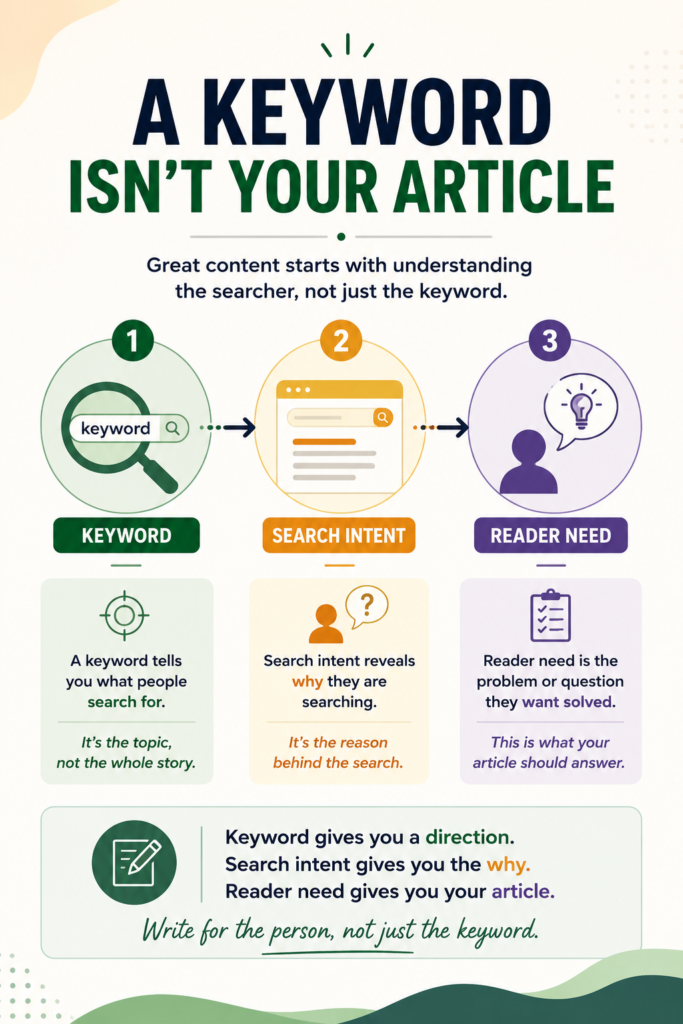
The Reader-First Blog Framework doesn’t replace keyword research or SEO. A keyword tells us what people are searching for, while search intent helps us understand why they’re searching. The framework takes that thinking a little further by asking what we’re going to do for the person once they arrive on the page.
Keywords, titles, meta descriptions, internal links, and search visibility all matter, but getting the click is only part of our job as content writers. If readers have to go through several unnecessary sections before finding the answer, or if we’ve stretched an article simply to reach a word count, optimization alone won’t make the content useful.
SEO can help readers find our content, but what happens after the click matters just as much. The writing has to answer the question that brought them there and give them a reason to stay.
To Sum Up
The idea that inspired the Reader-First Blog Framework was simple: know the destination before deciding how to get there. For blog writers, that means thinking about the reader before worrying about the perfect introduction. Ask what brought them to your article and what they should take away from it. Once those two points are clear, it becomes easier to decide what belongs in between. And that space in between is the blog post you need to write.
Frequently Asked Questions
- What is the Reader-First Blog Framework?
The Reader-First Blog Framework is a way to plan an article around what the reader needs rather than simply around a topic or keyword. It starts by identifying the desired reader outcome and then works through the reader’s problem, intent, journey, and next action. These five points give you a clearer idea of what the article needs to accomplish before you begin writing it.
- How does the Reader-First Blog Framework help with blog writing?
The Reader-First Blog Framework helps you decide what belongs in your article and what doesn’t. Instead of adding information simply because it’s related to your topic, you ask whether that information helps the reader move toward the intended outcome. This can make your writing more focused without making it feel thin or incomplete.
- Should I do keyword research before using the Reader-First Blog Framework?
You can start with initial keyword research, especially if organic search is part of your content strategy. But before you build the final outline, use the Reader-First Blog Framework to understand why someone is searching for that keyword and what they expect to find. The keyword gives you a search query; the framework helps you think about the person behind that query.
- Can the Reader-First Blog Framework help with writer’s block?
It can help when the problem isn’t a lack of ideas but a lack of direction. Sometimes writers get stuck because they have gathered too much information and don’t know where to begin. The Reader-First Blog Framework gives the article a destination first, which can make the introduction and outline easier to develop.
- Does every blog post need a CTA?
No. A CTA doesn’t always have to ask someone to buy, subscribe, book a call, or contact you. The next action could be applying what they’ve learned, reading a related article, checking something on their own website, or trying a technique you’ve explained. In some cases, giving the reader the answer they came for is enough.
- Is the Reader-First Blog Framework only for beginner content writers?
No. Beginners can use the framework to learn how to structure articles around reader needs, but experienced content writers may find it useful too. It can act as a quick planning check, particularly when you’re dealing with a broad topic or have collected more research than you can reasonably include.