
You Are My Princess by Tanushree Das

Not every train journey is about reaching a place. Sometimes, it quietly reminds us of how far we have come. That was the thought I was left with after reading You Are My Princess by Tanushree Das, one of the stories in Stories from Trains. The story follows Tanushree, or Tanu, who is traveling alone to Kolkata after a long gap. Somewhere along the journey, she hears two familiar voices calling out to her. They belong to Joshua and Arjun, children she had taught earlier. They are delighted to see her, and very soon, the train compartment fills with the kind of easy affection children bring with them. There are nursery rhymes, laughter, dancing, and conversations that take Tanu back to a part of her life she clearly holds close to her heart. Then comes an encounter she wasn’t expecting. Tanu sees Hemant, a man she had once quietly loved. There was a time when she had hoped he would notice her the way she noticed him. That never happened. Now, years later, she meets him again, this time with his wife and child. This was the point where I wanted the story to slow down. What happens inside you when you unexpectedly meet someone who once occupied so much space in your heart? Do you remember the person you were then? Does something still hurt? Or do you look at that person and wonder why you once wanted their attention so badly? I wanted to know what went through Tanu’s mind in those few seconds. Instead, the story moves past the encounter rather quickly and tells us about her earlier feelings for Hemant. I felt this was a missed opportunity. A small hesitation, an awkward exchange, a memory that surfaced without warning, or even Tanu’s surprise at realizing that she felt nothing anymore could have said far more than an explanation of their past. Hemant doesn’t need to become a major character, but his presence matters because he represents something Tanu once wanted very badly. The children, on the other hand, represent a very different kind of love. One of the sweetest moments in the story comes when Joshua looks at Tanu and says, “You are my princess Tanu.” His mother immediately corrects him and asks him to call her “Ma’am,” while Arjun joins in and calls her their princess. It is such an innocent exchange, but there is something deeper sitting beneath it. Tanu had once imagined herself as a princess. Perhaps, when she was younger, being someone’s princess meant being chosen, loved, and made to feel special. Yet here are two children offering her that affection without knowing anything about the disappointments she has carried. This was one of those moments where I wished the author had simply allowed the scene to breathe. I also wanted to know a little more about Joshua and Arjun. We know Tanu taught them and that they remember her fondly, but why do they share such a warm bond with her? Was there something she did as their teacher that stayed with them? Did Tanu remember something about them from their preschool days? Even one small shared memory could have made their reunion warmer and helped us understand why their affection touches her so deeply. There are also places where the dialogue could have been more natural. At times, characters seem to speak mainly to give the reader information. Real conversations are rarely that complete. People interrupt themselves, leave things unsaid, laugh, hesitate, change the subject, or communicate through a look. Bringing some of that into the conversations would have made the people inside that train compartment feel more real. I also found myself rereading a few sentences because the wording made the meaning difficult to follow. Some descriptions are imaginative, but they don’t always create a clear picture. A tighter edit for grammar, sentence structure, and word choice would have made the story much easier to read. This matters because when a reader has to stop to work out what a sentence means, they are pulled away from the emotion of the scene. And this is a story that depends heavily on emotion. For me, the strongest part comes after the train journey. Tanu goes alone to Flurys on Park Street. She orders the food she wants and sits in a restaurant she had once dreamed of visiting but couldn’t afford. There is something quietly satisfying about that moment. No grand achievement is required. She is simply sitting in a place that once felt beyond her reach, able to pay for her own meal and enjoy her own company. Then she tells herself: “Tanu, you are my princess.” I liked that moment. In fact, I liked it enough to wish the story had trusted it more. The long audio message that follows is where I felt the story said a little more than it needed to. Tanu talks about Hemant, self-love, healthy relationships, earning her own money, publishing her book, and learning to find a sense of safety within herself. I understand why the author wanted Tanu to say all of this. These are clearly important experiences, and they explain the woman she has become. But by then, I had already understood much of it. Seeing Hemant with his wife and child had brought her old hopes face-to-face with reality. Meeting Joshua and Arjun reminded her that love and affection had existed in her life in other forms. Sitting alone at Flurys showed us that she could now give herself something she once couldn’t. And that one sentence, “Tanu, you are my princess,” brought all those threads together. The story had already spoken. That is why the audio message felt more like an explanation of the ending than part of the ending itself. A shorter message might have worked. Perhaps even no message at all. I would have been happy to leave Tanu sitting at that table, remembering the little boy on the train who had called her a princess and
My Review of Nandini Gupta’s Mini Concert

My review of Mini Concert by Nandini Gupta, a story from Stories of Trains, explores Jatin’s memorable journey filled with music, strangers, kindness, and a few important realizations.
My Review of Life on Tracks
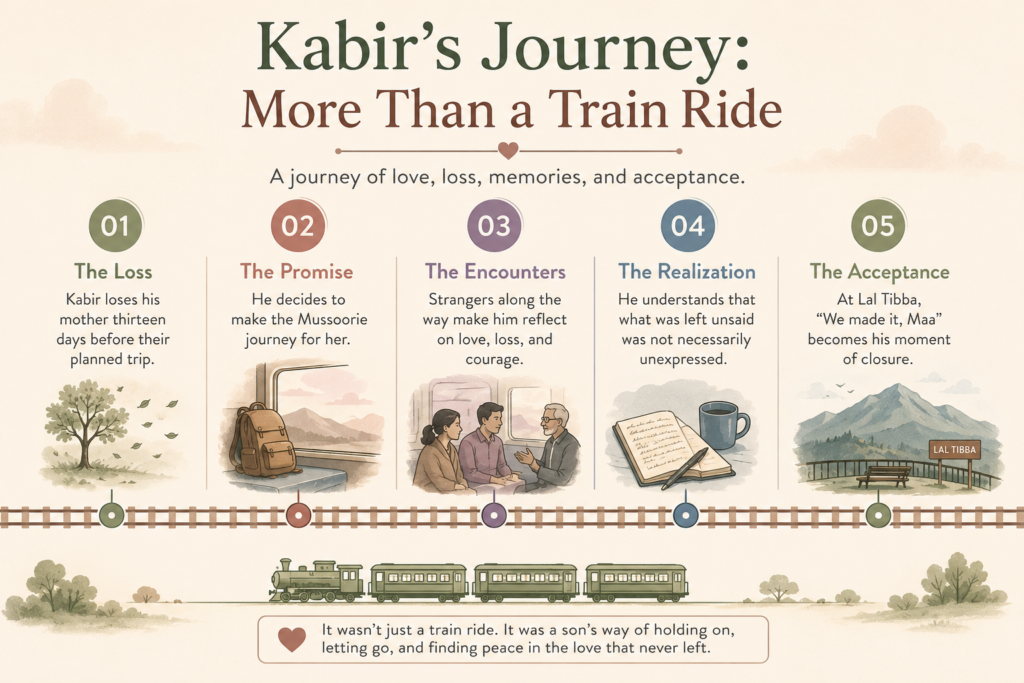
Life on Tracks by Kailash Chander Moryani is one of the stories from the anthology Stories from Trains. When I first saw the title, I had already imagined a very different story. I thought Life on Tracks would take me into the world of a locomotive pilot, perhaps telling the story of someone who had spent years travelling these tracks, watching stations, landscapes, and countless lives pass before him. I was wrong, and I am glad I was, because what Kailash gave me was something I hadn’t expected at all. This wasn’t a story about a life spent working on railway tracks. It was about a son taking a journey he was supposed to make with his mother and slowly coming to terms with the fact that she would never be sitting beside him. As I read further, I realised that the train journey was only one part of it. What stayed with me was Kabir’s journey through grief, his regret over things he never said, and his gradual understanding that losing someone doesn’t mean losing everything they gave you. Kabir loses his mother just thirteen days before they are supposed to travel together to Mussoorie. This was not a casually planned holiday. Mussoorie belonged to their past, to a photograph of three-year-old Kabir sitting on his mother’s lap against the Himalayas, a photograph she had kept beside her bed for thirty years. When Kabir sees the two confirmed berths they had booked for the journey, he makes a decision that becomes the heart of the story. If his mother cannot make the journey, he will make it for her. There was something about that decision that moved me immediately, perhaps because grief often leaves us holding on to plans that suddenly have nowhere to go. A ticket, a reservation, a promise, or even a conversation you thought you would have next week can become unbearably precious when the person connected to it is no longer there. What I liked most about Kailash’s writing is that he doesn’t try to make Kabir’s grief loud. Instead, he allows us to find it in the ordinary things left behind in his mother’s room. Her reading glasses are still on the side table, her cardigan is lying on the armchair, her prayer beads are beside the photograph, and the room still smells of her. These are such familiar, everyday things, yet after someone is gone, it is often these very things that hurt the most. The person is absent, but their presence seems to remain everywhere. The detail that affected me most in the early part of the story was the empty berth. Kabir had booked two berths, and both were confirmed, just as his mother had believed they would be. One would now remain empty. I could picture that empty space beside him, and somehow it said more about his loss than a long description of grief could have done. Kabir’s journey through the train also felt meaningful because the people he meets don’t seem to be there merely to move the plot forward. Each encounter touches a different part of what he is going through. In the crowded general compartment, he watches a mother holding her crying child close, quietly creating a safe space for him while people push and move around them. It reminds Kabir of something he had carried all his life without consciously thinking about it, the security of knowing that his mother was there and that, somehow, she had him. I found that thought very relatable. As children, and sometimes even as adults, we don’t always recognise everything our parents do for us while they are doing it. Their presence becomes so much a part of everyday life that we assume it will always be there, and sometimes we understand the depth of that presence only when it is missing. Then Kabir meets Tukaram, an army officer who has also recently lost someone he loves. His grandfather has died, but Tukaram is returning to duty because his orders remain. When he tells Kabir that it takes courage to show up for someone who is no longer there to see it, the journey to Mussoorie begins to feel different. Kabir is not simply going somewhere his mother wanted to visit. He is keeping a promise to her, even though she will never physically see him fulfil it. But the part that touched me most was Kabir’s conversation with the elderly man in S4. Until that point, Kabir has been carrying his grief, but beneath it is something even more painful: guilt. He finally admits that he never properly told his mother everything she had done for him or how much she meant to him. I think that regret is what made his grief feel so human to me, because many of us are guilty of leaving our deepest feelings unspoken with the people closest to us. We assume they know, or we tell ourselves that we will say it another day when there is more time and when the moment feels right. The old man’s answer, “Unsaid and unspoken are not the same thing,” was the line that stayed with me long after I had finished reading. There is so much comfort in those few words. We may not always say “I love you” or “thank you for everything you have done for me” as often as we should, but love has its own language. It is present in the way we show up for one another, in the small acts of care that become part of everyday life, and in the things we do without needing to explain why. Kabir may regret the words he never spoke, but the old man helps him see that his mother did not necessarily need those words to know that she was loved. At the same time, that part of the story made me think about something else. We shouldn’t always rely on the belief that the people we love