
How Much Grammar Do Writers Really Need to Know?
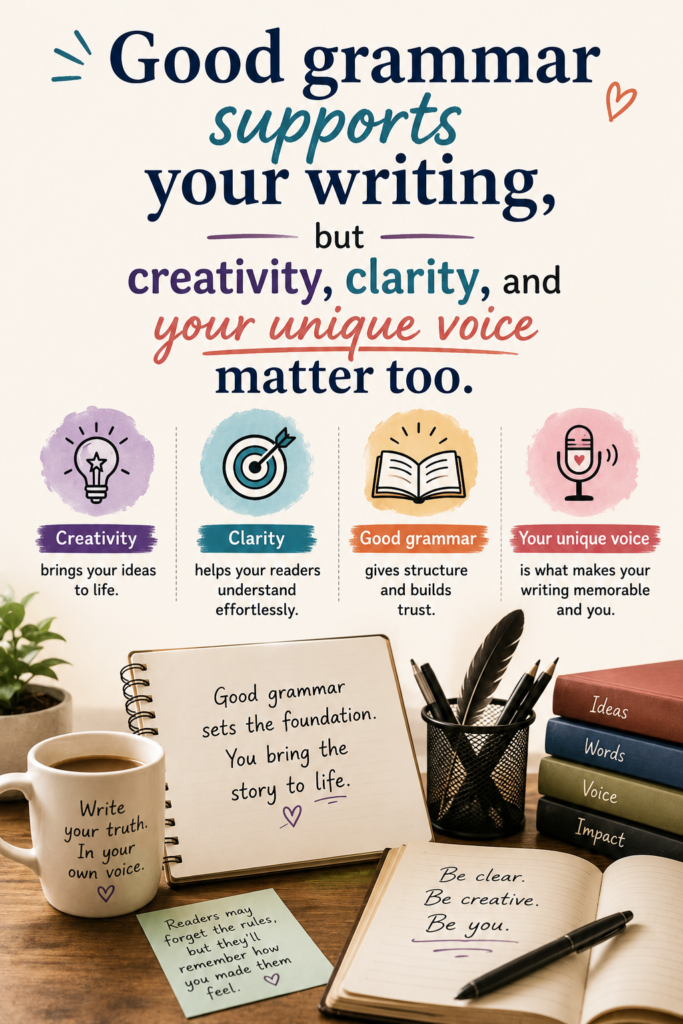
Do writers need to know every grammar rule to write well? After more than 25 years as a professional writer, I don’t think so. I still pause, check a word, or look up a grammar rule when I’m unsure. Knowing grammar and writing effectively aren’t always the same thing. Whether you’re an aspiring story writer, content writer, or experienced professional, you need enough grammar knowledge to communicate clearly and recognize when a sentence isn’t working. AI and grammar tools can suggest corrections, but they can’t replace your judgment. So, how much grammar do writers really need to know? Enough to write clearly, question suggestions, and make informed choices. This blog is for aspiring writers who are still finding their way with grammar, content writers who want to write with more clarity, and story writers who don’t want grammar rules to restrict their creativity. It’s also for experienced writers who occasionally stop mid-sentence and wonder, “Is this actually correct?” If you’ve ever wondered how much grammar you really need to know, especially when AI and grammar tools are always within reach, this article is for you. What Does Knowing Grammar Really Mean for a Writer? When we say a writer should “know grammar,” what exactly do we mean? Does it mean being able to name every tense, explain the difference between a phrase and a clause, or recall every punctuation rule without looking it up? Not necessarily. For a writer, knowing grammar is less about proving how many rules you remember and more about knowing how to use language to express an idea clearly. It’s the ability to build sentences that say what you intend, notice when something sounds unclear, and make changes without losing your natural voice. You may not always remember the technical term for what you’re doing, but you understand how your choice of words, sentence structure, and punctuation affects the person reading them. Knowing Grammar Is More Than Memorizing Rules You don’t need to remember the name of every tense or explain every grammatical term to be a good writer. What you do need is an understanding of how sentences work. For example: “She don’t know why the meeting was cancelled.” You may not stop to think about subject-verb agreement, but you probably know that “She doesn’t know” sounds right. That’s grammar knowledge at work. The same applies when you’re writing a story, blog post, or client article. Knowing grammar helps you spot something that doesn’t sound quite right, even if you can’t immediately name the rule behind it. Understanding How Language Communicates Meaning Grammar isn’t only about whether a sentence is correct. It also affects what the sentence means. Consider these two sentences: “Let’s eat, Grandma.” means you are inviting Grandma to join you for a meal. The comma shows that you are speaking directly to her.“Let’s eat Grandma.” without the comma suggests something very different—it sounds like you are suggesting eating Grandma herself. One small comma changes the meaning completely. It’s an exaggerated example, but it shows why punctuation and sentence structure matter. As writers, our job is to make sure the reader understands what we intended to say. If a reader has to go back and read a sentence twice because the meaning isn’t clear, the problem may not be the idea. It may simply be how the sentence is structured. Developing an Instinct for What Works The more you write, read, and edit, the more you begin to develop an instinct for language. You start noticing when a sentence feels too long, when a word doesn’t quite fit, or when punctuation interrupts the natural flow. For instance: “The article that I wrote last week, which was about grammar and was written for new writers, received a lot of responses.” There’s nothing terribly wrong with the sentence, but it feels heavy. You might naturally rewrite it as: “Last week, I wrote an article about grammar for new writers. It received a lot of responses.” That’s the instinct writers develop over time. It’s not about showing how much grammar you know. It’s about making choices that help your readers move through your words without struggling to understand them. And that, to me, is what knowing grammar as a writer really means. This section builds on the previous one by moving from what knowing grammar means to why that knowledge matters in real writing. Why Does Grammar Matter for Writers? When you write, you already know what you want to say. Your reader doesn’t. They have only the words you put on the page to understand your thoughts, ideas, or story. Grammar helps those words carry your intended meaning from your mind to theirs. This is why grammar matters whether you’re writing a novel, a blog post, website copy, an email, or an article for a client. The purpose and style may change, but the need to be understood doesn’t. Good grammar works quietly in the background. Readers may not notice when you get it right, but they often notice when something goes wrong. Grammar Helps Writers Communicate Clearly At its simplest, grammar gives structure to our thoughts. It helps us show who did what, when something happened, and how one idea connects to another. Consider this sentence: “After speaking to Riya, Meera said she would send the manuscript.” This sentence confuses the reader because the pronoun “she” is unclear. It could refer to either Meera or Riya, so the reader cannot be sure who is supposed to send the manuscript. Who is sending the manuscript, Riya or Meera? The sentence is grammatically possible, but the pronoun “she” makes the meaning unclear. A simple rewrite solves the problem: “After speaking to Riya, Meera said, ‘I’ll send the manuscript.’” As writers, we shouldn’t make readers work harder than necessary to understand what we mean. Clear grammar helps keep the reader focused on the idea or story rather than on figuring out the sentence. Grammar Prevents Misunderstandings Sometimes, a small grammatical or punctuation error can communicate something