
What He Meant
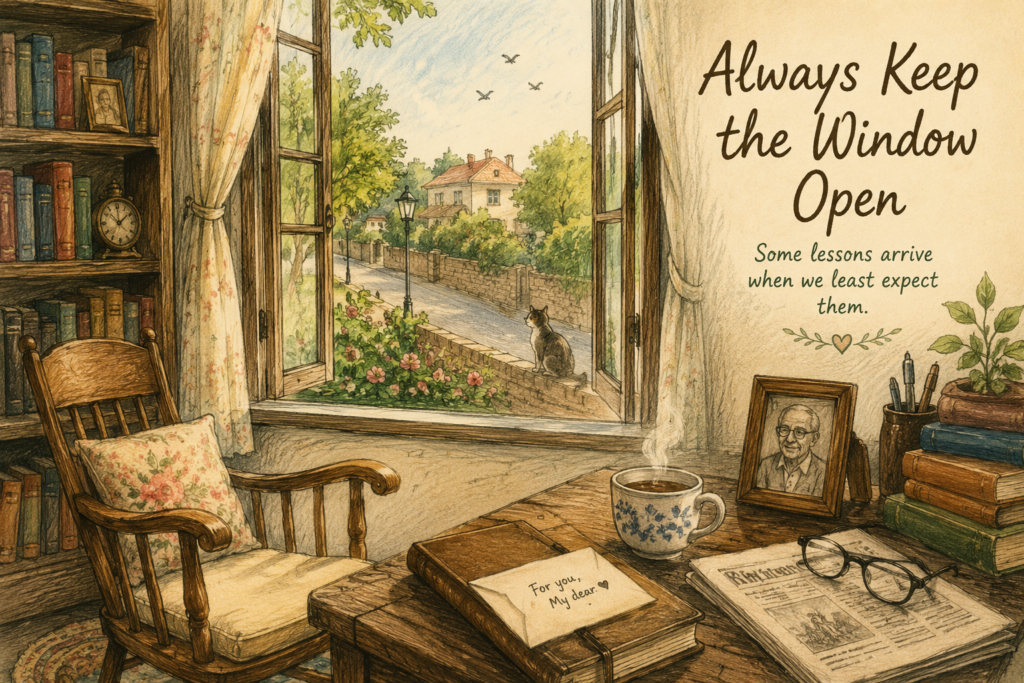
“I don’t know what he meant when he said, ‘Keep the window open.’”My grandfather said those words often.Whenever I visited him during my school holidays, I would find him in his study, sitting beside the large window. It was the brightest spot in the room and his favorite place during winter, when the afternoon sun warmed the wooden floor. But during the windy monsoon days, it was the coldest corner of the house. He never liked curtains on that window.His old wooden rocking chair sat beside it, with a soft cotton cushion that had taken the shape of his back over the years. A short carpet lay beneath his feet to keep them warm on chilly mornings.From there, he could watch people pass by on the road. Sometimes, he would have a one-sided conversation with the neighborhood cat that lazed on the compound wall. On other days, he would fill the little birdbath with water and scatter a few grains beside it. Every now and then, a few sparrows would land on the window rail, stay for a while, and fly away.It was his favorite place in the house.“Why don’t you close it when it gets windy?” I once asked.He looked at me over his glasses.“Because a closed window keeps everything out.”I thought he was talking about fresh air.I was twelve then. I didn’t think much about what he said.Years passed.I grew up, moved to another city, got a job, and became busy with my own life. My visits to my grandparents became less frequent. Phone calls replaced long afternoons at their house.Grandfather never complained.Whenever I called, he would ask about my work, my friends, and whether I was eating properly.Then one summer, I had a silly argument with Anu, my closest friend since school. We had grown up together, shared secrets, celebrated birthdays, and stayed in touch even after I moved to another city.The argument was over something so small that I can’t remember what it was now. What I remember is that neither of us wanted to be the first to say sorry. A few days later, Anu called. I saw her name on my phone but let the call go unanswered. I thought about calling her back that evening. I didn’t. A week later, I typed a message, read it twice, and deleted it. Neither of us called again. I told myself that if she really cared, she would call again. She didn’t.Around the same time, Grandfather called one evening. We hadn’t spoken in a few weeks, so I was happy to hear his voice.“When are you coming home?”“Soon,” I said.“You’ve been saying that for months.”I laughed. “I’ll come next month. I have a few days off for Diwali.”“Good. I’ll hold you to that.”We spoke about a few things after that. He asked about my work, reminded me to take care of myself, and told me about the new plants he had put in the backyard.Just before we ended the call, he said, “And keep the window open.”I laughed.“You still say that?”“Always.”I didn’t ask what he meant. I had heard him say it so many times that I had stopped wondering about it.A few months later, Grandfather passed away.After the funeral, I stood outside his study for a long time. I had walked past that door several times, but I couldn’t bring myself to go in. It felt strange to think that he would never be sitting in that rocking chair again, calling me over to show me something he had found in the newspaper.Finally, I placed my hand on the doorknob and turned it. I pushed the door open slowly.Everything inside looked just as I remembered it. His books were still arranged on the shelves, their spines worn from years of use. His reading glasses rested on the desk beside the newspaper he had been reading that morning. His wooden rocking chair stood beside the window, the cotton cushion still holding its familiar shape, with the little carpet beneath it. For a moment, the room felt as though he had only stepped away and would return any minute. But the window was closed. I walked over and opened it. The room filled with a gentle breeze that carried the fragrance of the roses in full bloom outside. I stood there for a moment, taking in the familiar scent and looking out at the road where Grandfather had spent so many hours watching people pass by. I curled up in his rocking chair for a while, running my fingers over the worn cotton cushion. I remembered the many afternoons he had spent there, reading the newspaper, watching people pass by, or simply sitting quietly with his tea.Then I noticed that the drawer of the small table opposite the chair was slightly open. I pulled it out and found a small envelope tucked beneath his diary. My name was written on it in his familiar handwriting.I held the envelope in my hands for a moment. Somehow, I knew there was something inside that I wasn’t quite ready to read.Reluctantly, I opened it.My dear Maya,You once asked me why I always kept this window open. I gave you an answer, but I never told you the whole story.When I was young, your grand-uncle and I had a terrible argument. Neither of us was willing to apologize. I waited for him to come to me, and he waited for me to go to him. We let our pride get in the way. One year became five. Five became ten. Before we knew it, twenty years had passed.When we finally met again to put away our differences, we were happy to see each other, but we couldn’t get back those twenty years.I often wondered what might have happened if one of us had simply taken the first step.That is why I keep this window open. Not just for the breeze or the birds. It reminds me to leave a little space for people. People will disappoint us. We will disappoint them too.
Tips to Write a Short Story in 1500 Words

Writing a short story in 1500 words is a challenge that tests your creativity and precision. The beauty of short fiction lies in its brevity—it captures a moment, an emotion, or a transformation in just a few pages. It’s like crafting a snapshot of life that resonates deeply, all while staying concise. But here’s the tricky part: how do you deliver an unforgettable story within such a tight limit? If you’ve ever felt stuck while trying to fit an entire world into a handful of paragraphs, you’re not alone. Many writers struggle with balancing detail and brevity, but with the right approach, you can create a masterpiece that stays with your readers long after the last word. This blogpost will walk you through actionable tips to write a compelling short story in 1500 words or less—without sacrificing creativity or impact. 1. Anchor Your Story with a Strong, Singular Concept Every great story starts with a compelling idea. The key to writing a short story is to keep your focus razor-sharp—there’s no room for sprawling plots or endless backstories. Zero in on One Theme or Event: Ask yourself, “What’s the essence of this story?” Whether it’s a moment of redemption, a life-changing decision, or an unexpected encounter, choose one central idea and build around it. Example: Instead of writing about a character’s entire journey, focus on the moment they decide to leave their small town or confront an old friend. Relatable Meets Unique: The best stories feel universal yet fresh. Tap into emotions your readers can connect with—love, loss, fear—but frame them in an unexpected way. Example: A story about unspoken love might center on a woman writing a letter she never intends to send. Your concept is the heart of the story. Once you have it, everything else will naturally fall into place. 2. Let Your Characters Speak Volumes with Fewer Words In a short story, your characters need to feel real and memorable—quickly. With limited space, every detail about them has to pull its weight. Focus on One or Two Key Characters: You don’t need an ensemble cast. A protagonist and maybe one supporting character are enough to drive your narrative. Show, Don’t Tell: Instead of saying, “John was shy,” let his actions reveal his personality. Maybe he hesitates before knocking on a door or avoids eye contact during a tense conversation.Details That Define: Use a single vivid detail to make a character come alive. A worn leather jacket, a nervous tick, or a tendency to hum under their breath can make them unforgettable. 3. Start in the Middle of the Action Readers don’t have time to wade through paragraphs of setup in a short story. Grab their attention from the very first line. In Media Res: This Latin phrase means “in the middle of things.” Drop your readers right into the story’s most interesting moment. Example: Instead of, “It was a rainy day, and Jane was feeling restless,” try, “The knife clattered to the floor as Jane slammed the door shut, her breath ragged.” Hook Them with the First Line: Your opening sentence is your chance to intrigue, shock, or delight your reader. A question, an action, or a bold statement works wonders. Example: “They always said the house was haunted, but no one told me it would laugh.” 4. Structure Your Plot for Maximum Impact Even in a short story, you need a clear beginning, middle, and end. But brevity means cutting straight to the core. Classic Story Arc: Stick to this framework: Setup: Introduce your protagonist and their world. Conflict: Present the problem or decision they must face. Climax: Deliver the emotional or narrative peak. Resolution: Wrap up the story with a sense of closure—or leave the reader wondering. Trim the Fat: Every scene should serve a purpose. If a paragraph doesn’t reveal something important about the character, setting, or plot, cut it. 5. Use Descriptive Language to Create Atmosphere Good descriptions don’t just paint a picture—they evoke emotion. In a short story, they also save space by doing double duty. Show More, Tell Less: Instead of saying, “The room was cold,” describe the frost on the windows or the character’s breath turning to mist. Lean on the Senses: What does the character see, hear, smell, or feel? Sensory details create vivid, immersive scenes. Example: “The coffee shop smelled of burnt toast and cinnamon, a strange comfort on a winter morning.” Be Concise but Evocative: Descriptive language should enrich the story, not weigh it down. A single metaphor can convey an entire mood. 6. Make Dialogue Work Harder Dialogue is a powerful tool in short stories, but it has to earn its place. Every word should reveal something important. Keep It Realistic: Your characters should sound like real people, but without the “um” and “uh” filler of actual conversations. Advance the Plot: Don’t let dialogue meander. Each line should add depth to the character, hint at backstory, or escalate tension. Example: Instead of “Hi, how are you?” try “I thought you’d never come back.” Use Subtext: Let your characters say one thing but mean another. It adds complexity and intrigue. Example: “It’s fine,” she said, her hand gripping the table edge until her knuckles turned white. 7. End with a Bang (or a Whisper) The ending is where your short story leaves its lasting mark. Aim for something memorable. Resolution Doesn’t Mean Closure: Your story can wrap up without answering every question. Sometimes, ambiguity keeps readers thinking. Example: “He watched her walk away, the letter still crumpled in his pocket.” Deliver an Emotional Punch: Whether it’s joy, sorrow, or surprise, the ending should resonate deeply. Consider a Twist or Revelation: A well-executed twist can elevate your story, but it should feel earned—not gimmicky. 8. Edit Like Your Story Depends on It (Because It Does) Once you’ve written your story, the real work begins: Cut Ruthlessly: Every sentence, word, and comma must serve a purpose. Tighten your prose until it feels lean and impactful. Read Aloud: