Synopsis
Some words live in the margins. Nuance is one of them. It captures the small distinctions that prevent ideas from collapsing into oversimplified binaries. In writing and thinking, nuance allows complexity to exist without confusion. It invites attention, patience, and care.
Table of Contents
ToggleWord of the Day
Nuance
Word of the Day Meaning
Nuance refers to a subtle difference or distinction in meaning, expression, or feeling. It describes the fine shades that separate similar ideas, words, or perspectives.
Word of the Day Pronunciation
NOO-ahns
Word of the Day: Origin and Etymology
The word nuance comes from the French nuance, meaning “shade” or “slight variation,” which itself is derived from nuer, meaning “to shade.” Its origins are visual, rooted in the idea of gradual variation rather than sharp contrast.
When the word entered English, it retained this sense of subtle differentiation. Over time, nuance became central to language, criticism, and analysis, especially in fields that resist absolute interpretations.
Nuance: Synonyms and Antonyms
Synonyms:
Subtlety, distinction, shade, refinement, variation
Antonyms:
Simplicity, bluntness, obviousness, uniformity, generalization
Nuance Usage in Sentences: Across Genres
- In Journalism:
The article captured the nuance of public opinion rather than reducing it to extremes. - In Political Analysis:
The debate lacked nuance and ignored regional differences. - In Academic Writing:
The author examines the nuance between closely related theories. - In Literature:
Her writing was rich with emotional nuance. - In Travel Writing:
The guide explained the cultural nuance behind local customs. - In Legal Commentary:
Legal arguments often turn on nuance rather than broad principles.
Why “Word of the Day” Is Worth Knowing
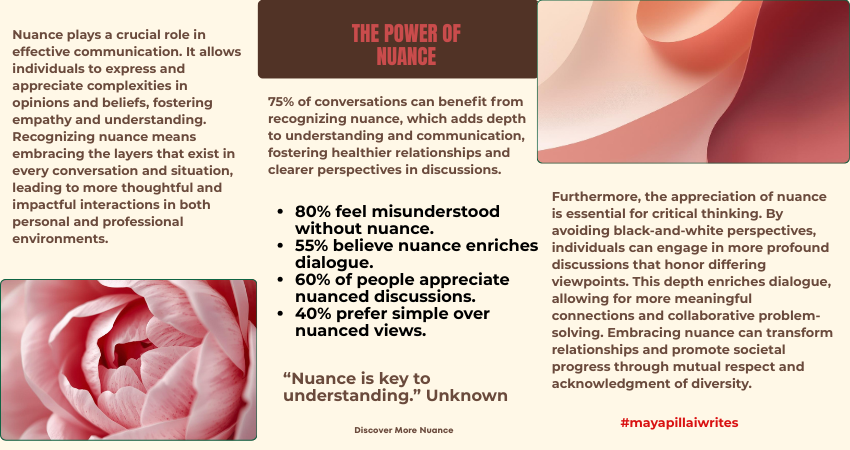
Nuance is essential for precise communication. It allows writers to acknowledge complexity without losing clarity. Instead of flattening ideas into simple categories, nuance makes space for difference, contradiction, and context.
For writers, nuance separates competent writing from thoughtful writing. It shows respect for the reader’s intelligence and for the subject itself. Whether you are analyzing events, crafting essays, or telling stories, nuance helps avoid overstatement and distortion.
In editorial work, nuance often determines credibility. Readers trust writing that recognizes shades of meaning rather than forcing certainty where none exists.
Nuance in Modern Context
In today’s fast-paced information environment, nuance is often overlooked. Short formats and rapid opinions favor clarity, but not always accuracy. As a result, nuanced positions can be mistaken for indecision or weakness.
Yet, nuance remains critical in discussions around culture, politics, technology, and identity. It allows conversations to move beyond extremes and encourages deeper understanding. In creative work, nuance gives texture to characters, emotions, and ideas, making them feel real rather than symbolic.
For professionals and writers alike, holding space for nuance is increasingly a skill, not a luxury.
FAQs
Is nuance the same as detail?
Not exactly. Detail refers to specific information, while nuance refers to subtle differences in meaning or interpretation.
Can nuance make writing unclear?
Only if overused. When balanced well, nuance adds clarity rather than confusion.
Why is nuance important in serious writing?
Because complex topics rarely fit into simple explanations. Nuance helps preserve accuracy and fairness.
If you need help with long-form writing, blog content, or editorial pieces, I write at a pace that values thought over haste. Connect with me.