

Some train journeys are remembered for the destination. Others stay with us because of the people we meet along the way. Mini Concert by Nandini Gupta, from the anthology Stories of Trains, belongs to the second kind.
When I began reading the story, I met Jatin Sahni at a point when his mind was anything but peaceful. He is travelling home to Amritsar after eight months, but there is little excitement in him. He is tired after a punishing week at work, irritated with his boss, worried about his family’s plans for his marriage, and confused about his feelings for Shivani, his best friend and colleague. Home is where he wants to be, yet going home is also the reason for much of his anxiety.
I liked how Nandini Gupta establishes Jatin’s state of mind almost immediately. The luggage rack above him, crammed with bags, becomes a simple reflection of his own cluttered thoughts. His boss’s message about a client contract, followed almost immediately by a reminder to bring papad and wadiyan, adds humor to his frustration. And when Jatin sees an ass outside the window and decides it would make the perfect cover for the imaginary novella about his boss, I couldn’t help but smile. It is a small moment, but it tells us quite a bit about Jatin and his mood.
There is another worry waiting for him at home. Jatin has recently turned 30, and his family, particularly the elders, has decided that it is time he got married. He has been ignoring the profiles sent to him, not because there is anything wrong with the women, but because there is already someone occupying that space in his mind. Shivani is his best friend and colleague, the person who can even make machine-made office tea taste wonderful. Jatin knows she likes him, but he doesn’t know if she feels the same way he does. And he hasn’t found the courage to ask.
So Jatin sits by the window carrying far more than the luggage above his head. There is work, family, marriage, Shivani, Daarji, and a long list of what-ifs. I think most of us would recognize that feeling. Sometimes we spend so much time imagining conversations and outcomes that haven’t happened that we barely notice what is happening around us.
Then Archit Khurana enters the story with his guitar.
Archit is almost everything Jatin isn’t at that moment. He is young, carefree, impulsive, social media savvy, and quite comfortable bending the rules. At first, Jatin seems mildly annoyed by him. Even Archit’s innocent remark, “You wouldn’t have heard my name,” makes Jatin suddenly conscious of the age difference between them. I found Jatin’s reaction quite amusing because it is such a human one. Archit probably means nothing by it, but Jatin, already tired and irritable, reads much more into those few words.
But somewhere between the songs, jokes, food, and conversations, that distance begins to disappear.
The mini concert slowly changes the atmosphere inside the coach. Strangers begin singing together. People make requests. Snacks are shared. Someone livestreams the performance while others take photographs for social media. What began with a young man and his guitar turns into something the entire coach becomes a part of.
One scene in particular stayed with me. Archit helps an eighty-year-old man strum a guitar for the first time. The elderly gentleman sings his wife’s favorite romantic song from the sixties while she sits there blushing. I could picture the scene as I read it, and perhaps that is why it felt so endearing. For those few minutes, age doesn’t matter. Neither does musical ability. An elderly couple, a group of youngsters, Jatin, and a coach full of strangers are simply enjoying the same moment.
And without quite realizing it, Jatin begins to change with them.
One conversation between Jatin and Archit becomes particularly important. Archit and his friends have been travelling without tickets, something Jatin strongly disapproves of. When Jatin asks whether they are afraid of being caught, Archit replies with another question: what if they don’t get caught?
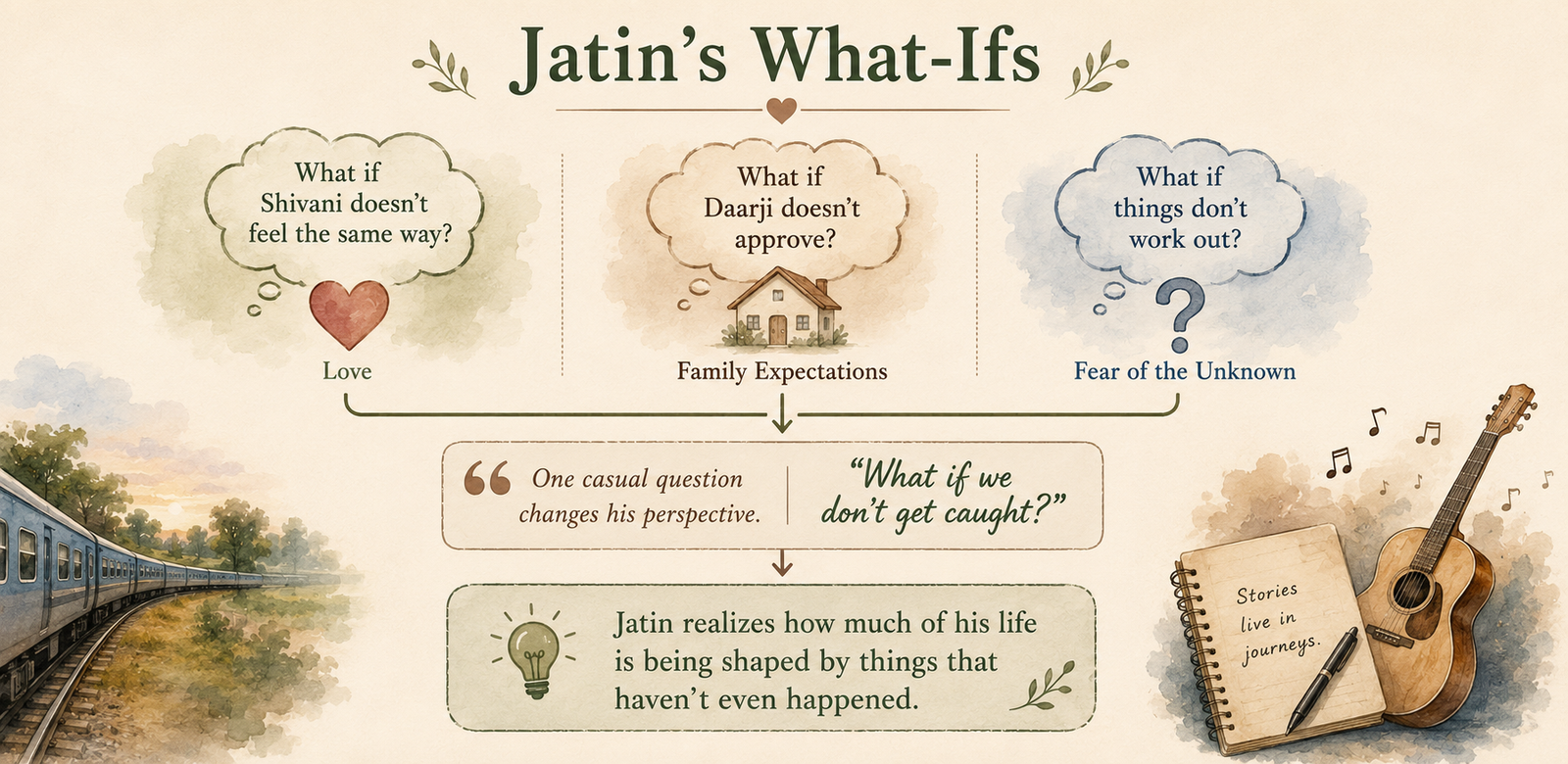
That casual “what if” makes Jatin look at his own life differently. He has been living with his own set of what-ifs. What if Shivani doesn’t feel the same way? What if Daarji disapproves? What if things don’t turn out as he hopes?
I liked this part because Jatin’s realization doesn’t come through a lecture or some grand piece of wisdom. It comes from a boy he had initially dismissed as reckless and immature. Archit may have a lot to learn about responsibility, but without intending to, he gives Jatin something to think about too.
The story also doesn’t allow Archit and his friends to get away with everything simply because they are young and entertaining. Their ticketless travel eventually catches up with them. The TTE knows what they have been doing and insists that the fare be paid. When the elderly gentleman offers to pay for them, the other passengers decide to contribute as well.
I liked the way this part was handled. The youngsters have broken the rules, and the story doesn’t pretend otherwise. But neither are they publicly humiliated. The people who have spent the journey laughing, singing, and sharing food with them step forward to help. Their kindness doesn’t erase what Archit and his friends did; instead, it makes the lesson harder for the youngsters to ignore.
Even the TTE turns out to be more than the stern railway official he first appears to be. He remembers being carefree at their age and wants them to understand the value of discipline. Once the point has been made, he asks Archit if he knows the notes of an old classic. Soon, the music begins again, and this time the TTE is part of the moment too.
For me, though, the heart of Mini Concert lies in what happens quietly within Jatin during this journey. He boards the train exhausted, anxious, and trapped in his own thoughts. By the time Amritsar draws closer, his problems haven’t magically disappeared. His family is still waiting for him. Daarji is still Daarji. His feelings for Shivani still need to be addressed. But Jatin himself is no longer quite the same man who boarded the train.

He has begun to see how much of his life is being held back by uncertainty and fear of what might happen.
And then comes an ending I particularly liked. Jatin signs up on a social media platform and begins following Archit. At the time, it seems like a small consequence of an unusual train journey. We then discover that this simple act eventually leads Jatin towards writing, something he had always wanted to do but had put aside because Daarji had other plans for him.
That stayed with me because important changes in our lives don’t always begin with big decisions. Sometimes a stranger says something that makes us question the way we have been thinking. Sometimes a shared meal makes strangers feel familiar. And sometimes a young man walking through a railway coach with a guitar unknowingly nudges someone towards a life he had wanted all along.
Nandini Gupta tells Mini Concert with humor, nostalgia, music, food, and the familiar chaos and camaraderie of an Indian train journey. The story moves easily between generations, from youngsters livestreaming their music to an elderly man singing a romantic classic for his wife. And through Jatin, it also touches on something many of us struggle with: the habit of allowing imagined outcomes to influence choices we haven’t even made yet.
What I carried with me after finishing Mini Concert was not just the music or the laughter inside that railway coach. It was the thought that sometimes we become so occupied with our “what-ifs” that we forget to participate in the life happening right in front of us.
Perhaps not every unexpected encounter changes our lives. But once in a while, someone gets into the seat beside us, starts a conversation, plays a song, and leaves us thinking a little differently by the time we reach our station.