
Why Long-Tail Keywords Matter in Voice Search SEO
I first noticed this change when I watched my daughter use voice search. She didn’t type a few keywords into Google. Instead, she picked up my phone and asked a complete question, just as she would ask another person. That’s when I realized that that people no longer search the way they used to. With voice assistants like Alexa, Siri, and Google Assistant becoming part of everyday life, the way people search has changed. Instead of typing a few words into a search engine, people ask complete questions and expect quick, accurate answers. This shift has made long-tail keywords in voice search SEO more important than ever. Think about the last time you used voice search. You probably didn’t say, “content writing” or “voice search SEO.” Instead, you asked something like, “How do I optimize my blog for voice search?” or “What are the best content writing tips for beginners?” People don’t speak in keywords. They speak naturally. Search engines have adapted to that behavior, and your content needs to do the same. Long-tail keywords help search engines understand user intent and connect your content with the questions people actually ask. If you want your content to appear in voice search results, AI-powered search, and featured snippets, long-tail keywords should become a key part of your SEO strategy. Therefore, you should be familiar with writing in conversational style so you rank in voice search What Are Long-Tail Keywords? Long-tail keywords are search phrases that contain three or more words. They are more specific than broad keywords and usually reflect a clear question, need, or intention. Although they may receive fewer searches than popular one or two-word keywords, they often attract people who are looking for a particular answer. Take the keyword voice search as an example. It tells you very little about what the user wants. They could be looking for a definition, examples, tools, or optimization techniques. Now compare it with a search such as How do I optimize my website for voice search? The second query leaves little room for guesswork. It tells search engines exactly what information the user expects to find. Short-Tail Keyword Long-Tail Keyword Voice search How do I optimize my website for voice search? Content writing How can I become a freelance content writer? SEO tools What are the best SEO tools for beginners? Antivirus Which antivirus software is best for small businesses? Long-tail keywords give search engines more context. They also help writers create focused content that answers a specific question instead of covering a broad topic without direction. Why Content Writers Should Focus on Long-Tail Keywords Many writers begin keyword research by looking for the highest search volume. While search volume is important, it should never be the only factor when choosing a topic. A better approach is to identify the questions your audience asks most often and build content around those questions. Each question can become a separate article that supports a broader pillar page. Over time, these articles create topical authority and strengthen your website’s overall SEO. For example, a pillar article about voice search optimization could link to supporting articles on conversational content, FAQ optimization, schema markup, voice search mistakes, and long-tail keywords. Each article answers one topic thoroughly while strengthening the others through internal links. This strategy benefits both readers and search engines. Readers find related information more easily, and search engines gain a better understanding of your website’s expertise. Why Voice Search Relies on Long-Tail Keywords Voice search has changed the way people interact with search engines. When people type, they often shorten their searches to save time. A typed search might look like voice search SEO or best laptop. The same person is more likely to ask, How do I improve my website for voice search? or Which laptop is best for graphic designers? when using a voice assistant. This difference matters because voice assistants are designed to understand natural conversations. They don’t simply match individual keywords. They analyze the complete question, understand the context, and identify the user’s intent before providing an answer. As a content writer, your goal should be to match the way people speak rather than the way they type. That doesn’t mean filling your article with random questions. It means anticipating the questions your audience is likely to ask and answering them clearly. When your content reflects natural speech, search engines can understand its relevance more easily, and voice assistants have a better chance of selecting it as a response. Long-Tail Keywords Reveal User Intent Understanding user intent is one of the most important parts of modern SEO. Search engines no longer rank pages simply because they contain a keyword. They want to know whether the page satisfies the reason behind the search. Imagine someone searches for content writing. That search could mean almost anything. The person might be looking for writing services, freelance jobs, online courses, salary information, or examples of good content. Now consider a search such as How do I start content writing with no experience? The intention is obvious. The user wants practical advice for beginners. The same principle applies across every industry. A search for cybersecurity is broad and open to interpretation. A search like How can a small business protect itself from phishing attacks? tells you exactly what the reader wants. Long-tail keywords reduce ambiguity. They help writers create content with a clear purpose, and they help search engines deliver results that closely match the user’s expectations. Long-Tail Keywords Are Easier to Rank For Every website wants to rank for broad keywords such as SEO, marketing, or content writing. Unfortunately, those keywords are also the most competitive. Large websites with years of authority, thousands of backlinks, and extensive content libraries often dominate those search results. Long-tail keywords offer a more realistic opportunity, especially for newer websites and independent bloggers. Instead of competing for voice search, you could target phrases such as How to write conversational content for voice search or Voice search SEO tips
Voice Search Optimization for Content Writers
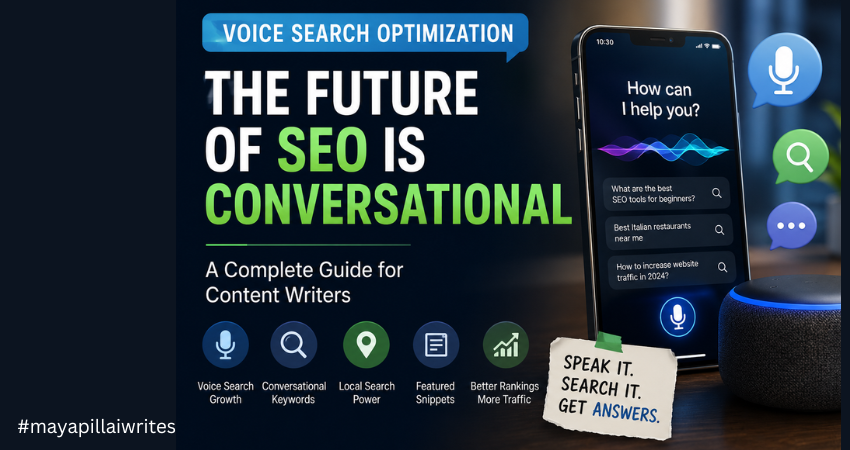
Search behavior has changed significantly over the last few years. People no longer rely only on typed searches to find information online. Instead, they increasingly use voice assistants and smart devices to ask questions naturally and conversationally. Whether someone is asking for nearby restaurants, product recommendations, weather updates, or detailed explanations, voice search has become part of everyday digital behavior. Devices powered by Amazon Alexa, Apple Siri, and Google Assistant have changed how users interact with search engines. Instead of typing fragmented keywords like “best headphones under 5000,” users now ask complete questions such as, “What are the best wireless headphones under ₹5000 for daily use?” This shift has changed modern SEO. Content writers can no longer rely only on traditional keyword placement and search engine optimization tactics. They now need to understand conversational search behavior, user intent, and natural language patterns. This is where voice search optimization becomes essential. Voice search optimization is not simply another SEO trend. It reflects a broader change in how search engines understand language, context, and user expectations. Writers who adapt early can improve content visibility, user engagement, and search rankings while building stronger topical authority in their niche. This guide explains everything content writers need to know about voice search SEO, including conversational content strategies, long-tail keywords, featured snippets, search intent, mobile optimization, local SEO, and AI-driven search behavior. TL;DR Voice search optimization is changing how content ranks in search engines. Modern voice search SEO focuses more on conversational language, user intent, long-tail keywords, and direct answers instead of traditional keyword-heavy strategies. For content writers, optimizing content for voice search now means creating natural, user-focused, and mobile-friendly content that aligns with how people actually speak and search online. What Is Voice Search Optimization? Voice Search Optimization is the process of creating and structuring content so it performs better for spoken search queries made through voice assistants, smartphones, smart speakers, and AI-powered devices. Traditional SEO mainly focused on short typed queries. Voice search SEO focuses more on conversational phrasing, natural speech patterns, and direct answers. For example, a typed query may look like this: “best SEO tools” A voice search query is more likely to sound like this: “What are the best SEO tools for small businesses?” This difference may appear small, but it changes how search engines process intent and rank content. Modern search engines now rely heavily on natural language processing and semantic search to understand the meaning behind queries rather than simply matching keywords. Because of this, optimizing content for voice search requires writers to think more about user behavior and less about keyword stuffing. Why Voice Search Is Growing Rapidly Voice search adoption continues to grow because of convenience, accessibility, and improvements in AI technology. According to a 2023 study by PwC, 71% of users prefer using voice search for simple tasks. This indicates a major behavioral shift in how people interact with search engines and digital platforms. Several factors are driving this growth. Four important ones are listed below. Smart Devices Have Become Mainstream Voice-enabled devices are now common in homes, workplaces, smartphones, cars, and wearable technology. Users rely on voice assistants for tasks such as: checking weather updates finding nearby businesses setting reminders controlling smart home devices searching for information making online purchases As smart devices continue expanding globally, voice search usage is expected to grow alongside them. Voice Search Is Faster and More Convenient Most people can speak significantly faster than they type on a mobile keyboard. Voice search allows users to multitask while driving, cooking, walking, or working. This convenience makes spoken queries more practical for everyday use. For mobile users especially, voice search reduces friction and improves accessibility. AI and Natural Language Processing Have Improved Search engines now understand conversational queries more accurately than before. Advancements in natural language processing help search systems interpret: user intent context conversational phrasing follow-up questions semantic relationships between words This allows search engines to provide more relevant answers instead of relying only on exact keyword matches. Mobile Usage Continues to Dominate Most voice searches happen on smartphones. Since mobile browsing already dominates internet usage globally, voice search naturally continues to grow within mobile-first experiences. This connection between mobile SEO and voice search optimization makes responsive design and page speed increasingly important. How Voice Search Is Changing SEO Voice search is changing both user behavior and the way search engines understand content. Earlier SEO strategies focused mainly on exact-match keywords and short typed queries. Today, users interact with search engines more conversationally through voice assistants and smart devices. Instead of typing fragmented phrases, people now ask complete questions in natural language. Because of this shift, search engines have become more focused on understanding user intent, context, relevance, and content quality rather than simply matching keywords. Modern voice search SEO now prioritizes conversational content, direct answers, mobile-friendly experiences, and user-focused information that solves queries quickly and clearly. It has also increased the importance of long-tail keywords, featured snippets, local SEO, and natural language optimization. For content writers, this means SEO is no longer just about inserting keywords into articles. It now involves understanding how users speak, what information they expect, and how search engines interpret conversational queries to deliver accurate and relevant results. Conversational Search Has Replaced Fragmented Keywords One of the biggest changes in modern SEO is the shift from fragmented keyword searches to conversational search behavior. Earlier, users typically typed short and incomplete phrases into search engines because search algorithms relied heavily on keyword matching. Searches often looked like this: “cheap hotels Goa” “best laptop students” “SEO company Bangalore” Today, voice assistants and AI-powered search engines understand natural language much better. As a result, users now search in a more conversational and human way. Instead of typing isolated keywords, they ask complete questions such as: “What are the best affordable hotels in Goa for families?” This shift has changed how content should be written and optimized. Search engines are now focused more on understanding context, search intent,
TL;DR in Content: How to Engage Readers and Rank Better
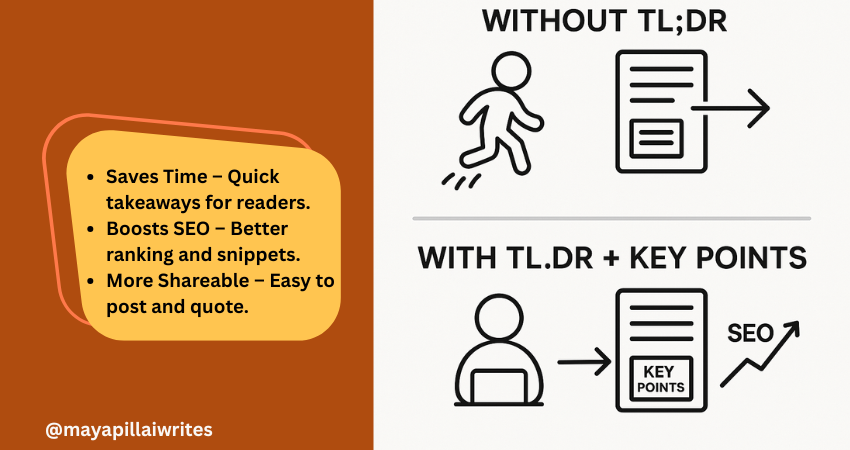
Including a TL;DR in content is no longer optional. Readers skim, AI search engines summarize, and attention spans keep shrinking. A TL;DR(Too Long; Didn’t Read) gives a quick summary that respects your readers’ time and makes your blog easier for AI tools and Google’s Search Generative Experience (SGE) to surface. But a TL;DR alone isn’t enough. Adding Key Points beneath it ensures that both skimmers and detail-seekers get value. In an era where AI decides what parts of your content get shown, these two elements can set your blog/article apart. TL; DR A TL;DR in content is a short summary that captures your article’s main idea. It helps readers, AI tools, and search engines understand your blog quickly. Key Points expand on the TL;DR with detailed highlights, giving both readers and AI more context. Using both together improves readability, SEO performance, AI search visibility, and builds trust with your audience. Key Takeaways A TL;DR isn’t just a convenience — it’s a strategic tool that improves both user experience and how AI-driven search engines interpret your content. Key Points aren’t filler; they strengthen SEO by adding structure, making your blog more likely to rank for related queries and appear in featured snippets. Pairing TL;DR and Key Points bridges the gap between human readers and AI systems, ensuring content is engaging, scannable, and machine-readable at the same time. In long-form blogs, Key Points can double as jump links for better navigation, which is especially important for mobile readers. Respecting reader time with a TL;DR and guiding them with Key Points ultimately builds trust and authority, which pays off in both engagement and search rankings. What is TL;DR in Content? TL;DR is a short summary that captures the core message of your article. Usually placed right after the introduction, it helps readers and AI tools quickly understand what the content is about. Why it’s important now: Readers want speed Most online readers don’t have the patience to go through long paragraphs before deciding if something is worth their time. A TL;DR gives them the headline takeaways immediately, allowing them to judge whether to continue reading. Without it, you risk losing them before they get to your key message. AI favors clarity Search engines and AI-powered tools are built to pick up well-structured summaries. A TL;DR written in simple, direct language makes it easier for these systems to surface your blog in snippets, SGE cards, and chat-based search results. This increases your visibility without extra effort. Boosts visibility Blogs with a TL;DR have a higher chance of being featured in “People Also Ask” boxes or summary snippets. Search engines look for clear, condensed content they can repurpose quickly, and a TL;DR is ready-made for that. Improves shareability Readers who find value in your TL;DR are more likely to copy it into a LinkedIn post, share it in a newsletter, or use it as a quote in their own content. This creates organic backlinks and visibility for your blog. Voice search ready Voice assistants like Alexa and Google Assistant prefer short, straightforward answers. A TL;DR formatted in 2–3 sentences naturally fits the length of a spoken response, which makes your blog more discoverable in voice search results. Mobile-first reading On small screens, people scroll faster and often skim through headlines only. Having a TL;DR upfront ensures your blog’s value is captured in the first screen view, even if the reader doesn’t scroll further. Trust-building By offering a summary upfront, you show readers you respect their time. It also signals confidence in your content — you’re not hiding the main message in walls of text. This creates trust and makes readers more likely to return to your blog. Supports accessibility Not all readers consume content the same way. For people with attention difficulties or those using screen readers, a TL;DR provides a simple entry point that ensures they still get value from your writing. What are Key Points? Key Points are a set of bulleted highlights that expand slightly beyond a TL;DR. While TL;DR gives the big picture, Key Points provide a roadmap of what’s inside the article. Why they’re valuable in the AI era: Act as signposts Many readers jump around instead of reading blogs linearly. Key Points act like a table of contents in miniature, showing readers what the article covers. This keeps them on your page longer because they know exactly what to expect. Strengthen SEO Search engines like Google prioritize structured content. Bullet lists with concise explanations often show up in featured snippets and “zero-click” results. By using Key Points, you give your blog multiple chances to rank for related queries, even if the reader never clicks through. Support AI summaries AI-driven platforms, including Google SGE, scan content for structured data they can repurpose. Well-written Key Points make it easier for these systems to understand your blog’s scope and deliver accurate summaries, increasing your chances of being displayed in answer cards. Increase retention When readers see clear Key Points, they know the content is organized. This makes them more likely to stay on your blog and read further. A messy block of text, in contrast, often leads to higher bounce rates. Add clarity for busy readers Some people want more than a one-line TL;DR but don’t have time for the full article. Key Points give them the middle ground: detailed highlights that still save time. It’s a way of serving both casual readers and more serious ones at the same time. Improve content navigation In long-form blogs, Key Points can be turned into clickable jump links. This is especially helpful for mobile readers, who don’t want to keep scrolling endlessly to find one section. It improves usability and keeps them engaged. Build authority Presenting your highlights clearly at the start shows confidence in your insights. It signals that you know your subject well enough to extract the main lessons upfront, which builds trust with both human readers and AI tools. TL;DR vs Key Points: Why You Need Both You might wonder, “If I already