

I first noticed this change when I watched my daughter use voice search. She didn’t type a few keywords into Google. Instead, she picked up my phone and asked a complete question, just as she would ask another person. That’s when I realized that that people no longer search the way they used to. With voice assistants like Alexa, Siri, and Google Assistant becoming part of everyday life, the way people search has changed. Instead of typing a few words into a search engine, people ask complete questions and expect quick, accurate answers. This shift has made long-tail keywords in voice search SEO more important than ever.
Table of Contents
ToggleThink about the last time you used voice search. You probably didn’t say, “content writing” or “voice search SEO.” Instead, you asked something like, “How do I optimize my blog for voice search?” or “What are the best content writing tips for beginners?”
People don’t speak in keywords. They speak naturally. Search engines have adapted to that behavior, and your content needs to do the same. Long-tail keywords help search engines understand user intent and connect your content with the questions people actually ask. If you want your content to appear in voice search results, AI-powered search, and featured snippets, long-tail keywords should become a key part of your SEO strategy. Therefore, you should be familiar with writing in conversational style so you rank in voice search
What Are Long-Tail Keywords?
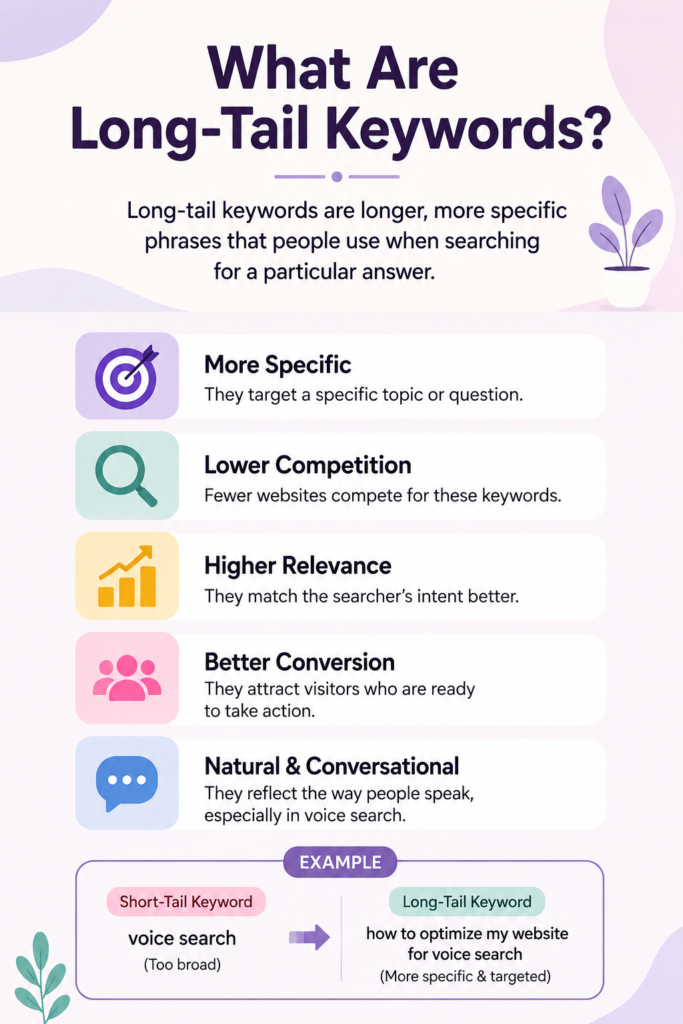
Long-tail keywords are search phrases that contain three or more words. They are more specific than broad keywords and usually reflect a clear question, need, or intention. Although they may receive fewer searches than popular one or two-word keywords, they often attract people who are looking for a particular answer.
Take the keyword voice search as an example. It tells you very little about what the user wants. They could be looking for a definition, examples, tools, or optimization techniques. Now compare it with a search such as How do I optimize my website for voice search? The second query leaves little room for guesswork. It tells search engines exactly what information the user expects to find.
Short-Tail Keyword | Long-Tail Keyword |
Voice search | How do I optimize my website for voice search? |
Content writing | How can I become a freelance content writer? |
SEO tools | What are the best SEO tools for beginners? |
Antivirus | Which antivirus software is best for small businesses? |
Long-tail keywords give search engines more context. They also help writers create focused content that answers a specific question instead of covering a broad topic without direction.
Why Content Writers Should Focus on Long-Tail Keywords
Many writers begin keyword research by looking for the highest search volume. While search volume is important, it should never be the only factor when choosing a topic.
A better approach is to identify the questions your audience asks most often and build content around those questions. Each question can become a separate article that supports a broader pillar page. Over time, these articles create topical authority and strengthen your website’s overall SEO.
For example, a pillar article about voice search optimization could link to supporting articles on conversational content, FAQ optimization, schema markup, voice search mistakes, and long-tail keywords. Each article answers one topic thoroughly while strengthening the others through internal links.
This strategy benefits both readers and search engines. Readers find related information more easily, and search engines gain a better understanding of your website’s expertise.
Why Voice Search Relies on Long-Tail Keywords
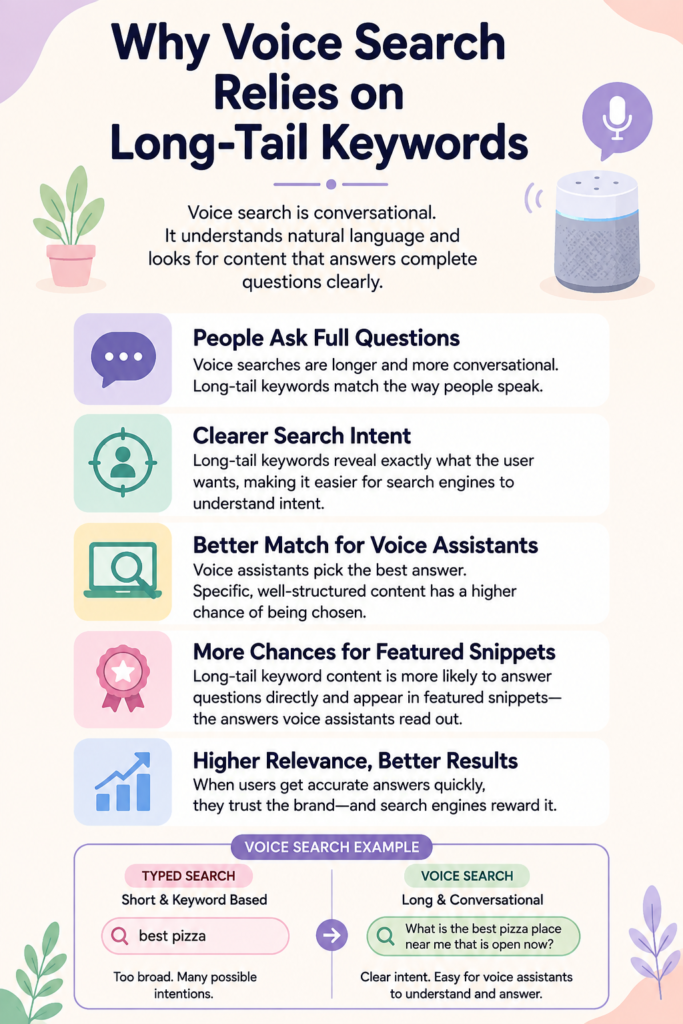
Voice search has changed the way people interact with search engines. When people type, they often shorten their searches to save time. A typed search might look like voice search SEO or best laptop. The same person is more likely to ask, How do I improve my website for voice search? or Which laptop is best for graphic designers? when using a voice assistant.
This difference matters because voice assistants are designed to understand natural conversations. They don’t simply match individual keywords. They analyze the complete question, understand the context, and identify the user’s intent before providing an answer.
As a content writer, your goal should be to match the way people speak rather than the way they type. That doesn’t mean filling your article with random questions. It means anticipating the questions your audience is likely to ask and answering them clearly. When your content reflects natural speech, search engines can understand its relevance more easily, and voice assistants have a better chance of selecting it as a response.
Long-Tail Keywords Reveal User Intent
Understanding user intent is one of the most important parts of modern SEO. Search engines no longer rank pages simply because they contain a keyword. They want to know whether the page satisfies the reason behind the search.
Imagine someone searches for content writing. That search could mean almost anything. The person might be looking for writing services, freelance jobs, online courses, salary information, or examples of good content.
Now consider a search such as How do I start content writing with no experience? The intention is obvious. The user wants practical advice for beginners.
The same principle applies across every industry. A search for cybersecurity is broad and open to interpretation. A search like How can a small business protect itself from phishing attacks? tells you exactly what the reader wants.
Long-tail keywords reduce ambiguity. They help writers create content with a clear purpose, and they help search engines deliver results that closely match the user’s expectations.
Long-Tail Keywords Are Easier to Rank For
Every website wants to rank for broad keywords such as SEO, marketing, or content writing. Unfortunately, those keywords are also the most competitive. Large websites with years of authority, thousands of backlinks, and extensive content libraries often dominate those search results.
Long-tail keywords offer a more realistic opportunity, especially for newer websites and independent bloggers. Instead of competing for voice search, you could target phrases such as How to write conversational content for voice search or Voice search SEO tips for bloggers. These keywords may attract fewer searches each month, but they also have less competition.
More importantly, the people who search using detailed phrases usually know what they are looking for. They are not browsing out of curiosity. They have a problem they want to solve or a question they need answered. That makes them far more valuable visitors than someone who lands on your page by chance.
Ranking for several relevant long-tail keywords often brings better results than chasing a single competitive keyword that may take years to rank.

Long-Tail Keywords Improve Voice Search Visibility
Voice assistants usually provide one answer instead of presenting a list of search results. That means your content has to be clear, relevant, and easy to understand if you want it to become the chosen response.
Articles that answer specific questions naturally have an advantage. When someone asks, Why are long-tail keywords important for voice search? search engines look for pages that provide a direct and reliable answer. They are less interested in pages that mention the keyword repeatedly without explaining it.
This is one reason question-based headings work well. They reflect the way people speak and allow you to answer the question immediately before expanding on the topic. Readers appreciate this structure because they don’t have to search through long paragraphs to find the information they need. Search engines benefit because the page clearly matches the user’s query.
Long-Tail Keywords Support AI Search
Search has evolved far beyond matching keywords. AI-powered search engines now evaluate context, meaning, and user intent before selecting information to display.
Long-tail keywords naturally provide that context because they describe complete ideas rather than isolated words. A phrase such as How can a local business optimize its website for voice search? tells AI systems far more than the keyword voice search. It identifies the audience, the topic, and the user’s objective in a single sentence.
As AI-generated search experiences continue to grow, content that answers specific questions in a clear and conversational way will become even more valuable. Writers who understand this shift today will be better prepared for the future of search.
To Sum Up
Voice search has changed the way people search, but it hasn’t changed what they expect. They still want clear, accurate, and trustworthy answers.
Long-tail keywords make that possible. They reflect natural conversations, reveal user intent, and help search engines understand exactly what your content offers. They also create opportunities to rank for highly relevant searches that broad keywords often overlook.
As you plan your next article, don’t begin with the keyword you want to rank for. Begin with the question your audience wants answered. When your content solves real problems in natural language, long-tail keywords become more than an SEO technique. They become the bridge between your content and the people searching for it.
Frequently Asked Questions
- Why are long-tail keywords important for voice search SEO?
Long-tail keywords are important because voice searches are usually longer and more conversational than typed searches. People tend to ask complete questions, such as “How do I optimize my website for voice search?” Long-tail keywords help your content match these specific queries and the intent behind them.
- How do I find long-tail keywords for voice search?
You can find long-tail keywords through Google Autocomplete, People Also Ask, Related Searches, Google Search Console, keyword research tools, and questions on platforms such as Reddit and Quora. Pay attention to the exact questions people ask about your topic, since these can provide useful ideas for voice search content.
- Are long-tail keywords better than short-tail keywords for SEO?
Neither is always better. Short-tail keywords can attract more searches, but they are usually more competitive and less specific. Long-tail keywords have lower search volume but often match user intent more closely. A good SEO strategy can use broad keywords to establish the topic and long-tail keywords to target specific searches.
- How do long-tail keywords improve voice search rankings?
Long-tail keywords help your content match the longer, conversational queries people use with voice assistants. When your page provides a clear answer to a specific question, search engines can better understand its relevance. This can improve your chances of appearing for relevant voice searches and question-based results.
- How should content writers use long-tail keywords for voice search?
Content writers should use long-tail keywords naturally in headings, introductions, body content, and FAQs. Start with the question behind the keyword and provide a clear answer early in the section. Don’t repeat the exact phrase unnecessarily. Focus on creating useful content that sounds natural when read aloud.
Long-tail keywords in voice search play a crucial role in optimizing content for user intent. As voice search continues to rise in popularity, understanding the nuances of long-tail keywords allows businesses to better align their SEO strategies with natural language queries. This targeted approach not only enhances visibility but also improves the overall user experience by delivering more relevant search results. Emphasizing long-tail keywords is essential for brands seeking to maintain a competitive edge in the evolving landscape of voice search.