
The growth of voice-enabled devices has changed the way people search for information online. Consumers no longer rely exclusively on short, keyword-driven searches typed into a search engine. Instead, they speak to their devices in the same way they would speak to another person. This shift has created a greater demand for conversational content, content that reflects natural speech patterns while maintaining accuracy, authority, and clarity. For professional content writers, copywriters, and small business owners, understanding this change is no longer optional.
Table of Contents
ToggleVoice search is influencing how search engines interpret intent, evaluate relevance, and select content for featured snippets and spoken responses. Businesses that continue to write solely for traditional search behavior risk missing opportunities to connect with users who increasingly prefer spoken queries. The challenge for writers is not simply to insert more questions into their content. The challenge is to produce conversational content that sounds natural, addresses user intent directly, and still reflects professional expertise.
Why Voice Search Requires a Different Writing Approach
Traditional search behavior encouraged writers to optimize for short and often fragmented keywords. A user might type “content marketing tips” or “best accounting software” into a search engine because typing long phrases was inconvenient. Voice search has removed that limitation. Users now ask complete questions such as:
- “What are the best content marketing strategies for a small business?”
- “Which accounting software is suitable for freelancers managing multiple clients?”
- “How can I improve my website’s visibility in voice search results?”
These searches reveal far more about user intent than traditional keywords ever could. Search engines have evolved to understand context, relationships between words, and the purpose behind a search query. As a result, content that mirrors natural speech patterns often performs better in voice search environments than content written solely around keyword placement. This is where conversational content becomes particularly valuable. It aligns with the way people ask questions and the way search engines interpret those questions.
Understanding What Conversational Content Really Means
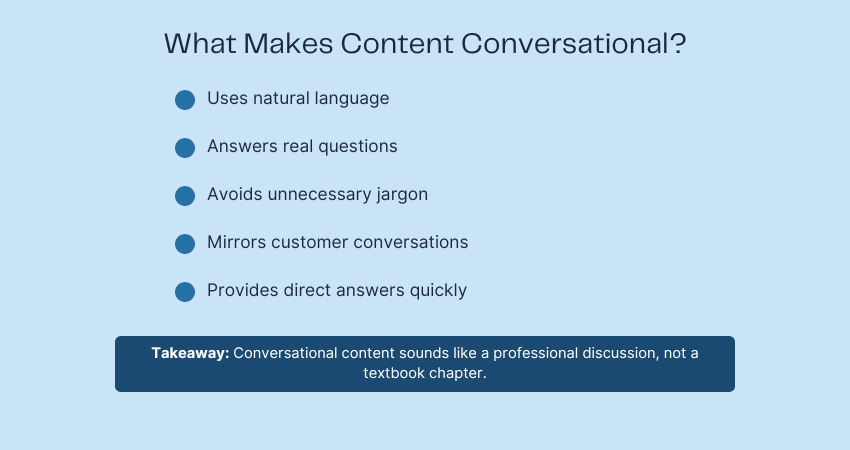
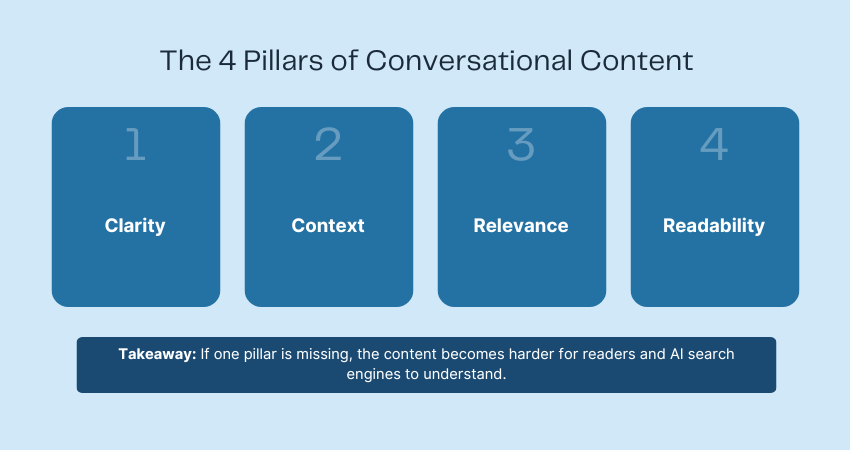
Many writers mistakenly assume that conversational writing requires an informal tone or excessive use of casual language. In reality, professional conversational content is neither overly formal nor overly casual.
A useful way to think about it is this: conversational writing should resemble the way an experienced professional explains a subject to a client or colleague during a meeting.
The language should be:
- Clear and direct.
- Easy to understand.
- Free from unnecessary jargon.
- Structured around the reader’s questions.
- Supported by examples and practical context.
The objective is not to simplify ideas to the point of losing accuracy. The objective is to remove barriers that prevent readers from understanding those ideas quickly.
A cybersecurity consultant explaining ransomware to a small business owner does not rely on technical terminology simply to demonstrate expertise. An experienced consultant explains the issue in language that allows the client to understand both the risk and the solution. Content writers should approach voice search in the same manner.
Begin With the Questions Your Audience Is Already Asking
The foundation of effective conversational content lies in understanding audience language. Many writers begin with keywords and then attempt to build content around them. Voice search often requires the opposite approach. Writers should begin with questions and then identify the keywords embedded within those questions.
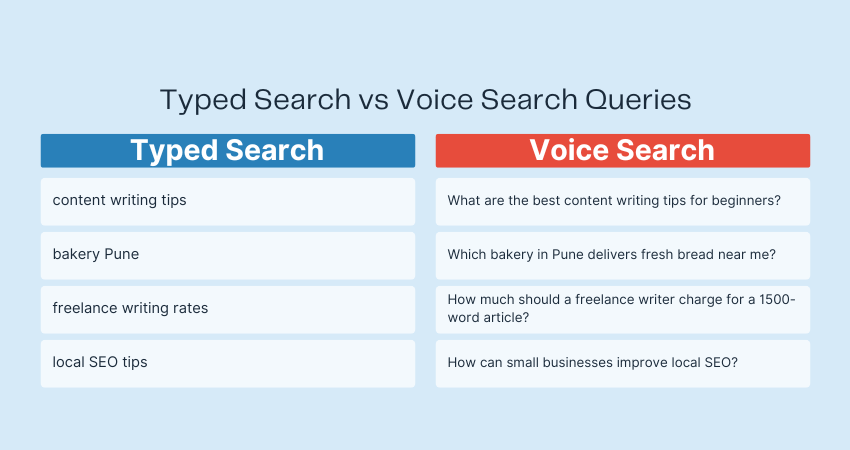
Several sources provide valuable insight into audience language:
- Customer emails and inquiries.
- Frequently asked questions received by sales teams.
- Customer support conversations.
- Social media discussions.
- Industry forums and communities.
- Google’s “People Also Ask” section.
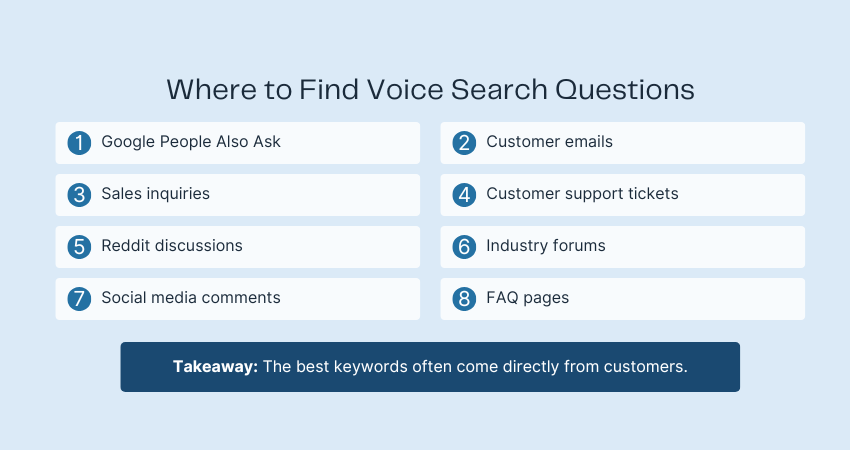
For example, a traditional SEO keyword may be:
Freelance writing rates
However, a voice search user is more likely to ask:
“How much should a freelance writer charge for a 1500-word article?”
The second query provides context, intent, and a clear expectation of the information required.
Professional writers who study audience questions carefully will naturally produce stronger conversational content because they are responding to genuine concerns rather than hypothetical search terms.
Write the Way People Speak, Not the Way Textbooks Read
One of the habits many writers struggle to overcome is the tendency to sound overly academic or unnecessarily formal.Consider the following example.
Formal corporate language:
“Organizations should implement comprehensive cybersecurity frameworks to mitigate vulnerabilities and enhance digital resilience.”
Natural professional language:
“Businesses should strengthen their cybersecurity practices before attackers can exploit weaknesses in their systems.”
Both statements communicate the same idea.
The difference is that the second example sounds closer to the language used during a professional consultation or client meeting.
Experienced writers understand that authority does not come from complicated vocabulary. Authority comes from clarity, relevance, and accuracy.
When developing conversational content, writers should ask themselves whether the sentence sounds like something they would comfortably say during a presentation or workshop. If the answer is no, the sentence may require revision.
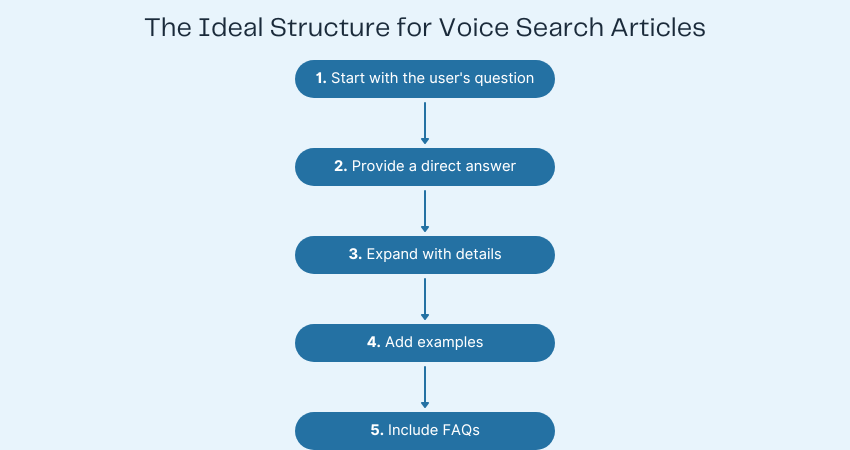
Use Questions as Structural Elements Within the Article
Voice search is fundamentally question-driven.
As a result, question-based headings often perform exceptionally well because they align closely with search behavior. Instead of using generic headings such as:
- Pricing Models
- Local SEO
- Content Distribution
Consider headings such as:
- How Should Freelance Writers Price Their Services?
- How Can Local Businesses Improve Their Visibility in Voice Search?
- Which Distribution Channels Deliver the Best Results for Long-Form Content?
Question-based headings provide several advantages:
- They mirror real search behavior.
- They improve topical relevance.
- They support featured snippet opportunities.
- They help readers navigate the article more easily.
This structure also strengthens conversational content because it creates the feeling of a dialogue between the writer and the reader.
Provide the Answer Before Expanding the Discussion
One of the defining characteristics of successful voice search content is immediacy.
When users ask a question through a voice assistant, they expect an answer quickly. Search engines respond to this expectation by favoring content that addresses the query directly.
For example, if the heading asks:
What Is Voice Search Optimization?
The opening sentence should answer the question immediately. Voice search optimization is the process of creating content that matches the natural language patterns people use when speaking to voice-enabled devices.
Once the answer has been established, the writer can introduce examples, supporting arguments, and implementation strategies.
This structure benefits both readers and search engines while improving the overall effectiveness of conversational content.
Reduce Dependence on Exact Match Keywords
Modern search engines understand semantic relationships between words and concepts.
This means that writers no longer need to repeat the same phrase unnaturally throughout an article.
An article discussing voice search may naturally include related terms such as:
- spoken queries
- natural language search
- smart speakers
- voice assistants
- search intent
- virtual assistants
Search engines understand the relationship between these terms and use that context to evaluate relevance.
This allows writers to create conversational content that feels natural while still satisfying SEO requirements.
Develop FAQ Sections Around Real Customer Conversations
Frequently asked questions continue to be one of the strongest formats for voice search optimization.
However, many businesses weaken their FAQ sections by creating questions that sound artificial or overly promotional.
Effective FAQ sections should reflect actual customer conversations.
Examples include:
- How long does delivery usually take?
- Do you offer support after installation?
- Can I make changes to my order after payment?
- Is there a minimum contract period?
These questions improve the quality of conversational content because they reflect the language customers naturally use when interacting with businesses.
Read the Content Aloud Before Publishing
One of the simplest editorial techniques for evaluating voice search readiness is reading the article aloud.
This exercise often reveals:
- Sentences that are unnecessarily long.
- Phrases that sound unnatural when spoken.
- Repetition that may not be obvious during silent reading.
- Technical language that may confuse readers.
If a sentence feels awkward when spoken, there is a strong possibility that it will also feel awkward to readers.
Experienced writers often use this technique during the editing stage because it helps refine rhythm, pacing, and readability.
Build Credibility Through Clarity Rather Than Complexity
Professional writers often worry that simpler language may reduce perceived expertise. In practice, the opposite is often true. Readers trust writers who explain complex ideas clearly.
Whether discussing cybersecurity, finance, healthcare, or content strategy, the most followed professionals are usually those who can communicate difficult subjects without creating confusion.
Strong conversational content achieves this balance by combining subject expertise with accessible language. The goal is not to sound intelligent. The goal is to make the reader feel informed.
To Sum Up
Voice search is changing the relationship between search engines, businesses, and audiences. As search behavior becomes more conversational, writers must adapt their approach to match those changes. Creating effective conversational content requires more than replacing keywords with questions. It requires a deeper understanding of audience intent, natural language patterns, and the ways in which people seek information through spoken queries.
For professional writers, this shift presents an opportunity to create content that feels more useful, more human, and more closely aligned with the needs of modern audiences. For small business owners, it offers a chance to compete effectively by answering customer questions with clarity and precision. The future of search increasingly resembles a conversation rather than a database query. Writers who understand this transition and adapt their methods accordingly will be better prepared for the next phase of search behavior and content strategy.
FAQs
What is conversational content in SEO?
Conversational content is content written in natural language that reflects how people speak in real conversations rather than how they type short keywords into search engines.
Why is conversational content important for voice search?
Voice search users typically ask complete questions instead of typing fragmented keywords. Conversational content matches these speech patterns and improves the chances of appearing in voice search results.
How does conversational content improve search rankings?
Conversational content helps search engines understand user intent more accurately, increases the likelihood of appearing in featured snippets, and improves visibility in AI-generated search responses.
What is the difference between traditional SEO content and conversational content?
Traditional SEO content often focuses heavily on exact-match keywords, while conversational content focuses on natural language, context, and answering complete questions that users ask through voice or AI search tools.
How do you identify conversational keywords for voice search?
Conversational keywords can be identified through customer questions, Google’s People Also Ask section, customer support tickets, community forums, and tools such as AnswerThePublic and AlsoAsked.
Should content writers use questions as headings for voice search optimization?
Yes. Question-based headings align closely with voice search behavior and improve the chances of being selected for featured snippets and AI-generated answers.
How long should conversational content be for voice search?
There is no fixed word count. The content should answer the user’s question completely while maintaining clarity and readability. Comprehensive answers generally perform better than brief responses that leave important questions unanswered.
Does conversational content work for B2B businesses?
Yes. B2B buyers also use voice search and AI search tools during research and vendor evaluation. Professional conversational content helps businesses appear for high-intent informational searches.
How can small businesses optimize their content for voice search?
Small businesses can improve voice search visibility by answering customer questions, creating FAQ sections, targeting local search intent, and writing in natural language that reflects customer conversations.
What are the most common mistakes writers make when creating conversational content?
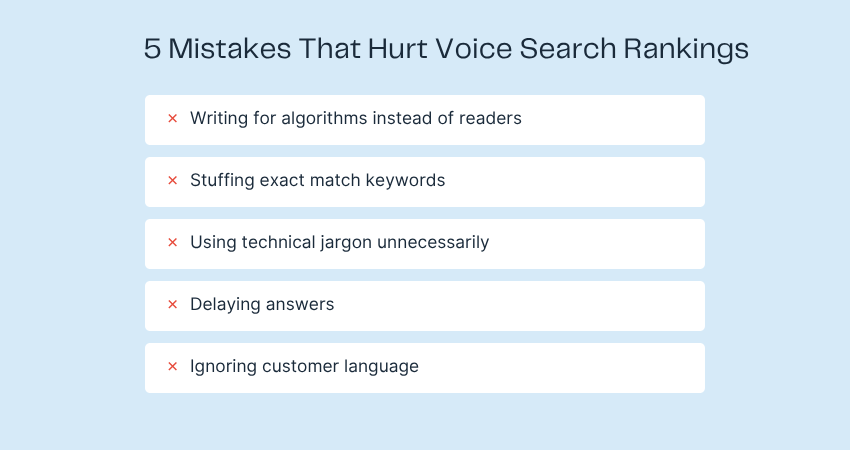
The most common mistakes include overusing keywords, writing for algorithms instead of people, using technical jargon unnecessarily, and delaying answers instead of addressing questions directly.
How do AI search engines use conversational content?
AI search engines prioritize content that provides direct answers, clear structure, question-based formatting, and strong topical authority. Conversational content helps AI systems understand context and extract useful responses for users.
Can conversational content help websites appear in Google AI Overviews?
Yes. Content that answers specific questions clearly and uses natural language is more likely to be referenced in AI Overviews and answer engines.
How many FAQs should a voice search article include?
For most articles, 8 to 12 highly relevant FAQs provide enough topical coverage without creating redundancy. The emphasis should be on relevance rather than quantity.
Is conversational content replacing traditional SEO writing?
No. Conversational content builds upon traditional SEO principles rather than replacing them. Strong content combines keyword strategy, search intent, topical authority, and natural language optimization.
How do content writers prepare for AI search and answer engines?
Content writers should focus on topical authority, direct answers, structured headings, schema markup, experience-based insights, and question-driven content formats to improve visibility in AI search environments.