How Much Grammar Do Writers Really Need to Know?
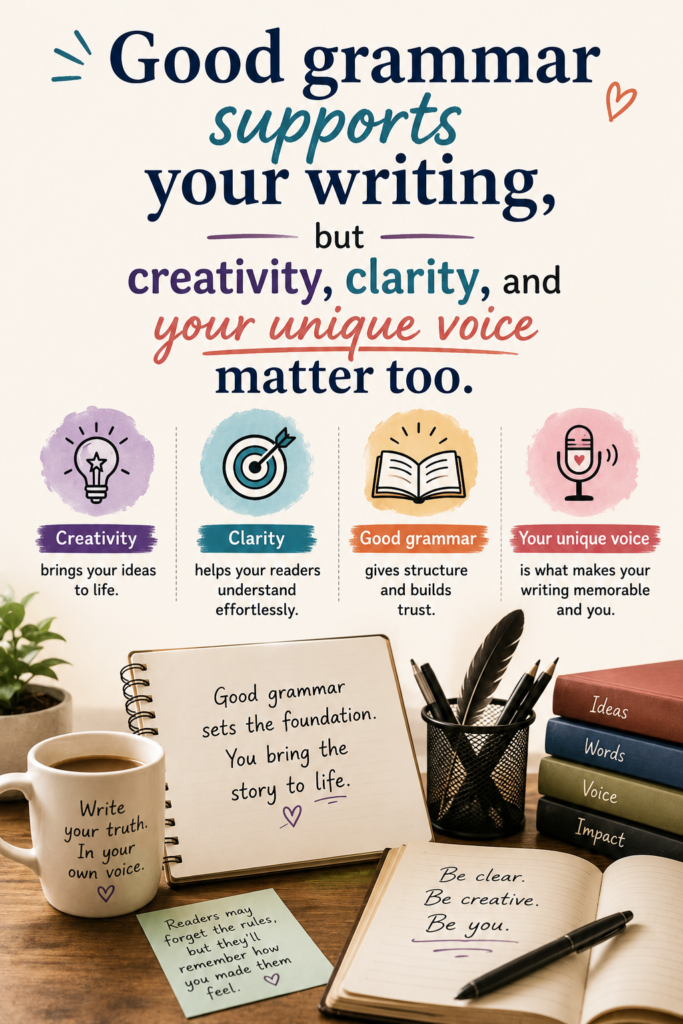
Do writers need to know every grammar rule to write well? After more than 25 years as a professional writer, I don’t think so. I still pause, check a word, or look up a grammar rule when I’m unsure. Knowing grammar and writing effectively aren’t always the same thing. Whether you’re an aspiring story writer, content writer, or experienced professional, you need enough grammar knowledge to communicate clearly and recognize when a sentence isn’t working. AI and grammar tools can suggest corrections, but they can’t replace your judgment. So, how much grammar do writers really need to know? Enough to write clearly, question suggestions, and make informed choices. This blog is for aspiring writers who are still finding their way with grammar, content writers who want to write with more clarity, and story writers who don’t want grammar rules to restrict their creativity. It’s also for experienced writers who occasionally stop mid-sentence and wonder, “Is this actually correct?” If you’ve ever wondered how much grammar you really need to know, especially when AI and grammar tools are always within reach, this article is for you. What Does Knowing Grammar Really Mean for a Writer? When we say a writer should “know grammar,” what exactly do we mean? Does it mean being able to name every tense, explain the difference between a phrase and a clause, or recall every punctuation rule without looking it up? Not necessarily. For a writer, knowing grammar is less about proving how many rules you remember and more about knowing how to use language to express an idea clearly. It’s the ability to build sentences that say what you intend, notice when something sounds unclear, and make changes without losing your natural voice. You may not always remember the technical term for what you’re doing, but you understand how your choice of words, sentence structure, and punctuation affects the person reading them. Knowing Grammar Is More Than Memorizing Rules You don’t need to remember the name of every tense or explain every grammatical term to be a good writer. What you do need is an understanding of how sentences work. For example: “She don’t know why the meeting was cancelled.” You may not stop to think about subject-verb agreement, but you probably know that “She doesn’t know” sounds right. That’s grammar knowledge at work. The same applies when you’re writing a story, blog post, or client article. Knowing grammar helps you spot something that doesn’t sound quite right, even if you can’t immediately name the rule behind it. Understanding How Language Communicates Meaning Grammar isn’t only about whether a sentence is correct. It also affects what the sentence means. Consider these two sentences: “Let’s eat, Grandma.” means you are inviting Grandma to join you for a meal. The comma shows that you are speaking directly to her.“Let’s eat Grandma.” without the comma suggests something very different—it sounds like you are suggesting eating Grandma herself. One small comma changes the meaning completely. It’s an exaggerated example, but it shows why punctuation and sentence structure matter. As writers, our job is to make sure the reader understands what we intended to say. If a reader has to go back and read a sentence twice because the meaning isn’t clear, the problem may not be the idea. It may simply be how the sentence is structured. Developing an Instinct for What Works The more you write, read, and edit, the more you begin to develop an instinct for language. You start noticing when a sentence feels too long, when a word doesn’t quite fit, or when punctuation interrupts the natural flow. For instance: “The article that I wrote last week, which was about grammar and was written for new writers, received a lot of responses.” There’s nothing terribly wrong with the sentence, but it feels heavy. You might naturally rewrite it as: “Last week, I wrote an article about grammar for new writers. It received a lot of responses.” That’s the instinct writers develop over time. It’s not about showing how much grammar you know. It’s about making choices that help your readers move through your words without struggling to understand them. And that, to me, is what knowing grammar as a writer really means. This section builds on the previous one by moving from what knowing grammar means to why that knowledge matters in real writing. Why Does Grammar Matter for Writers? When you write, you already know what you want to say. Your reader doesn’t. They have only the words you put on the page to understand your thoughts, ideas, or story. Grammar helps those words carry your intended meaning from your mind to theirs. This is why grammar matters whether you’re writing a novel, a blog post, website copy, an email, or an article for a client. The purpose and style may change, but the need to be understood doesn’t. Good grammar works quietly in the background. Readers may not notice when you get it right, but they often notice when something goes wrong. Grammar Helps Writers Communicate Clearly At its simplest, grammar gives structure to our thoughts. It helps us show who did what, when something happened, and how one idea connects to another. Consider this sentence: “After speaking to Riya, Meera said she would send the manuscript.” This sentence confuses the reader because the pronoun “she” is unclear. It could refer to either Meera or Riya, so the reader cannot be sure who is supposed to send the manuscript. Who is sending the manuscript, Riya or Meera? The sentence is grammatically possible, but the pronoun “she” makes the meaning unclear. A simple rewrite solves the problem: “After speaking to Riya, Meera said, ‘I’ll send the manuscript.’” As writers, we shouldn’t make readers work harder than necessary to understand what we mean. Clear grammar helps keep the reader focused on the idea or story rather than on figuring out the sentence. Grammar Prevents Misunderstandings Sometimes, a small grammatical or punctuation error can communicate something
How to Make Grammar Part of Your Daily Life
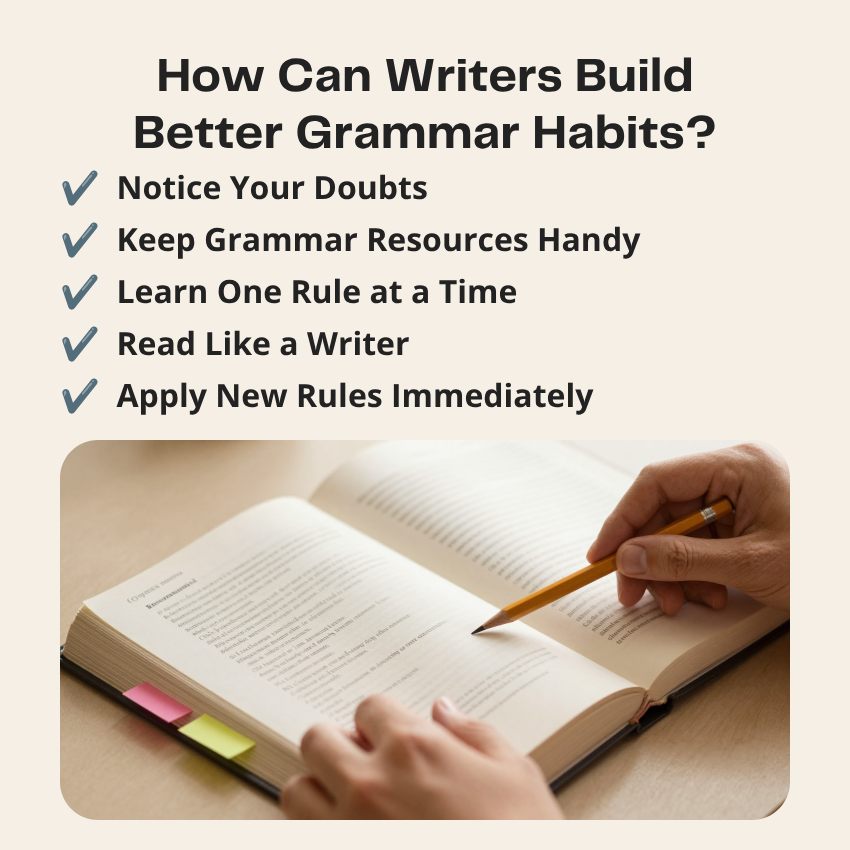
I recently started learning how to bake bread after a long hiatus. Not that I ever really learned how to bake properly in the first place, so in many ways, I’m still very much a beginner. And some days, it frustrates me. I want the measurements to be right. I want the dough to feel right in my hands. I want that smooth elasticity that experienced bakers seem to achieve without even thinking about it. Instead, I find myself adding too much flour, too little water, kneading too much, or perhaps not enough. And then there is the shoulder pain. Nobody tells you that bread making can be hard work. Kneading dough repeatedly for ten or fifteen minutes can leave your shoulders protesting long before the dough is ready. But I keep trying. Because somewhere between the sticky dough and the imperfect loaves, I know I’m learning something. Writing and grammar work much the same way. When we first start writing seriously, grammar can feel like an obstacle course. There are commas to worry about, sentence structures to remember, and rules that seem to have exceptions just when we think we finally understand them. Sometimes it feels easier to ignore grammar altogether and simply write. But grammar is not the enemy of good writing. It is one of the tools that helps good writing reach the reader. Why Grammar is Important Can people communicate without perfect grammar? Absolutely. We’ve all read messages filled with spelling mistakes and missing punctuation and still understood what the writer meant. But understanding and clarity are not always the same thing. Good grammar removes distractions. It allows readers to focus on your ideas instead of trying to interpret your sentences. It gives your writing rhythm, structure, and confidence. For freelance writers, it also builds trust. Clients may forgive the occasional typo, but consistent grammar mistakes can make even excellent ideas look careless. Nobody Truly Finishes Learning Grammar One of the biggest surprises I discovered as a writer was that experienced writers still look things up. They still debate commas. They still question whether a sentence should end with a preposition. They still open style guides and grammar references when something doesn’t feel quite right. Grammar isn’t a destination you eventually arrive at. It’s a skill you continue sharpening throughout your writing life. The same is true of vocabulary and usage. Even experienced writers occasionally pause to check whether two words mean exactly the same thing or carry slightly different shades of meaning. Take “finish” and “complete,” for example. They are often used interchangeably, yet context can make one a better choice than the other. Those small distinctions are part of what makes writing both challenging and rewarding, and they remind us that learning the craft never really stops. How Can Writers Build Better Grammar Habits? The good news is that grammar doesn’t require hours of study. Small habits often make the biggest difference. Pay Attention to the Moments of Doubt Every writer has moments when a sentence doesn’t quite feel right. Maybe the punctuation looks awkward. Perhaps you’re unsure whether a word should be hyphenated or whether you’ve used the correct tense. Sometimes you read a sentence three times and still can’t decide if it works. Don’t ignore that feeling. Those moments of uncertainty are often the best opportunities to learn. Instead of making your best guess and moving on, take a minute to look it up. Check a grammar guide, search for examples, or consult a trusted resource. More often than not, you’ll remember the answer because it was connected to a real writing problem you were trying to solve. Over time, these small moments of curiosity begin to add up. The grammar rule you looked up for a blog post today becomes something you remember for an article next month or a client project next year. Learning grammar rarely happens in one big leap. More often, it happens one question, one doubt, and one discovery at a time. Keep reference material close Every writer should have a trusted grammar reference or style guide within easy reach. Professional writers use them all the time. The good news is that you don’t have to invest in shelves full of grammar books to get started. There are plenty of reliable online resources that can help clear your doubts in minutes. If you’re unsure about commas, citation styles, sentence structure, or grammar rules, look them up. Over time, those quick searches become knowledge that stays with you. Even experienced writers regularly consult reference materials. Looking something up isn’t a sign that you’re inexperienced. It’s a sign that you care about getting it right. Learn one thing at a time Trying to master grammar on a weekend is like trying to master bread baking in a single afternoon. You wouldn’t expect to understand hydration ratios, gluten development, fermentation, shaping, and scoring all at once. Most bakers learn one technique at a time and build on it gradually. Grammar works the same way. Don’t try to memorize every rule, exception, and punctuation mark in one sitting. Start with one concept, perhaps commas, subject-verb agreement, or the difference between “its” and “it’s.” Use it in your writing until it begins to feel natural. Then move on to the next concept. Small improvements made consistently often lead to bigger results than trying to learn everything at once. A year from now, you probably won’t remember the afternoon you spent learning a grammar rule, but you’ll notice how much more confident and effortless your writing has become. Read with a writer’s eye Reading is one of the easiest ways to improve your grammar without feeling as though you’re studying. The next time you read a book, a blog post, or a magazine article, pay attention to how experienced writers structure their sentences, use punctuation, and guide readers from one idea to the next. Notice where they use short sentences for emphasis and longer ones to develop an idea. Observe how commas
What Makes Great Writing Truly Stand Out
Great writing goes beyond perfect grammar and clear structure. It creates an experience that lingers in the reader’s mind long after they’ve finished reading. While good writing serves its purpose by presenting information in a clear and polished manner, great writing does so much more—it connects, captivates, and leaves a lasting impact. Let’s uncover what sets exceptional writing apart and how you can craft work that truly resonates. The Difference Between Good and Great Writing At its core, good writing is dependable. It gets the point across, keeps the reader interested, and avoids unnecessary fluff. Think of good writing as the sturdy bridge that takes you from point A to point B without any hiccups. It’s the blog post that explains a concept clearly, the email that communicates effectively, or the story that entertains. Now, great writing? It’s the kind of bridge that makes you stop halfway, admire the view, and remember the journey forever. It doesn’t just deliver—it leaves an imprint. Great writing doesn’t settle for being understood; it aims to be felt. Here’s the breakdown. Good writing is functional: It informs, explains, or entertains. Great writing is emotional: It engages, inspires, and lingers in the mind. Good writing serves a purpose: It’s clear and concise. Great writing transcends purpose: It tells a story, creates a connection, and sparks thought. Simply put, good writing does its job well, but great writing transforms the ordinary into something unforgettable. Why the Difference Matters The digital landscape is overflowing with content, yet only a small fraction truly leaves a mark. The difference between good and great writing often becomes the tipping point for lasting impact. Readers aren’t just looking for information—they’re searching for authenticity, creativity, and a connection that feels real. Good writing can get you noticed. It might grab a moment of attention, perhaps even a nod of approval. But great writing? That’s what builds trust. It’s the kind of writing that stays with readers, earning their loyalty and inspiring action. It has the power to influence perspectives, spark conversations, and create lasting bonds. Think about the books, articles, or blogs you hold close to your heart. They weren’t just grammatically correct or well-structured—they spoke to you. They had that spark, that rare quality that moved you, made you think, or even changed your outlook. They were more than words; they were an experience. This is the essence of great writing. It challenges the writer to dig deeper, to bring their truest self into their work, and to create something that resonates. Every writer, no matter where they are in their journey, has the potential to close the gap between good and great. The question is: Are you ready to take that step? How to Transition from Good to Great Focus on Your Audience: Great writing starts with understanding who you’re writing for. What moves them? What do they value? Add Personality: Don’t just stick to the facts. Infuse your writing with your unique voice and perspective. Prioritize Emotion: Think beyond what your readers need to know—ask yourself what you want them to feel. Refine Relentlessly: Great writing often starts as good writing, shaped and polished through thoughtful editing. The Writer’s Journey Every writer has the potential to move from good to great. It takes curiosity, effort, and a willingness to push boundaries. Great writing isn’t just about the words on the page—it’s about the energy, emotion, and authenticity behind them. As you reflect on your own work, ask yourself: Is this just delivering information, or is it creating an experience? The answer to that question could be the first step in your journey to becoming the writer you’ve always wanted to be. Ready to Create Something Great? Great writing doesn’t just happen—it’s crafted with care and purpose. If you’re looking for content that connects, inspires, and drives results, let’s collaborate. Whether you need compelling blogs, engaging web copy, or content that speaks directly to your audience, I can help. Let’s create something unforgettable together! Let’s Talk Because the world is full of good writing. Let’s make yours great. Good writing informs; great writing transforms and lingers.