
I recently started learning how to bake bread after a long hiatus. Not that I ever really learned how to bake properly in the first place, so in many ways, I’m still very much a beginner. And some days, it frustrates me. I want the measurements to be right. I want the dough to feel right in my hands. I want that smooth elasticity that experienced bakers seem to achieve without even thinking about it. Instead, I find myself adding too much flour, too little water, kneading too much, or perhaps not enough.
And then there is the shoulder pain. Nobody tells you that bread making can be hard work. Kneading dough repeatedly for ten or fifteen minutes can leave your shoulders protesting long before the dough is ready. But I keep trying. Because somewhere between the sticky dough and the imperfect loaves, I know I’m learning something.
Writing and grammar work much the same way. When we first start writing seriously, grammar can feel like an obstacle course. There are commas to worry about, sentence structures to remember, and rules that seem to have exceptions just when we think we finally understand them. Sometimes it feels easier to ignore grammar altogether and simply write. But grammar is not the enemy of good writing. It is one of the tools that helps good writing reach the reader.

Why Grammar is Important
Can people communicate without perfect grammar? Absolutely. We’ve all read messages filled with spelling mistakes and missing punctuation and still understood what the writer meant. But understanding and clarity are not always the same thing. Good grammar removes distractions. It allows readers to focus on your ideas instead of trying to interpret your sentences. It gives your writing rhythm, structure, and confidence. For freelance writers, it also builds trust. Clients may forgive the occasional typo, but consistent grammar mistakes can make even excellent ideas look careless.

Nobody Truly Finishes Learning Grammar
One of the biggest surprises I discovered as a writer was that experienced writers still look things up. They still debate commas. They still question whether a sentence should end with a preposition. They still open style guides and grammar references when something doesn’t feel quite right.
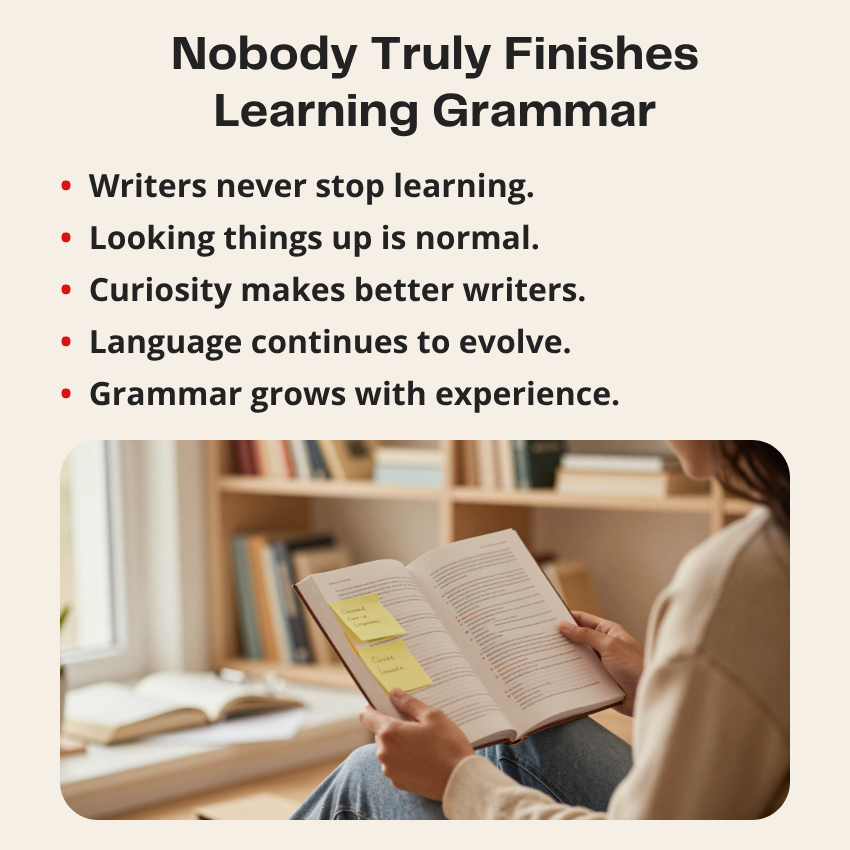
Grammar isn’t a destination you eventually arrive at. It’s a skill you continue sharpening throughout your writing life.
The same is true of vocabulary and usage. Even experienced writers occasionally pause to check whether two words mean exactly the same thing or carry slightly different shades of meaning. Take “finish” and “complete,” for example. They are often used interchangeably, yet context can make one a better choice than the other. Those small distinctions are part of what makes writing both challenging and rewarding, and they remind us that learning the craft never really stops.
How Can Writers Build Better Grammar Habits?
The good news is that grammar doesn’t require hours of study. Small habits often make the biggest difference.
- Pay Attention to the Moments of Doubt
Every writer has moments when a sentence doesn’t quite feel right.
Maybe the punctuation looks awkward. Perhaps you’re unsure whether a word should be hyphenated or whether you’ve used the correct tense. Sometimes you read a sentence three times and still can’t decide if it works.
Don’t ignore that feeling. Those moments of uncertainty are often the best opportunities to learn.
Instead of making your best guess and moving on, take a minute to look it up. Check a grammar guide, search for examples, or consult a trusted resource. More often than not, you’ll remember the answer because it was connected to a real writing problem you were trying to solve. Over time, these small moments of curiosity begin to add up.
The grammar rule you looked up for a blog post today becomes something you remember for an article next month or a client project next year. Learning grammar rarely happens in one big leap. More often, it happens one question, one doubt, and one discovery at a time.
- Keep reference material close
Every writer should have a trusted grammar reference or style guide within easy reach. Professional writers use them all the time.
The good news is that you don’t have to invest in shelves full of grammar books to get started. There are plenty of reliable online resources that can help clear your doubts in minutes. If you’re unsure about commas, citation styles, sentence structure, or grammar rules, look them up. Over time, those quick searches become knowledge that stays with you. Even experienced writers regularly consult reference materials. Looking something up isn’t a sign that you’re inexperienced. It’s a sign that you care about getting it right.
- Learn one thing at a time
Trying to master grammar on a weekend is like trying to master bread baking in a single afternoon. You wouldn’t expect to understand hydration ratios, gluten development, fermentation, shaping, and scoring all at once. Most bakers learn one technique at a time and build on it gradually.
Grammar works the same way. Don’t try to memorize every rule, exception, and punctuation mark in one sitting. Start with one concept, perhaps commas, subject-verb agreement, or the difference between “its” and “it’s.”
Use it in your writing until it begins to feel natural. Then move on to the next concept. Small improvements made consistently often lead to bigger results than trying to learn everything at once. A year from now, you probably won’t remember the afternoon you spent learning a grammar rule, but you’ll notice how much more confident and effortless your writing has become.
- Read with a writer’s eye
Reading is one of the easiest ways to improve your grammar without feeling as though you’re studying. The next time you read a book, a blog post, or a magazine article, pay attention to how experienced writers structure their sentences, use punctuation, and guide readers from one idea to the next.
Notice where they use short sentences for emphasis and longer ones to develop an idea. Observe how commas create pauses and how paragraphs are arranged to improve readability and flow. You don’t have to analyze every sentence like an English teacher marking an exam. Simply becoming more aware of how good writing works can make a surprising difference to your own writing.
The more you read well-written content, the more naturally grammar patterns begin to settle into your mind. Reading, in many ways, is grammar practice in disguise.
- Apply what you learn immediately
Grammar rules become useful only when they move from theory into practice. Reading about a rule is one thing. Using it in your own writing is what helps it stick. If you’ve just learned how to use semicolons, try using them in your next blog post. If you’ve finally understood the difference between “which” and “that,” look for opportunities to apply it in your articles or emails.
Use new grammar concepts in blog posts, newsletters, social media captions, client work, and even everyday messages. Don’t worry about getting it perfect the first time.
Like bread baking, there may be a few failed attempts before things start to feel natural. The first loaf may be dense, the second may be overproofed, and the third may finally begin to resemble the bread you had in mind. Grammar develops in much the same way. The more you use a rule, the less you have to stop and think about it. What once required conscious effort gradually becomes instinct.
Repetition doesn’t just build knowledge. It builds confidence.
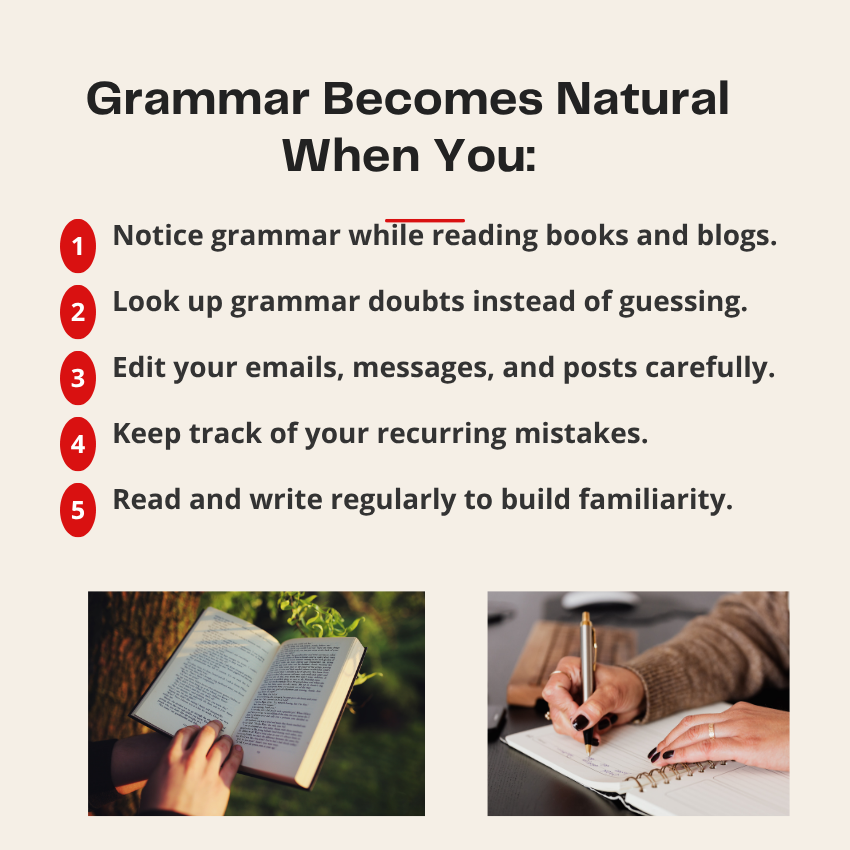
How Does Grammar Become Second Nature?
The idea isn’t to spend hours studying grammar textbooks or memorizing rules. A grammar lifestyle is built through small, everyday habits. Notice how writers use punctuation when you read books, blogs, or newspaper articles. Pay attention to sentence length, word choices, and how ideas flow from one paragraph to the next.
When you come across a grammar rule that confuses you, look it up instead of guessing. Those small moments of curiosity often become the lessons we remember the longest. Take a second look at the emails, messages, and social media posts you write each day. Editing your own writing is one of the simplest ways to improve your grammar naturally.
Keep a list of grammar rules that you often forget. Many writers have a handful of recurring mistakes, and becoming aware of them is half the battle won. Most importantly, read regularly.
Good writing has a way of teaching grammar without making it feel like a lesson. The more you read well-written content, the more natural sentence structure, punctuation, and rhythm begin to feel.
Grammar stops being something you study and slowly becomes something you notice, practice, and use without thinking about it. That is what a grammar lifestyle looks like.

It Eventually Becomes Natural
I still struggle with bread dough. Some days it behaves beautifully. Other days it seems determined to prove that I have no idea what I’m doing. But each loaf teaches me something new. Grammar works the same way. There will be sentences that refuse to cooperate. There will be rules you forget and punctuation marks that leave you second-guessing yourself.
That’s normal. What feels awkward today often becomes second nature tomorrow. One day you’ll look back and realize you are no longer stopping to think about every comma or every sentence structure.
You’ll simply write. And perhaps that’s the real goal. Not perfection. Just enough familiarity with the tools that they quietly step aside and allow your ideas to take center stage. Grammar isn’t something you visit only when you make a mistake. It’s something you live with quietly every day, much like a baker learns to recognize good dough by touch or an experienced driver changes gears without thinking. And that, perhaps, is the essence of the grammar lifestyle.
Frequently Asked Questions
Can grammar improve naturally with practice?
Yes. The more you read, write, edit, and pay attention to language, the more familiar grammar patterns become. Over time, many grammar decisions become instinctive rather than deliberate.
How can I improve my grammar as a writer?
Start with small habits. Read regularly, look up grammar doubts when they arise, use trusted reference materials, and apply new grammar concepts in your writing as soon as you learn them.
Do professional writers still use grammar guides?
Absolutely. Many experienced writers regularly consult style guides, dictionaries, and grammar resources to confirm rules or settle doubts.
How long does it take to become good at grammar?
There is no fixed timeline. Grammar develops gradually through consistent reading, writing, and practice. Most writers continue learning throughout their careers.
What is the best way to learn grammar without feeling overwhelmed?
Focus on one concept at a time. Trying to learn everything at once can be frustrating. Small, steady improvements are often more effective than intensive study sessions.
Is reading a good way to improve grammar?
Yes. Reading exposes you to sentence structures, punctuation, and writing styles in context. It is one of the most natural ways to strengthen grammar skills.
Which grammar resources are useful for writers?
Writers often use online resources such as Purdue OWL, dictionaries, style guides, and grammar reference websites to clarify doubts and improve their writing.
Why is grammar important for freelance writers?
Good grammar improves clarity, builds credibility, and creates trust with clients and readers. Strong ideas are easier to appreciate when they are communicated clearly.
What is a grammar lifestyle?
A grammar lifestyle means making grammar part of your everyday writing habits rather than treating it as something you study only when preparing for an exam or fixing mistakes.
Does every writer struggle with grammar?
Yes. Even experienced writers occasionally question punctuation, sentence structure, or word choice. Looking things up is a normal part of the writing process.