
Synopsis
Some qualities announce themselves loudly. Tenacity does not. It stays quiet, steady, and firm, even when progress feels slow or invisible. This word is often used to describe people who keep going long after enthusiasm fades and external motivation runs out. In writing, work, learning, and life, tenacity is what bridges intention and outcome. 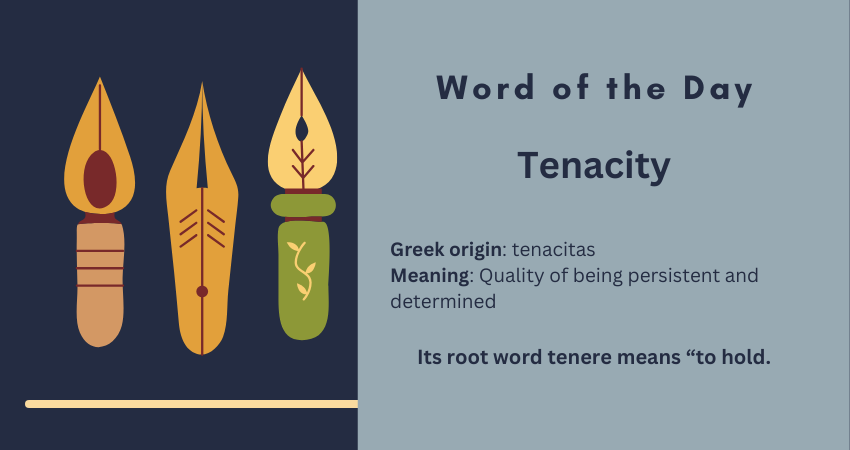
Word of the Day
Tenacity
Table of Contents
ToggleWord of the Day Meaning
Tenacity refers to the quality of being persistent and determined, especially in the face of difficulty, resistance, or delay. It is the ability to hold on, mentally or emotionally, when giving up would be easier. Word of the Day Pronunciation
tuh-NASS-uh-tee
Tenacity: Origin and Etymology
The word tenacity comes from the Latin tenacitas, meaning firmness or the act of holding fast. Its root word tenere means “to hold.” In its earliest usage, tenacity described physical grip or adhesion. Over time, its meaning evolved to represent mental strength and emotional endurance, which is how the word is commonly used today.
Tenacity: Synonyms and Antonyms
Synonyms:
Perseverance, grit, determination, resilience, persistence
Antonyms:
Apathy, indifference, surrender, weakness, passivity
Tenacity Usage in Sentences: Across Genres
In Journalism:
Her tenacity turned a small local issue into a national conversation.
In Political Analysis:
The leader’s tenacity helped sustain reforms despite internal opposition.In Academic Writing:
The researcher’s tenacity was evident in years of fieldwork and multiple revisions.In Literature:
It was her quiet tenacity, not dramatic courage, that carried her forward.In Travel Writing:
Tenacity mattered more than strength while crossing the rugged terrain.In Legal Commentary:
The lawyer’s tenacity led to the reopening of a long-dismissed case.
Why Tenacity Is Worth Knowing
Tenacity is a useful word because it captures effort without exaggeration. It avoids drama while still acknowledging sustained work. For writers, this word holds particular relevance. Writing is rarely about sudden inspiration. It is about showing up repeatedly, revising patiently, and staying with an idea until it becomes clear. Tenacity names that process honestly. Tenacity in Modern Context
In modern usage, tenacity often appears in discussions around careers, entrepreneurship, education, and personal growth. It describes freelancers building momentum slowly, students navigating long academic paths, and professionals adapting to changing industries. In a culture that celebrates quick wins, tenacity quietly reminds us that progress often comes from staying consistent.

In digital spaces, tenacity is visible in long-term content creation, steady learning, and audience-building efforts that take time to mature. It is less visible than talent, but far more reliable.
FAQs
Is tenacity a positive trait?
Yes. Tenacity is generally viewed as a positive quality because it reflects persistence, commitment, and the ability to continue despite obstacles.

Can tenacity be used in professional or academic writing?
Yes. Tenacity fits naturally in journalism, academic writing, leadership analysis, and workplace communication.

Is tenacity the same as resilience?
Not exactly. Tenacity focuses on persistence and staying the course, while resilience emphasizes recovery after setbacks. The two often work together.
If you’re refining ideas where clarity, nuance, and tone matter, I work on long-form writing and editorial content that balances precision with intent.
Post Views: 106