As a content writer, I've watched the profession change quite a bit over the years. The way we research, write, edit, and deliver content today is very different from what it was a decade ago. And the changes haven't stopped. AI writing tools, evolving search engine algorithms, changing reader expectations, and new content formats are influencing how we approach our work.  As I look ahead to 2027, I find myself thinking about what these changes mean for those of us who make a living through writing. Will traditional blog writing continue to offer the same opportunities? Should we be learning new skills? How much should we rely on AI? And perhaps more importantly, how do we make sure our work continues to offer something valuable to readers and clients?

 I don't believe content writing is disappearing. But I do think the profession is entering a new phase where writers need to be more adaptable, informed, and willing to learn. Writing well will always matter, but it may no longer be enough on its own. So, I've put together some of the content writing trends I believe every writer should watch as we move into 2027. Some are already shaping the industry, while others are likely to influence the opportunities available to writers in the coming year.

Table of Contents
ToggleAI-assisted writing will become a standard skill
AI tools have already changed the way writers work. They help with research, brainstorming, outlining, editing, proofreading, and repurposing content. By 2027, knowing how to use AI tools effectively will be an expected professional skill for many content writers.

But using AI doesn't mean handing over the entire writing process to a tool. Writers still need to check facts, understand context, identify gaps, and bring their own perspective to the content.

What writers should prepare for:
Learn to use AI tools for research and content planning.Use AI to improve productivity, not replace independent thinking.Develop strong editing and fact-checking skills.Learn to identify generic, repetitive, and inaccurate AI content.Establish a workflow that combines AI assistance with human judgment.
The real advantage will come from knowing when to use AI and when to rely on your own expertise. GEO and AEO will become important writing skills
SEO has been an important part of content writing for years. But the way people search for information is changing. Readers now use AI-powered search tools to ask questions, compare products, and find recommendations. This has increased interest in two areas:
GEO (Generative Engine Optimization): Making content easier for generative AI systems to discover, understand, and reference.AEO (Answer Engine Optimization): Structuring content to provide direct answers to specific questions.
For writers, this means understanding how to create content that serves both traditional search users and people using AI-powered search.

What writers should prepare for:
Understand search intent.Write clear, direct answers to relevant questions.Use meaningful headings and logical content structures.Include credible references and supporting information.Develop topical expertise.Learn how AI search experiences retrieve and present information.
Don't abandon SEO. Instead, expand your knowledge to include the changing ways people discover content. First-hand experience will give content a stronger identity
AI can generate articles on almost any subject. But producing information and sharing genuine experience are two different things. Readers want more than another article that repeats information available on dozens of websites.

Consider the difference between explaining how ransomware works and discussing lessons learned from a real ransomware incident.

The second approach gives writers an opportunity to include observations, expert opinions, practical lessons, and original insights.

What writers should prepare for:
Include practical examples wherever possible.Conduct interviews with subject matter experts.Use original research and case studies.Share informed observations.Develop experience in specific subject areas.
First-hand experience doesn't mean every article needs a personal story. It means adding something useful that goes beyond repeating existing information. 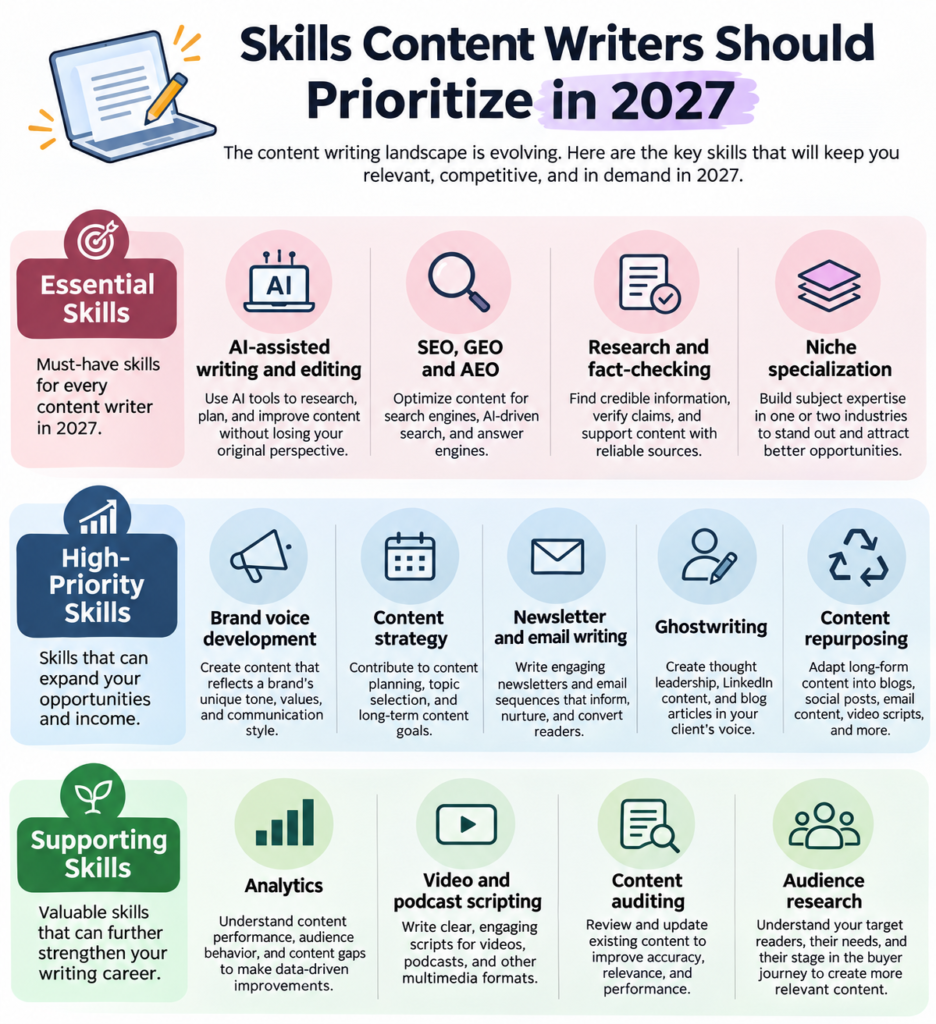
Niche specialization will become more valuable
General content writing skills will continue to have a place. However, writers with industry knowledge can offer something more specific.

A cybersecurity writer understands threats, vulnerabilities, security products, and industry terminology. A healthcare writer needs to understand medical concepts and communicate them accurately. A finance writer must be comfortable researching financial products, regulations, and market developments.

This knowledge helps writers produce content with less dependence on basic explanations and repeated client instructions.

What writers should prepare for:
Identify one or two industries that interest you.Build a portfolio around your chosen niches.Follow industry news and developments.Learn the terminology used by professionals.Develop the ability to explain complex subjects in simple language.
You don't need to know everything about an industry. But you should understand your subject well enough to ask the right questions and research it independently. Research and fact-checking will become core competencies
AI tools can produce convincing paragraphs that contain incorrect information. Even traditional online research can lead writers to outdated statistics, unreliable sources, and misleading claims.

This makes research and fact-checking essential skills.

Clients may increasingly expect writers to support important claims with reliable references rather than simply produce polished prose.

What writers should prepare for:
Learn to identify authoritative sources.Verify statistics, quotations, and research findings.Cross-check information before publication.Understand the difference between primary and secondary sources.Maintain a record of references.Avoid unsupported claims.
A well-researched article builds credibility. Good grammar alone cannot compensate for inaccurate information. Brand voice development will become an important skill
AI-generated content often follows familiar patterns. Without proper editing, different brands can end up publishing content that sounds remarkably similar. Writers who understand brand communication can help businesses maintain a distinct identity.

This requires more than changing a few words or adjusting the tone. It involves understanding the brand's audience, values, personality, and communication style.

What writers should prepare for:
Learn how to create brand voice guidelines.Study the client's existing communication.Adapt writing styles for different audiences.Maintain consistency across blogs, websites, newsletters, and social media.Develop strong editing skills.
Brand voice development can also become a separate freelance service. Content repurposing will create more writing opportunities
A single long-form article can provide material for several other content formats. For example, a 2,000-word article can become:Three LinkedIn posts.Five short social media updates.A newsletter.A video script.An infographic outline.A short email series.
Businesses want to make better use of their existing content. Writers who can adapt information for different platforms will have more opportunities.

What writers should prepare for:
Learn to convert long-form content into short-form content.Understand platform-specific writing styles.Develop skills in social media copywriting.Learn basic video scripting.Preserve the original message while adapting the format.
The important skill isn't simply shortening an article. It's knowing what information works for each platform. Newsletter and email writing will gain importance
Newsletters give businesses and independent professionals a direct way to communicate with their audiences. Unlike social media posts, newsletters allow writers to develop an ongoing relationship with readers through regular communication.

This creates opportunities for freelance writers who can write engaging, useful, and well-structured emails.

What writers should prepare for:
Learn newsletter writing.Understand email marketing fundamentals.Write welcome emails and email sequences.Develop subject lines that encourage readers to open emails.Understand audience segmentation.Learn how to write for subscriber engagement.
Newsletter writing is worth considering as a separate specialization rather than treating it as an extension of blog writing. 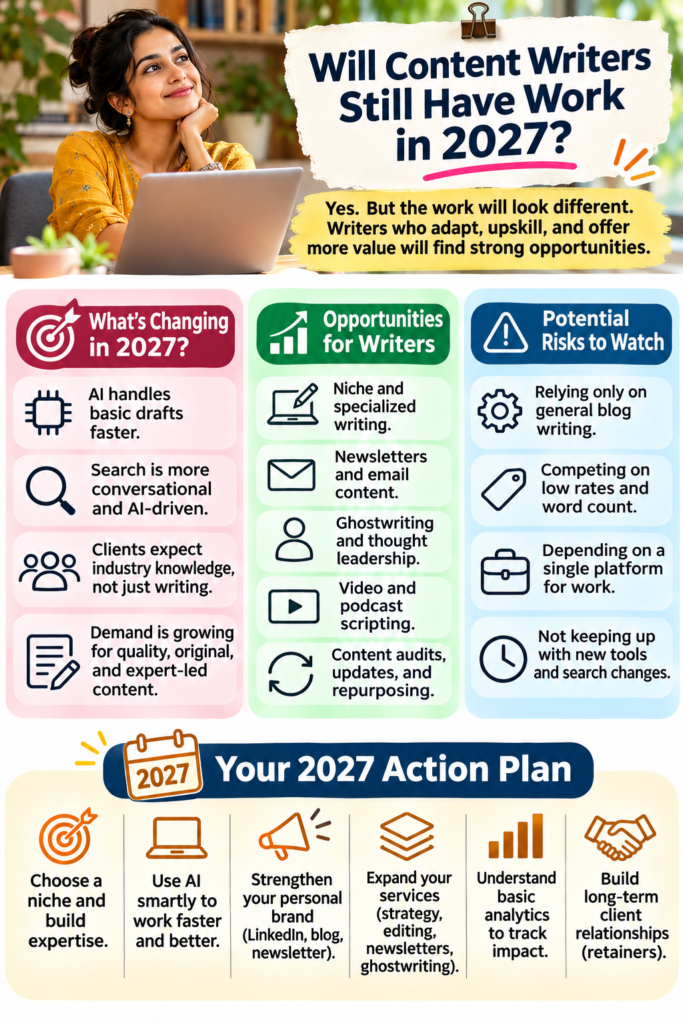
Ghostwriting and personal branding will create new opportunities
Professionals, founders, consultants, and industry experts often have valuable ideas but don't have the time or writing skills to communicate them regularly.

This is where ghostwriters come in.

Ghostwriting involves developing content in another person's voice and publishing it under their name, with their authorization. LinkedIn posts, newsletters, opinion articles, blogs, and thought leadership content are common examples.

What writers should prepare for:
Learn to interview clients and subject matter experts.Understand how to capture someone's communication style.Develop LinkedIn writing skills.Learn to structure thought leadership articles.Understand personal branding.Practice writing in different voices.
Ghostwriting requires listening and research as much as writing. Content auditing and updating will become regular work
Writers often focus on creating new content. But websites also need existing articles reviewed and updated. An article published two years ago may contain outdated information, broken links, old statistics, or references to products that no longer exist.

Content auditing gives writers an opportunity to work beyond new article production.

What writers should prepare for:
Learn to review existing website content.Identify outdated information.Check links and references.Find overlapping articles.Improve readability and structure.Understand basic content performance metrics.
Writers can offer content audits and maintenance packages to existing clients. Multimodal content skills will expand writing opportunities
Content is no longer limited to blogs and website pages. Businesses use videos, podcasts, infographics, webinars, and interactive content to communicate with their audiences.

Writers don't necessarily need to become designers or video editors. But understanding how to develop content for these formats can expand their services.

What writers should prepare for:
Learn video scripting.Write podcast scripts and show notes.Develop infographic content.Create webinar outlines.Understand basic storytelling for visual platforms.Learn to collaborate with designers and video editors.
Writers who can translate complex information into different formats will have more opportunities to work with marketing teams. Data-driven content writing will become more relevant
Writing an article and publishing it is only one part of the process. Writers who understand how their content performs can make better decisions about topics, formats, and audience needs.

You don't need to become a data analyst. But basic analytics knowledge can help you understand whether your content is reaching the intended audience.

What writers should prepare for:
Learn the basics of Google Analytics 4.Understand Google Search Console.Monitor organic traffic and search queries.Understand engagement and conversion metrics.Identify content gaps using performance data.Use insights to improve existing articles.
This knowledge can help writers move toward content strategy and consulting. Short-form storytelling will remain an important skill
People consume content in different ways. Some prefer detailed articles, while others want quick information through social media posts and short videos. Writers need to understand how to communicate an idea without losing its meaning.

Short-form writing requires more than cutting down paragraphs. It involves identifying the central message and presenting it in a way that captures attention.

What writers should prepare for:
Write effective hooks and headlines.Learn concise storytelling.Develop LinkedIn and social media writing skills.Write short video scripts.Adapt content for different audience preferences.
The ability to write both detailed articles and concise posts will be useful across several industries. Content personalization will require a better understanding of audiences
Generic content may attract some readers, but it doesn't always address their specific concerns. A beginner looking for cybersecurity advice needs different information from an IT manager responsible for protecting an enterprise network. Writers need to understand who they're writing for and what those readers expect to learn.

What writers should prepare for:
Develop audience personas.Understand customer pain points.Learn about different stages of the buyer journey.Write for different levels of subject knowledge.Adapt examples and explanations to specific audiences.
Audience research should become part of the writing process, not an optional step. Editorial judgment and ethical writing will matter more
As AI-generated content becomes more common, writers will need to take greater responsibility for what they publish. This includes checking facts, avoiding plagiarism, respecting copyright, protecting confidential information, and following client guidelines on AI use.Writers also need to know when an AI-generated suggestion is unsuitable, misleading, or unsupported.
What writers should prepare for:
Develop strong editorial judgment.Understand copyright and plagiarism.Verify sources and quotations.Follow responsible AI practices.Protect client information.Be transparent about research and content limitations.
A writer's responsibility doesn't end when the draft is submitted. The quality and accuracy of the information matter just as much as the writing itself. To Sum Up
Content writing in 2027 will require writers to bring more to the table than good grammar and the ability to meet deadlines. Research, subject knowledge, editorial judgment, audience understanding, and adaptability will become increasingly important. You don't have to become an SEO expert, social media manager, video producer, and data analyst all at once. But you do need to identify the skills that complement your writing strengths.

The future belongs to writers who know how to think, research, question, and communicate, not just produce words.

And perhaps the most important thing to remember is this: AI may change how we write, but writers must continue to understand why the content needs to be written in the first place.
Views: 2