

I've spent more than two decades writing content, and I've seen the way we approach writing change several times. We moved from writing primarily for readers to paying closer attention to search engines, keywords, rankings, and traffic. We learned to research keywords, understand search intent, structure articles, and optimize content for better visibility.But something else is happening now. People are asking ChatGPT for answers, turning to Perplexity for research, and using Google's AI-powered search features instead of browsing through pages of search results.
It makes me wonder: If an AI tool can summarize the information in my article in seconds, what would make someone want to read my original work?Every freelance content writer needs to consider this question. The answer isn't to abandon SEO or start writing exclusively for AI tools. It's to rethink how we create content. We need to offer more than information readers can find on a dozen other websites. Our writing should include research, experience, original observations, practical examples, and clear explanations.
This is where Generative Engine Optimization (GEO) and Answer Engine Optimization (AEO) become relevant. These concepts give us another reason to examine our writing habits and ask whether our content is genuinely useful. For freelance writers, this also means understanding what clients expect, asking the right questions before starting an assignment, and developing skills that go beyond keyword placement.
So, what do GEO and AEO mean, and how can we put them into practice? More importantly, what should we change when we sit down to write our next client assignment?
For a broader look at the changes shaping the writing profession, read the article on Content Writing Trends for 2027, which explores what freelance writers should prepare for in the coming year.
Table of Contents
ToggleUnderstanding GEO and AEO
Before discussing how to apply these concepts, let's look at what they mean and how they influence content discovery.What is GEO (Generative Engine Optimization)?
Generative Engine Optimization (GEO) refers to creating and structuring content so generative AI systems can discover, understand, retrieve, and potentially reference it when generating responses.
Consider a small business owner who asks an AI search tool:
“What cybersecurity measures should a small business implement to prevent ransomware attacks?”
The platform may generate an answer covering employee training, endpoint protection, backups, access controls, and incident response. It may also provide links to websites that support its response.

GEO focuses on making your content useful and accessible within these AI-powered discovery experiences. Your content should provide context, support its claims, and offer meaningful answers rather than repeat information already available elsewhere.

However, GEO doesn't guarantee that an AI platform will cite your article. Different platforms use different retrieval systems and selection methods. Writers can improve content quality and accessibility, but they cannot control which websites an AI system references.
What does this mean for freelance writers?
Move beyond paragraphs that simply contain the right keywords. Explain concepts, support important claims, include relevant examples, and provide information readers can use.What is AEO (Answer Engine Optimization)?
Answer Engine Optimization (AEO) focuses on creating content that directly answers users' questions.Think about how people search today. Instead of typing only "freelance content writing," someone might ask, "How do I find my first content writing client?" or "How much should a beginner charge for a blog?" These specific questions reflect what the reader wants to know.AEO encourages writers to identify such questions and provide clear, relevant answers. It also applies to search experiences such as featured snippets and voice search, where users may receive direct responses instead of browsing a list of websites.What does this mean for freelance writers?
Understand the questions your client's audience asks and answer them without making readers search through several paragraphs. This doesn't mean every article should become a question-and-answer document. It means organizing information so readers can find relevant answers easily. GEO, AEO, and SEO: How Are They Different?
These three approaches are related, but they have different objectives. SEO focuses on improving visibility in search engines, AEO focuses on answering questions directly, and GEO addresses visibility within generative AI experiences.Consider a client who asks you to write an article about password managers for small businesses. You can approach the assignment in three ways.Approach | What you should focus on |
SEO | Target relevant keywords such as "password manager for small business" and understand search intent. |
AEO | Answer questions such as "Why does a small business need a password manager?" |
GEO | Include useful comparisons, explain security features, provide practical examples, and support recommendations with reliable information. |
You don't need to write three different articles. One well-researched article can address all three objectives.It's also worth understanding Google's position. Google doesn't treat GEO and AEO as separate optimization systems for its AI search features. Its official guidance says that established SEO practices remain relevant to AI Overviews and AI Mode. GEO and AEO are useful ways for writers to think about content discovery, but they don't replace SEO. 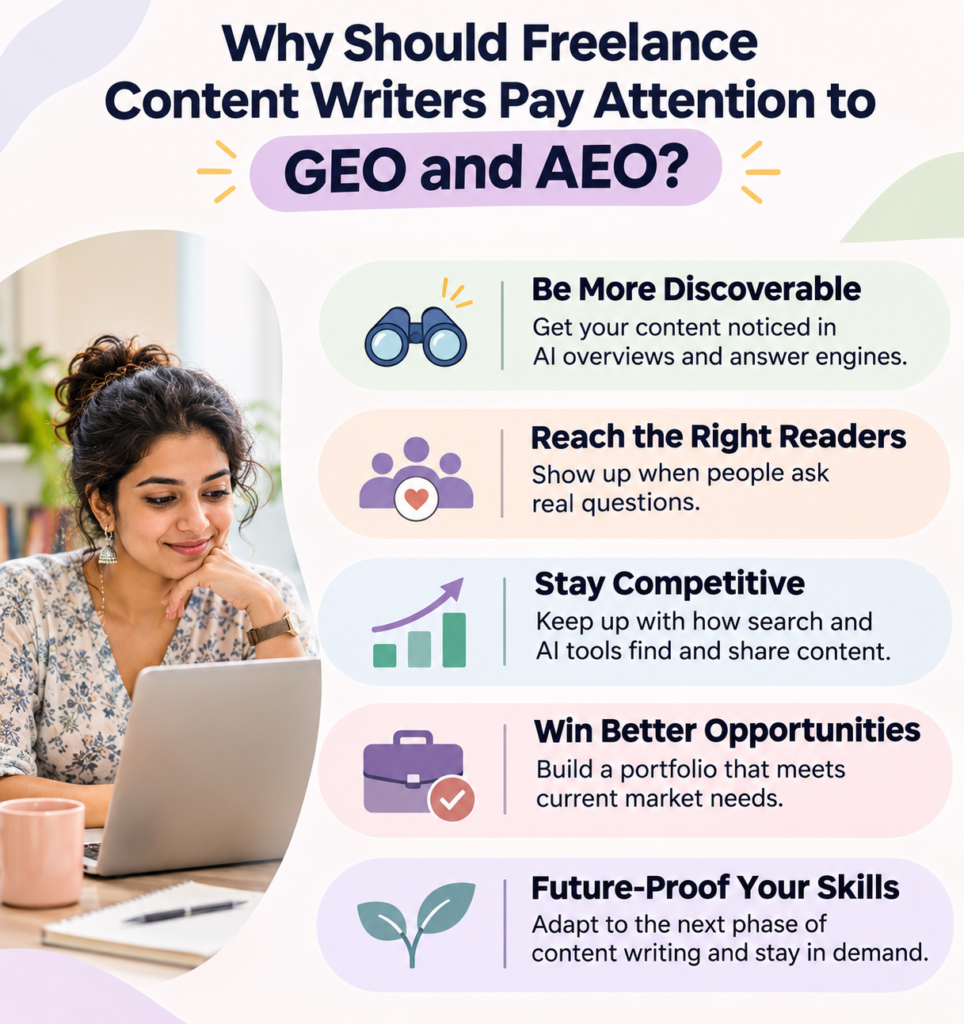
Why Should Freelance Content Writers Pay Attention to GEO and AEO?
You may wonder whether GEO and AEO are just more industry terms that will disappear after a few months. That's a reasonable question because terminology and individual platforms may change. However, the shift in how people discover information deserves attention.

Readers may get answers without visiting your website

Imagine someone searching for "What is multifactor authentication?" An AI-powered search tool may explain the concept in a few paragraphs. The reader may not need to open a separate article to understand the basic definition.

If your article only defines multifactor authentication, what additional value does it offer? You could explain how MFA works, compare authentication methods, discuss common implementation mistakes, and show how a small business can introduce it.

The definition provides basic information, but the additional details give readers a reason to explore the website.

Questions to consider:
Does my article offer more than a basic definition?Can readers learn something beyond a short AI-generated summary?Have I included practical information that helps them make a decision?
Rewriting existing information isn't enough

Search for almost any popular topic, and you'll find dozens of articles covering similar points. Freelance writers often study top-ranking results and build outlines around what competitors have published. Competitor research is useful, but repeating the same structure and covering the same points doesn't automatically produce valuable content.

Suppose a client asks you to write about "How to Become a Freelance Content Writer." Most articles discuss choosing a niche, creating a portfolio, finding clients, and setting rates. These are important subjects, but what else could you offer?

You could include a sample portfolio structure for someone without paid experience, an example of a client enquiry and a professional response, a sample content writing quotation, and common mistakes writers make when accepting their first assignment. You could also explain how to calculate the price of a 1,000-word article.

These additions make the article more useful because they help readers apply what they've learned.

Ask yourself: What can I add that isn't already covered by competing articles?

Clients need more than keyword-focused articles

Businesses want content that helps customers understand their products, solve problems, compare options, and make decisions. A client who hires you to write about cloud security doesn't need another article filled with generic statements about the importance of cybersecurity.

They need content that explains the risks, identifies suitable solutions, and helps their target audience understand what to do next.

As a freelancer, you can offer more than article production. You can help clients identify content gaps, develop useful outlines, research relevant questions, and improve existing website content.

Original research and professional experience matter

AI tools can generate summaries and explanations quickly, but they don't automatically have access to your professional experiences, client interactions, observations, or original research.

For example, a freelance writer who has worked with several clients may have noticed a recurring problem: clients often provide keywords but fail to share brand guidelines or prohibited terminology. That observation can become a useful section in an article about content briefs.

It adds a perspective that a generic explanation may not offer.

Think about this: What have you learned from your assignments that could help another writer or business owner avoid a mistake? You don't need to be a researcher or industry expert to offer useful insights. You need to observe, verify, explain, and share relevant experiences honestly.
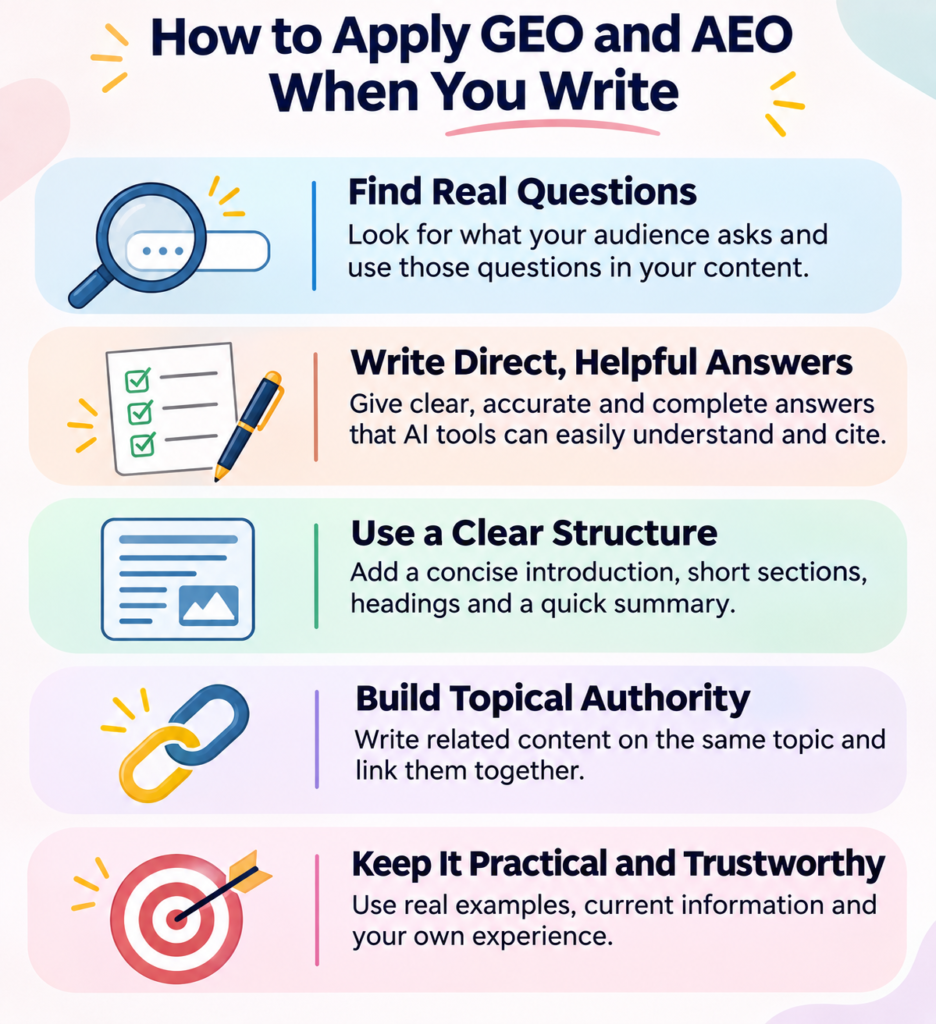
How to Apply GEO and AEO When You Write
Once you have the necessary information from your client, you can begin the research and writing process. Here are practical steps to follow with your next assignment.Step 1: Understand the reader before researching keywords
Let's continue with the email marketing example. Your client wants to attract small business owners who are considering email marketing services.

A small business owner may not understand email automation, segmentation, open rates, or conversion tracking. They may simply want to know how to send promotional emails to existing customers.

Start by identifying the reader's needs. What do they already know about the subject? What problem are they trying to solve? What information would help them take action?

Now compare two possible introductions.
Generic approach:
"Email marketing is an important digital marketing strategy that helps businesses connect with their customers and increase engagement."Reader-focused approach:
"Do you have a list of customer email addresses but don't know what to send them? Small businesses can use email marketing to share product updates, announce offers, collect feedback, and encourage repeat purchases. The first step is to understand what your customers want to receive."

The second introduction addresses a specific situation. It speaks to the reader rather than simply introducing a keyword.
Put this into practice: Before writing your next article, describe the reader's problem in one sentence. Use it to guide your research and outline. If the audience isn't clear, ask your client for clarification.Step 2: Build a question bank
AEO requires you to understand how people phrase their questions. Don't limit your research to the primary keyword. Use Google Autocomplete, People Also Ask, relevant forums, customer reviews, and keyword research tools to identify questions related to your subject.

For the email marketing example, your question bank might include:
How can a small business start email marketing?How often should a business send marketing emails?What should a promotional email contain?How do I build an email subscriber list?Is email marketing expensive?How can I measure email campaign performance?
Now group these questions according to the reader's concerns.Reader’s concern | Questions to address |
Getting started | How do I start email marketing? |
Planning | How often should I send emails? |
Content creation | What should a promotional email contain? |
Audience building | How do I build an email list? |
Budget | How much does email marketing cost? |
Measurement | How do I measure campaign performance? |
This gives you a natural article structure and helps you avoid sections that don't address the reader's needs.Put this into practice: Collect at least five relevant questions before preparing your next outline. Choose questions that genuinely help the reader rather than adding them simply to increase keyword coverage.Step 3: Give direct answers before expanding
One common writing mistake is taking too long to answer a question. Consider this heading:What is email segmentation?
A writer might begin with a long introduction about the history of email marketing, customer relationships, and personalized communication. But the reader wants to know what email segmentation means.

A better approach would be:

"Email segmentation is the practice of dividing an email subscriber list into smaller groups based on shared characteristics, interests, or behavior. Businesses can use these groups to send more relevant messages instead of sending the same email to everyone."

Now expand the explanation. An online clothing store could segment subscribers based on previous purchases, preferred product categories, location, shopping frequency, or customer interests. It could then send relevant product updates to different groups. The answer is direct, while the additional explanation provides useful context.
Put this into practice: Look at every H2 and H3 in your draft. Check whether the opening paragraph directly addresses the heading. If it doesn't, consider rewriting it.Step 4: Make your headings meaningful
Headings should help readers understand what each section covers. Avoid headings that sound attractive but provide little information.Vague heading | More useful heading |
The Right Way | How to Build an Email Subscriber List |
Things to Remember | Five Email Marketing Mistakes Small Businesses Should Avoid |
Making It Work | How to Improve Email Campaign Performance |
What You Need | Essential Features to Look for in an Email Marketing Tool |
The second column tells readers exactly what to expect. It also organizes the article around specific subjects and questions.However, don’t turn every heading into a long search query. Write naturally and keep each heading relevant to its section.
Put this into practice: Read your headings without the paragraphs. Can you understand the article's structure? If not, rewrite them.Step 5: Include examples that readers can use
Examples make abstract information easier to understand. Suppose you're writing about creating strong calls to action (CTAs). You could explain that a CTA encourages readers to take a specific action. That's correct, but it doesn't teach much.

Instead, show readers the difference.
Weak CTA: Click here.More specific CTA: Download the free email marketing checklist.
Another example: Book a 20-minute consultation to discuss your email marketing strategy.
Each example tells the reader what will happen when they click. You can use this approach across different assignments. For a cybersecurity article, show a sample phishing email and explain its warning signs. For a personal finance article, demonstrate how to calculate monthly expenses. For a product review, explain how a particular feature affects the user's experience.Put this into practice: Include at least two relevant examples in your next long-form article. Make sure they explain the subject rather than simply decorate the page.Step 6: Add original insights instead of repeating competitor content
This is particularly important for GEO. Imagine you're writing an article about content writing rates. You research five competing articles, and all five discuss word count, experience, niche, and project complexity.

You could repeat those points, but you can also add a practical pricing exercise.

Consider this example. A freelance writer receives an assignment to write a 1,000-word article, and the client offers $20. Before accepting, the writer should consider the research time, whether the assignment requires interviews or paid sources, how many revisions are included, and whether SEO optimization or image research is expected.

A 1,000-word article isn't necessarily a two-hour assignment. The writer should calculate the total time and effort before deciding whether the fee is reasonable.

This example adds a practical dimension to a familiar subject.
Ask yourself these three questions:
What is missing from the articles I've researched?What have I personally observed about this topic?Can I provide an example, comparison, or explanation that makes the subject easier to understand?
Don't invent experiences or present assumptions as facts. Use original insights that you can support.Step 7: Support your claims with reliable sources
A well-written article can still lose credibility if it contains inaccurate information. Suppose you're writing about ransomware attacks and mention that a particular percentage of organizations experienced an attack during the previous year. Where did that number come from?

Was it published in a cybersecurity report? Was it based on a survey? What year did the research cover? Does the statistic refer to all businesses or a particular group?

These details matter.

Use original research, government publications, industry reports, academic papers, and recognized experts. For example, a writer covering cybersecurity can refer to Verizon's Data Breach Investigations Report, IBM's Cost of a Data Breach Report, CISA publications, and ENISA threat landscape reports.

Don't simply copy a statistic from another blog. Find the original report and verify its context. Distinguish between a verified fact, an expert opinion, and your own interpretation.
Put this into practice: Highlight every number, research finding, and factual claim in your article. Verify its source before submission.
Step 8: Explain complex subjects in simple language
GEO and AEO don't mean that you should write in a robotic question-and-answer format. Your content should still sound natural and suit its audience.

Consider this example.
Technical version:
"Endpoint detection and response solutions continuously monitor endpoint activities to identify suspicious behavior and facilitate threat investigation and remediation."Simpler version:
"Endpoint Detection and Response (EDR) tools monitor devices such as laptops and desktops for suspicious activity. Security teams can use these tools to investigate potential attacks and respond before the threat spreads."

The second explanation is easier for a non-technical reader to understand. You can then explain how EDR works, provide an example of suspicious activity, and discuss its limitations.

Don't remove important technical details just to make an article shorter. Explain them properly.
Put this into practice: Identify three sentences in your next draft that a beginner might struggle to understand. Rewrite them without changing their meaning.Step 9: Use tables and lists when they improve understanding
Not every section needs to be written as a paragraph. Suppose you're comparing three email marketing platforms. A table can help readers compare pricing, automation features, integrations, and subscriber limits.

A step-by-step list also works well for tutorials.
How to create a basic email campaign:
Identify the campaign objective.Select the target subscriber group.Write a relevant subject line.Prepare the email content.Add a clear CTA.Test the email before sending.Review campaign performance.
Readers can follow the process without searching through a long paragraph. Use tables and lists when they make information easier to understand, not simply because you think AI systems prefer a particular format.Put this into practice: Review your draft and identify one section that would be easier to understand as a table, comparison, or numbered list.
Step 10: Review the article for completeness
Writers often finish an article after covering everything in their outline. But completing an outline doesn't necessarily mean answering the reader's questions.

Consider an article about choosing a website hosting provider. It may cover hosting types, pricing, and storage. But what about customer support, backups, uptime, scalability, and security? A reader making a purchase decision needs this information.

Review your article from the reader's perspective. Can they make an informed decision after reading it? Have you explained the advantages and limitations? Are there important questions you haven't answered? Have you included practical examples and explained what the reader should do next?

Put this into practice: Imagine you're the reader. Write down three questions you would still have after reading the article. If they're relevant, address them before submission.
Why Technical SEO Still Matters for GEO and AEO
Freelance writers don't need to become technical SEO experts, but they should understand that content must be accessible to search engines before it can gain visibility. The same applies to content we hope AI-powered search tools will discover and reference.

Before submitting an article, check whether it has a descriptive title, relevant meta description, clear headings, meaningful internal links, and descriptive image alt text. Also, confirm with the client or SEO team that the page is indexable and its main content is available as readable text.

The technical team usually handles crawling, indexing, mobile usability, and structured data. Writers should understand these basics so they can coordinate with the right people when something needs attention.

Google's official guidance confirms that established SEO practices remain relevant to AI Overviews and AI Mode. For a page to appear as a supporting link in these features, it must be indexed and eligible to appear in Google Search with a snippet. The website must also be included in Google's Search generative AI features.

Google doesn't require a separate GEO schema, special AI file, or different writing format to appear in these features. It recommends useful, reliable content, clear sourcing, accurate information, and a sound technical structure.

As freelance writers, our responsibility is to create useful, well-structured content. The website owner or technical SEO team must ensure that the website meets the technical requirements and can be discovered by search systems.
Your GEO and AEO Checklist Before Submitting an Article
Use this three-column checklist to review your article at each stage of the writing process.
Before Writing
Done | Checklist item | What to check |
☐ | Understand the assignment | Have I understood the client's expectations? |
☐ | Identify the audience | Do I know who will read the article? |
☐ | Understand the reader's problem | What question or problem should the article address? |
☐ | Clarify the purpose | Do I understand the article's objective? |
☐ | Review brand guidelines | Have I checked the preferred tone and prohibited terms? |
☐ | Research keywords | Have I identified the primary and secondary keywords? |
☐ | Find reader questions | Have I identified relevant questions readers may ask? |
☐ | Study competing content | Have I identified information gaps? |
☐ | Collect reliable sources | Do I have credible sources to support the article? |
☐ | Prepare the outline | Does it cover the reader's actual needs? |
While Writing
Done | Checklist item | What to check |
☐ | Write a relevant introduction | Does it address the reader's concern? |
☐ | Use descriptive headings | Does each section answer the question in its heading? |
☐ | Explain technical terms | Can the intended audience understand them? |
☐ | Include practical examples | Have I made the explanations useful and relatable? |
☐ | Add original insights | Does the article offer observations or analysis beyond generic information? |
☐ | Support important claims | Have I included credible evidence? |
☐ | Structure information clearly | Have I used tables and lists where useful? |
☐ | Avoid repetition | Have I removed unnecessary content and keyword stuffing? |
☐ | Follow brand guidelines | Does the article match the client's voice and style? |
Before Submission
Done | Checklist item | What to check |
☐ | Fact-check the article | Have I verified important claims and statistics? |
☐ | Review readability | Can a beginner understand the main explanations? |
☐ | Check content depth | Does the article offer value beyond generic information? |
☐ | Review reader questions | Have I answered the most relevant questions? |
☐ | Check headings | Are they clear and descriptive? |
☐ | Review links | Have I included relevant internal and external links? |
☐ | Check SEO metadata | Are the SEO title and meta description accurate? |
☐ | Include a next step | Does the article give readers a useful action to take? |
☐ | Review client requirements | Have I met all the assignment requirements? |
GEO and AEO shouldn’t turn writing into a mechanical checklist exercise. Use these checks to make your content clearer, more useful, and more valuable to readers.
To Sum Up
GEO and AEO don't require freelance writers to abandon what they already know. They require us to apply our research, writing, and critical thinking skills more carefully. Focus on answering real questions, verifying information, adding original insights, and making every article useful to its readers. Search technologies may change, but good writing still depends on accuracy, clarity, relevance, and value. Ultimately, don't measure your work by how many words you write, but by what readers gain from them.
Sources
- Google Search Central: Optimizing your website for generative AI features on Google Search
- Google Search Central: Attribution and factuality in Search generative AI features
- Google Search Console Help: Generative AI performance report
- Google Search Central: Control how your content is used for generative AI at Google
One Response