Do writers need to know every grammar rule to write well? After more than 25 years as a professional writer, I don’t think so. I still pause, check a word, or look up a grammar rule when I’m unsure. Knowing grammar and writing effectively aren’t always the same thing. Whether you’re an aspiring story writer, content writer, or experienced professional, you need enough grammar knowledge to communicate clearly and recognize when a sentence isn’t working. AI and grammar tools can suggest corrections, but they can’t replace your judgment. So, how much grammar do writers really need to know? Enough to write clearly, question suggestions, and make informed choices.
Table of Contents
ToggleThis blog is for aspiring writers who are still finding their way with grammar, content writers who want to write with more clarity, and story writers who don’t want grammar rules to restrict their creativity. It’s also for experienced writers who occasionally stop mid-sentence and wonder, “Is this actually correct?” If you’ve ever wondered how much grammar you really need to know, especially when AI and grammar tools are always within reach, this article is for you.
What Does Knowing Grammar Really Mean for a Writer?
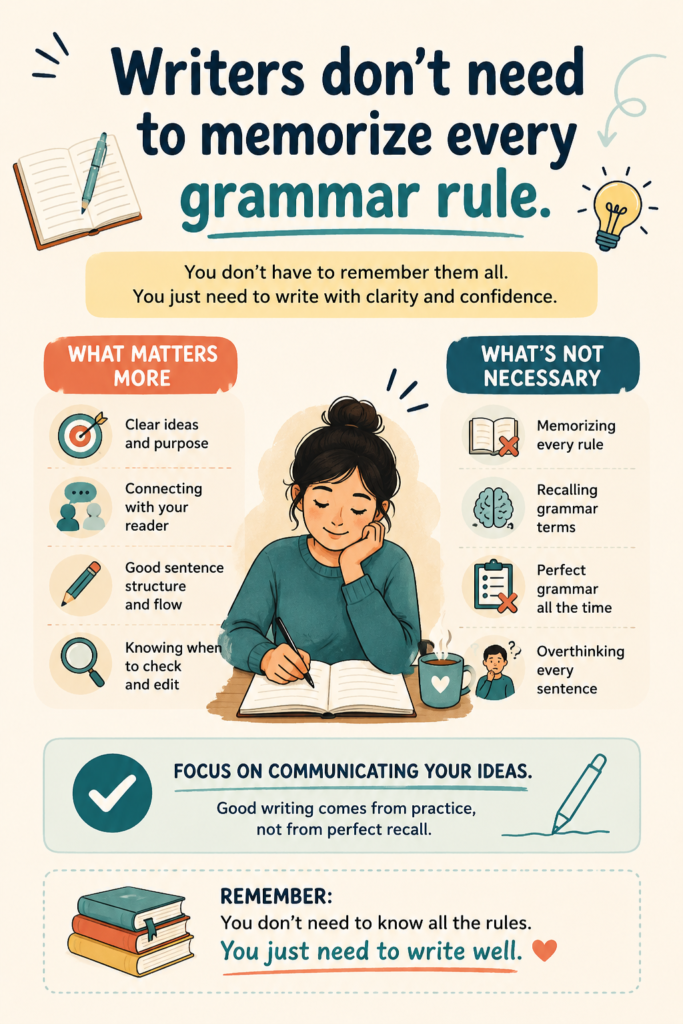
When we say a writer should “know grammar,” what exactly do we mean? Does it mean being able to name every tense, explain the difference between a phrase and a clause, or recall every punctuation rule without looking it up? Not necessarily. For a writer, knowing grammar is less about proving how many rules you remember and more about knowing how to use language to express an idea clearly. It’s the ability to build sentences that say what you intend, notice when something sounds unclear, and make changes without losing your natural voice. You may not always remember the technical term for what you’re doing, but you understand how your choice of words, sentence structure, and punctuation affects the person reading them.
- Knowing Grammar Is More Than Memorizing Rules
You don’t need to remember the name of every tense or explain every grammatical term to be a good writer. What you do need is an understanding of how sentences work.
For example:
“She don’t know why the meeting was cancelled.”
You may not stop to think about subject-verb agreement, but you probably know that “She doesn’t know” sounds right. That’s grammar knowledge at work.
The same applies when you’re writing a story, blog post, or client article. Knowing grammar helps you spot something that doesn’t sound quite right, even if you can’t immediately name the rule behind it.
- Understanding How Language Communicates Meaning
Grammar isn’t only about whether a sentence is correct. It also affects what the sentence means.
Consider these two sentences:
“Let’s eat, Grandma.” means you are inviting Grandma to join you for a meal. The comma shows that you are speaking directly to her.
“Let’s eat Grandma.” without the comma suggests something very different—it sounds like you are suggesting eating Grandma herself.
One small comma changes the meaning completely. It’s an exaggerated example, but it shows why punctuation and sentence structure matter.
As writers, our job is to make sure the reader understands what we intended to say. If a reader has to go back and read a sentence twice because the meaning isn’t clear, the problem may not be the idea. It may simply be how the sentence is structured.
- Developing an Instinct for What Works
The more you write, read, and edit, the more you begin to develop an instinct for language. You start noticing when a sentence feels too long, when a word doesn’t quite fit, or when punctuation interrupts the natural flow.
For instance:
“The article that I wrote last week, which was about grammar and was written for new writers, received a lot of responses.”
There’s nothing terribly wrong with the sentence, but it feels heavy.
You might naturally rewrite it as:
“Last week, I wrote an article about grammar for new writers. It received a lot of responses.”
That’s the instinct writers develop over time. It’s not about showing how much grammar you know. It’s about making choices that help your readers move through your words without struggling to understand them.
And that, to me, is what knowing grammar as a writer really means.
This section builds on the previous one by moving from what knowing grammar means to why that knowledge matters in real writing.
Why Does Grammar Matter for Writers?
When you write, you already know what you want to say. Your reader doesn’t. They have only the words you put on the page to understand your thoughts, ideas, or story. Grammar helps those words carry your intended meaning from your mind to theirs.
This is why grammar matters whether you’re writing a novel, a blog post, website copy, an email, or an article for a client. The purpose and style may change, but the need to be understood doesn’t. Good grammar works quietly in the background. Readers may not notice when you get it right, but they often notice when something goes wrong.
- Grammar Helps Writers Communicate Clearly
At its simplest, grammar gives structure to our thoughts. It helps us show who did what, when something happened, and how one idea connects to another.
Consider this sentence:
“After speaking to Riya, Meera said she would send the manuscript.”
This sentence confuses the reader because the pronoun “she” is unclear. It could refer to either Meera or Riya, so the reader cannot be sure who is supposed to send the manuscript.
Who is sending the manuscript, Riya or Meera?
The sentence is grammatically possible, but the pronoun “she” makes the meaning unclear. A simple rewrite solves the problem:
“After speaking to Riya, Meera said, ‘I’ll send the manuscript.'”
As writers, we shouldn't make readers work harder than necessary to understand what we mean. Clear grammar helps keep the reader focused on the idea or story rather than on figuring out the sentence.
- Grammar Prevents Misunderstandings
Sometimes, a small grammatical or punctuation error can communicate something entirely different from what we intended.
Imagine a content writer preparing this sentence for a company’s website:
“We offer services for businesses that are affordable.”
What is affordable, the businesses or the services?
A clearer version would be:
“We offer affordable services for businesses.”
In a story, ambiguity might occasionally be intentional. In content, business, or professional writing, however, unintended ambiguity can confuse the reader and weaken the message.
Grammar gives us the tools to remove that confusion before it reaches the reader.
Good Grammar Makes Writing Easier to Read
Have you ever read a paragraph that was technically correct but still felt exhausting? Long sentences, inconsistent tenses, misplaced punctuation, and too many ideas packed together can make readers lose track of what the writer is trying to say.
Good grammar isn’t about making every sentence perfect or formal. It’s about creating a natural flow from one thought to the next.
Compare:
“The writer finished the article she checked the grammar there were several mistakes which she corrected before she sent it to the client.”
With:
“The writer finished the article and checked the grammar. She found several mistakes and corrected them before sending it to the client.”
The information hasn’t changed. But the second version gives the reader space to process each idea.
When grammar supports readability, readers spend less time untangling sentences and more time engaging with what you have to say.
Grammar Supports a Writer’s Credibility
As writers, our words are often the first thing people see of our work. A potential client may read your website. An editor may review your manuscript. A reader may discover your blog through a search result.
An occasional typo won’t destroy your credibility. We all make mistakes. But frequent grammatical errors can distract readers and make them question the care that went into the writing.
For professional writers and content writers, this becomes even more important because clients are trusting us with their message. For story writers, grammar helps keep readers inside the world we’ve created rather than pulling them out of the story with confusing sentences.
Good grammar doesn't make someone a good writer on its own. Creativity, ideas, research, empathy, and storytelling all matter. But grammar gives those qualities a clear structure through which they can reach the reader. And ultimately, that's what we want our writing to do.
How Much Grammar Does a Writer Actually Need to Know?
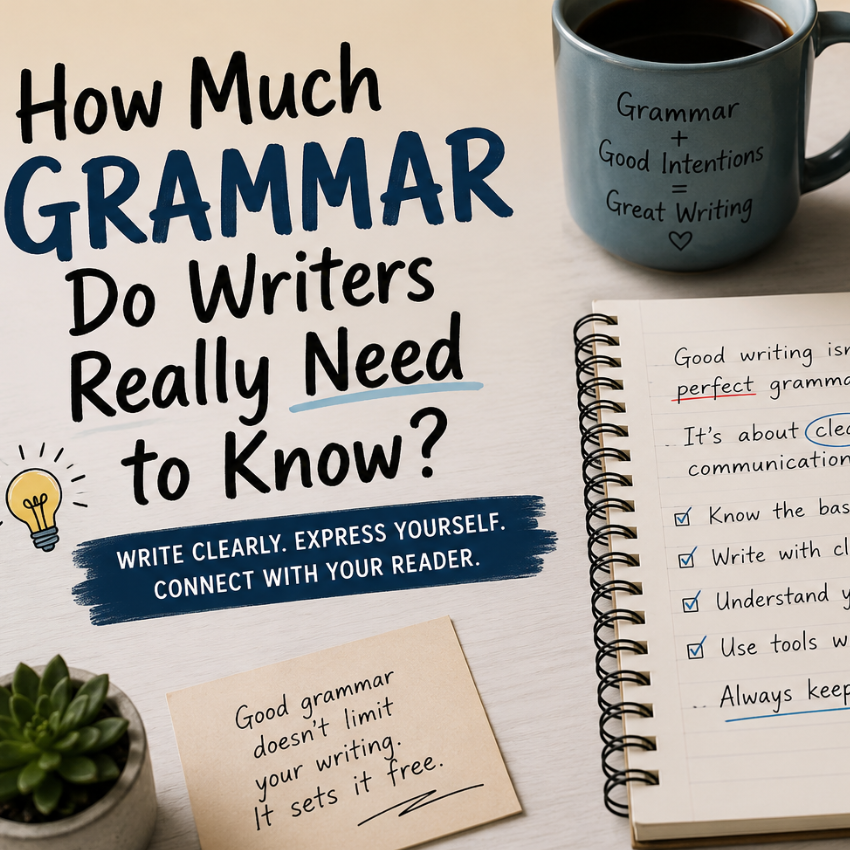
If you’ve ever hesitated to call yourself a writer because your grammar isn’t perfect, here’s something worth remembering: you don’t need to know everything before you start writing. I have spent more than 25 years working with words, and I still look things up when I’m unsure.
The amount of grammar you need also depends on what you write. A novelist, content writer, journalist, copywriter, and academic writer may all use the same language, but they use it differently. What matters is having enough grammar knowledge to express your ideas clearly, recognize common mistakes, and make informed choices about your writing.
You Don’t Need to Know Every Grammar Rule
English grammar is vast, and some of its rules can confuse even experienced writers. Trying to memorize every rule before you consider yourself a “good writer” isn’t practical.
Think about how you write every day. You probably use nouns, verbs, pronouns, different tenses, and punctuation without consciously identifying each one. You don’t stop before every sentence and think, “Am I using the present perfect tense correctly?” Much of what you know about language is already working in the background.
The goal isn’t to become a walking grammar handbook. It’s to understand enough to notice when something isn’t right and know how to fix it.
You Should Understand the Rules You Use Every Day
While you don’t need to know every grammar rule, some basics are difficult to avoid as a writer.
You should be comfortable constructing a complete sentence, maintaining consistent verb tenses, matching subjects with verbs, using pronouns clearly, and handling everyday punctuation. These are the building blocks of most forms of writing.
For example:
“The team of writers are working on the project.”
It may sound acceptable at first, but the subject is “team,” which is singular in American English in this context. The sentence should be:
“The team of writers is working on the project.”
These are the kinds of grammar rules writers encounter regularly. Understanding them helps you catch problems during editing rather than depending entirely on a tool to find them for you.
Knowing When to Look Something Up Is a Skill
One of the most useful things I’ve learned as a writer is that there’s nothing wrong with checking.
Is it “affect” or “effect”? Should there be a comma here? Is this word hyphenated? Have I used “who” when it should be “whom”?
Sometimes you know the answer immediately. Sometimes you don’t.
A good writer isn’t someone who never has grammar questions. A good writer recognizes uncertainty and takes the time to find the answer. Dictionaries, grammar references, and style guides are there to be used.
Even when an AI or grammar tool gives you an answer, it’s worth understanding why a change is being suggested. That way, you’re not simply correcting one sentence. You’re learning something you can apply the next time you encounter a similar situation.
Your Grammar Knowledge Should Match the Writing You Do
Not every writer needs the same depth of grammar knowledge.
If you’re a content writer, clarity, readability, sentence structure, and consistency may be your priorities. If you write professionally for clients, you may also need to understand the style guide they follow.
Story writers have different considerations. Dialogue, for instance, doesn’t always follow formal grammar because real people don’t speak in perfectly structured sentences. A character might say, “Ain’t nobody going to tell me what to do,” and that could be exactly right for the character, even though it wouldn’t belong in a formal business report.
Academic and technical writers may need greater precision and a more formal approach to grammar and sentence structure.
So, how much grammar does a writer actually need to know? Enough for the kind of writing you do, and enough to recognize when your knowledge isn’t enough for the sentence in front of you.
You don’t have to know every answer. But you should know when to ask the question.
This section can be conversational and practical, without turning into another grammar lesson. It also helps show readers that grammar isn’t one-size-fits-all.
Does the Type of Writing Change How Much Grammar You Need?
Yes, it does. The grammar basics remain the same, but how strictly you apply them often depends on what you’re writing, who you’re writing for, and where your words will appear.
As writers, we move between different kinds of writing more often than we realize. You might write a formal email in the morning, work on a conversational blog post in the afternoon, and share a casual social media post later in the day. You wouldn’t use exactly the same tone or sentence structure for all three.
The key is to understand your audience and purpose. Grammar should support your writing, not make every piece of content sound the same.
- Grammar for Blog and Content Writing
When you’re writing a blog or online article, clarity and readability usually come first. Your reader may be scanning the page on a phone or looking for a quick answer to a question. Long, complicated sentences can make even a useful article difficult to follow.
This doesn’t mean grammar becomes less important. It means you use it in a way that makes your writing easier to read. Shorter paragraphs, contractions, direct sentences, and a conversational tone can all work well.
As a content writer, I often ask myself a simple question: Would I say this naturally if I were explaining the topic to someone sitting across from me? If the answer is no, I usually take another look at the sentence.
- Grammar for Professional and Business Writing
Professional writing generally needs more consistency and precision. Whether you’re writing a report, proposal, business email, or website copy for a client, unclear language can create misunderstandings.
Here, you may need to pay closer attention to sentence structure, punctuation, word choice, and the style guide your organization or client follows.
But professional doesn’t have to mean stiff. A sentence can be grammatically sound and still feel natural. The goal is to communicate clearly while maintaining the level of formality your audience expects.
- Grammar for Social Media and Conversational Content
Social media has made our writing more conversational. We use shorter sentences. Fragments. Sometimes even a single word. And that’s okay.
A sentence fragment used deliberately for emphasis is different from a writer not knowing that the sentence is incomplete. Conversational content gives you more freedom to play with sentence structure, but clarity still matters. If breaking a conventional grammar rule makes your message sound more natural without confusing the reader, it may be a conscious style choice.
The important word here is conscious. You know what you’re doing and why you’re doing it.
- Grammar for Creative Writing
Creative writers probably have the greatest freedom with grammar, but that freedom comes with its own responsibility. Characters don’t always speak in grammatically perfect sentences. They interrupt each other, use slang, leave thoughts unfinished, and speak in ways that reflect their background and personality. Making every line of dialogue grammatically perfect could actually make a story feel less believable.
Narrative writing also allows writers to experiment with fragments, sentence length, and punctuation to create rhythm or emotion.
But even in creative writing, grammar provides the foundation. You need to know when you’re breaking a convention for a reason and when a sentence is simply unclear.
Whatever type of writing you do, the question isn’t always, “Is this grammatically perfect?” Sometimes the better question is, “Does this grammar work for what I’m writing, who I’m writing for, and what I’m trying to say?”
Knowing the difference is part of growing as a writer.
Does AI Reduce the Need to Learn Grammar?
I sometimes wonder what my early years as a writer would have been like if I had access to the tools we have today. Back then, when I wasn’t sure about a word or a grammar rule, I had to look it up. There was no instant answer waiting in a chat window.
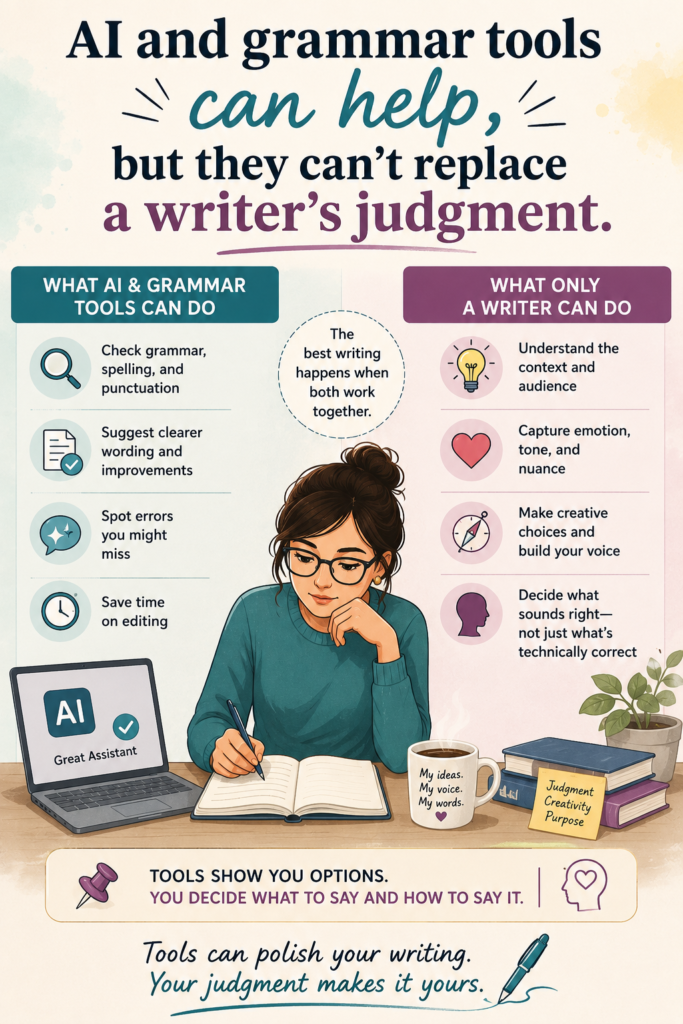
Today, AI can correct a sentence before we’ve had time to think about what’s wrong with it. That’s incredibly useful. I use AI tools too, and I appreciate how much time they can save. But as someone who has spent more than 25 years working with words, I don’t believe AI has made grammar knowledge less important.
The way I see it, the tool may have changed. The writer's responsibility hasn't.
How AI Is Changing Grammar Checking and Editing
AI has made editing faster and more accessible. You can ask it to check a sentence, improve clarity, change the tone, or suggest a better way to express an idea. For an aspiring writer who isn’t confident about grammar, that kind of support can be reassuring.
But convenience can also make us a little too trusting.
If a tool rewrites a sentence and we accept it without reading it carefully, we may end up with something that is technically correct but doesn’t sound like us. Sometimes the meaning shifts slightly. Sometimes a perfectly natural sentence becomes unnecessarily formal. And sometimes the suggestion simply isn’t right for the context.
AI can help us edit. But we still need to stay involved in the writing.
The Difference Between Getting a Correction and Understanding It
Imagine you’ve written a sentence incorrectly and AI fixes it for you. You click “accept” and continue writing.
Your sentence is now correct. But have you learned anything?
Probably not.
I’ve always believed that mistakes can teach us a great deal as writers, provided we understand why we made them. When you stop for a moment and find out why a sentence was wrong, there’s a better chance you’ll recognize the same problem the next time.
That’s the difference between correcting your writing and improving as a writer.
Using AI to Learn Why a Sentence Is Wrong
This is where I think AI can be genuinely helpful for writers who want to improve their grammar.
Instead of asking only, “Can you correct this sentence?”, ask:
“Why is my sentence incorrect?”
“What grammar rule applies here?”
“Are both versions grammatically acceptable?”
“Does your correction change what I’m trying to say?”
“Can you explain the mistake in simple language?”
I've found that the quality of the answer often depends on the question we ask. When we ask AI to explain rather than simply correct, we can use it as a learning tool.Of course, AI can also make mistakes. For important or disputed grammar questions, it’s worth checking a reliable dictionary, established style guide, or trusted grammar reference rather than treating an AI response as the final authority.
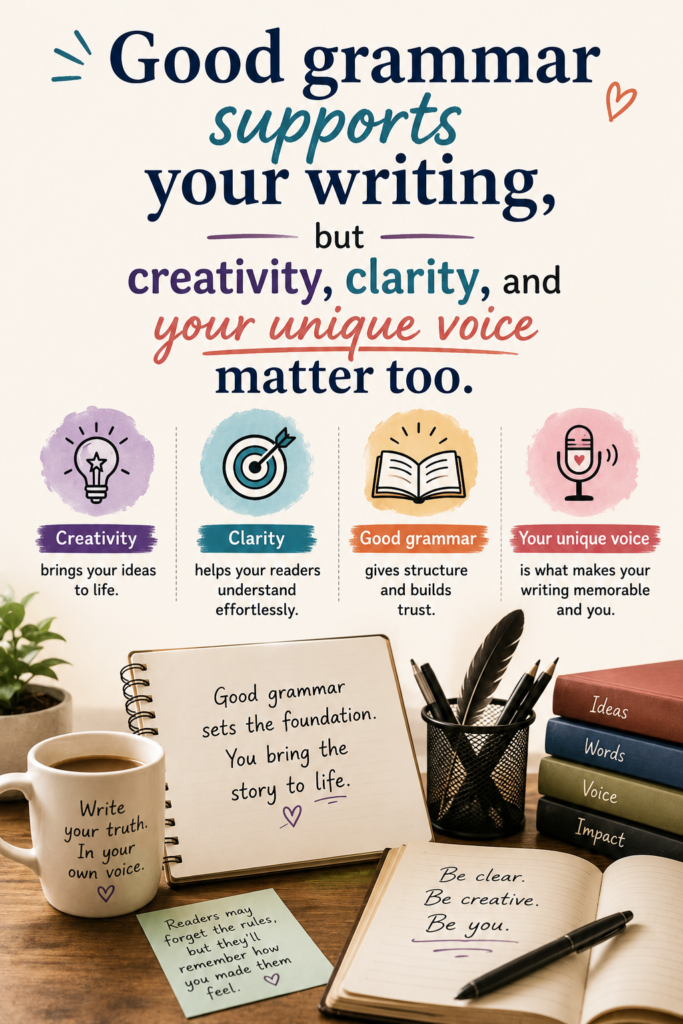
Why Writers Still Need to Make the Final Decision
This, for me, is the most important part.
AI doesn’t know your story the way you do. It doesn’t know your reader as well as you do. And it doesn’t always understand why you deliberately chose a particular word, pause, fragment, or turn of phrase.
A grammar tool may look at a sentence and see something to correct. As the writer, you may see a character’s personality, a moment of hesitation, a particular rhythm, or simply your own voice.
That’s why we still need enough grammar knowledge to question what a tool suggests.
Ask yourself: Is the suggestion grammatically correct? Does it preserve my meaning? Does it sound like me? Is it right for my reader?
Sometimes you’ll accept the suggestion. Sometimes you’ll rewrite the sentence yourself. And sometimes you’ll decide that what you originally wrote is exactly how you want it. AI can be a valuable writing companion. It can catch mistakes, offer alternatives, and help us understand grammar better. But it shouldn’t make us passive about our own words.
After all, AI can suggest how a sentence should be written. But only you know what you truly wanted to say.
To Sum Up
So, how much grammar do writers really need to know? After more than 25 years of writing, I still don’t believe the answer is “every rule.” You need enough grammar to express what you mean, recognize when something isn’t quite right, and make choices that serve your reader. The grammar you use may change depending on whether you’re writing a story, a blog, a social media post, or a professional document. What shouldn’t change is your commitment to clarity. And if you have to look up a rule occasionally, that’s perfectly normal. I still do. Writing has always been a process of learning, questioning, editing, and learning some more. AI and grammar tools have made that process easier, but they haven’t taken the writer out of writing. Use them to check your work, ask questions, and understand your mistakes. But don’t hand over your judgment completely. You don’t have to wait until your grammar is perfect to call yourself a writer. Write. Learn from what you write. Check when you’re unsure. And trust yourself enough to make the final decision about your own words. Because good writing isn’t about proving how many grammar rules you know. It’s about making sure the person on the other side of the page understands what you wanted to say.
Frequently Asked Questions
- Do you need good grammar to be a good writer?
Yes, writers need a good understanding of grammar, but that doesn’t mean knowing every rule by heart. Good writing also depends on clarity, ideas, creativity, storytelling, and understanding your reader. Grammar gives you the foundation to communicate those ideas without confusing your audience. - How much grammar does a content writer need to know?
A content writer should understand essential grammar skills such as sentence structure, subject-verb agreement, verb tense, pronouns, and punctuation. You should know enough to write clearly, recognize common errors, and edit your own work. When you’re unsure, knowing how and where to check is just as important. - Can I become a writer if my grammar isn’t very good?
Yes. You don’t have to wait until your grammar is perfect to start writing. Grammar can improve as you write, read, edit, and learn from your mistakes. What matters is being willing to recognize where you need help and continuing to develop your skills. - Can AI help me improve my grammar and writing skills?
Yes, AI can help you identify grammar mistakes, explain rules, and suggest clearer ways to write a sentence. But instead of simply accepting every correction, ask why a change was suggested. This helps you understand your mistakes and apply what you’ve learned to your future writing. - What grammar skills should every writer know?
Every writer should have a basic understanding of sentence structure, subject-verb agreement, verb tense, pronouns, punctuation, sentence fragments, run-on sentences, and active and passive voice. Writers should also watch for commonly confused words. You don’t need to master everything at once, but these basics will help you write with greater clarity and confidence.