
Why Long-Tail Keywords Matter in Voice Search SEO

I first noticed this change when I watched my daughter use voice search. She didn’t type a few keywords into Google. Instead, she picked up my phone and asked a complete question, just as she would ask another person. That’s when I realized that that people no longer search the way they used to. With voice assistants like Alexa, Siri, and Google Assistant becoming part of everyday life, the way people search has changed. Instead of typing a few words into a search engine, people ask complete questions and expect quick, accurate answers. This shift has made long-tail keywords in voice search SEO more important than ever. Think about the last time you used voice search. You probably didn’t say, “content writing” or “voice search SEO.” Instead, you asked something like, “How do I optimize my blog for voice search?” or “What are the best content writing tips for beginners?” People don’t speak in keywords. They speak naturally. Search engines have adapted to that behavior, and your content needs to do the same. Long-tail keywords help search engines understand user intent and connect your content with the questions people actually ask. If you want your content to appear in voice search results, AI-powered search, and featured snippets, long-tail keywords should become a key part of your SEO strategy. Therefore, you should be familiar with writing in conversational style so you rank in voice search What Are Long-Tail Keywords? Long-tail keywords are search phrases that contain three or more words. They are more specific than broad keywords and usually reflect a clear question, need, or intention. Although they may receive fewer searches than popular one or two-word keywords, they often attract people who are looking for a particular answer. Take the keyword voice search as an example. It tells you very little about what the user wants. They could be looking for a definition, examples, tools, or optimization techniques. Now compare it with a search such as How do I optimize my website for voice search? The second query leaves little room for guesswork. It tells search engines exactly what information the user expects to find. Short-Tail Keyword Long-Tail Keyword Voice search How do I optimize my website for voice search? Content writing How can I become a freelance content writer? SEO tools What are the best SEO tools for beginners? Antivirus Which antivirus software is best for small businesses? Long-tail keywords give search engines more context. They also help writers create focused content that answers a specific question instead of covering a broad topic without direction. Why Content Writers Should Focus on Long-Tail Keywords Many writers begin keyword research by looking for the highest search volume. While search volume is important, it should never be the only factor when choosing a topic. A better approach is to identify the questions your audience asks most often and build content around those questions. Each question can become a separate article that supports a broader pillar page. Over time, these articles create topical authority and strengthen your website’s overall SEO. For example, a pillar article about voice search optimization could link to supporting articles on conversational content, FAQ optimization, schema markup, voice search mistakes, and long-tail keywords. Each article answers one topic thoroughly while strengthening the others through internal links. This strategy benefits both readers and search engines. Readers find related information more easily, and search engines gain a better understanding of your website’s expertise. Why Voice Search Relies on Long-Tail Keywords Voice search has changed the way people interact with search engines. When people type, they often shorten their searches to save time. A typed search might look like voice search SEO or best laptop. The same person is more likely to ask, How do I improve my website for voice search? or Which laptop is best for graphic designers? when using a voice assistant. This difference matters because voice assistants are designed to understand natural conversations. They don’t simply match individual keywords. They analyze the complete question, understand the context, and identify the user’s intent before providing an answer. As a content writer, your goal should be to match the way people speak rather than the way they type. That doesn’t mean filling your article with random questions. It means anticipating the questions your audience is likely to ask and answering them clearly. When your content reflects natural speech, search engines can understand its relevance more easily, and voice assistants have a better chance of selecting it as a response. Long-Tail Keywords Reveal User Intent Understanding user intent is one of the most important parts of modern SEO. Search engines no longer rank pages simply because they contain a keyword. They want to know whether the page satisfies the reason behind the search. Imagine someone searches for content writing. That search could mean almost anything. The person might be looking for writing services, freelance jobs, online courses, salary information, or examples of good content. Now consider a search such as How do I start content writing with no experience? The intention is obvious. The user wants practical advice for beginners. The same principle applies across every industry. A search for cybersecurity is broad and open to interpretation. A search like How can a small business protect itself from phishing attacks? tells you exactly what the reader wants. Long-tail keywords reduce ambiguity. They help writers create content with a clear purpose, and they help search engines deliver results that closely match the user’s expectations. Long-Tail Keywords Are Easier to Rank For Every website wants to rank for broad keywords such as SEO, marketing, or content writing. Unfortunately, those keywords are also the most competitive. Large websites with years of authority, thousands of backlinks, and extensive content libraries often dominate those search results. Long-tail keywords offer a more realistic opportunity, especially for newer websites and independent bloggers. Instead of competing for voice search, you could target phrases such as How to write conversational content for voice search or Voice search SEO tips
What He Meant
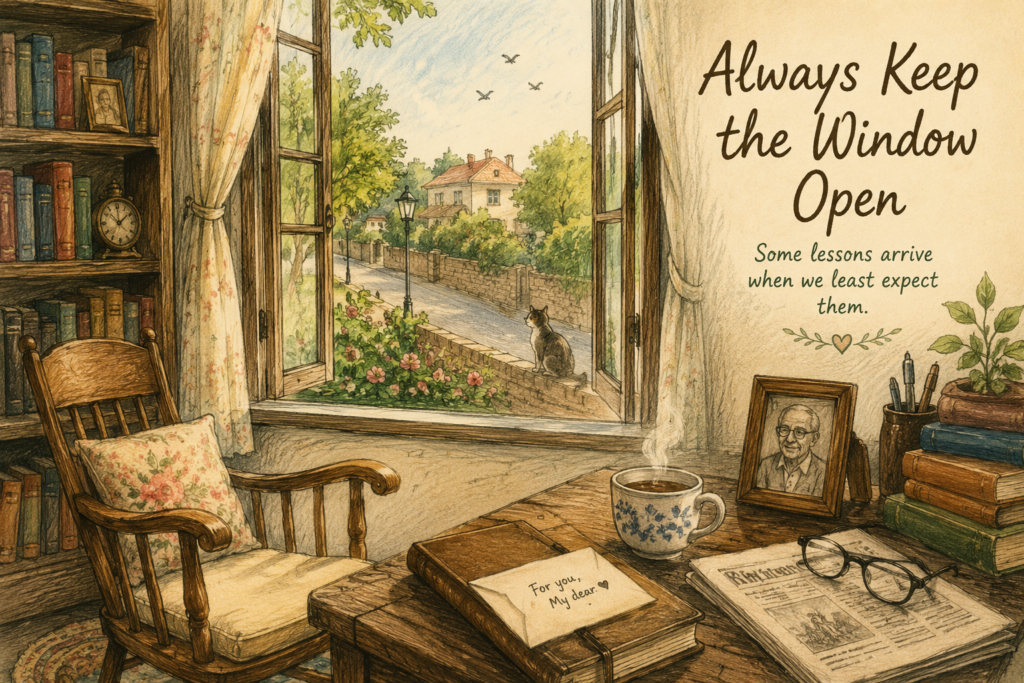
“I don’t know what he meant when he said, ‘Keep the window open.’”My grandfather said those words often.Whenever I visited him during my school holidays, I would find him in his study, sitting beside the large window. It was the brightest spot in the room and his favorite place during winter, when the afternoon sun warmed the wooden floor. But during the windy monsoon days, it was the coldest corner of the house. He never liked curtains on that window.His old wooden rocking chair sat beside it, with a soft cotton cushion that had taken the shape of his back over the years. A short carpet lay beneath his feet to keep them warm on chilly mornings.From there, he could watch people pass by on the road. Sometimes, he would have a one-sided conversation with the neighborhood cat that lazed on the compound wall. On other days, he would fill the little birdbath with water and scatter a few grains beside it. Every now and then, a few sparrows would land on the window rail, stay for a while, and fly away.It was his favorite place in the house.“Why don’t you close it when it gets windy?” I once asked.He looked at me over his glasses.“Because a closed window keeps everything out.”I thought he was talking about fresh air.I was twelve then. I didn’t think much about what he said.Years passed.I grew up, moved to another city, got a job, and became busy with my own life. My visits to my grandparents became less frequent. Phone calls replaced long afternoons at their house.Grandfather never complained.Whenever I called, he would ask about my work, my friends, and whether I was eating properly.Then one summer, I had a silly argument with Anu, my closest friend since school. We had grown up together, shared secrets, celebrated birthdays, and stayed in touch even after I moved to another city.The argument was over something so small that I can’t remember what it was now. What I remember is that neither of us wanted to be the first to say sorry. A few days later, Anu called. I saw her name on my phone but let the call go unanswered. I thought about calling her back that evening. I didn’t. A week later, I typed a message, read it twice, and deleted it. Neither of us called again. I told myself that if she really cared, she would call again. She didn’t.Around the same time, Grandfather called one evening. We hadn’t spoken in a few weeks, so I was happy to hear his voice.“When are you coming home?”“Soon,” I said.“You’ve been saying that for months.”I laughed. “I’ll come next month. I have a few days off for Diwali.”“Good. I’ll hold you to that.”We spoke about a few things after that. He asked about my work, reminded me to take care of myself, and told me about the new plants he had put in the backyard.Just before we ended the call, he said, “And keep the window open.”I laughed.“You still say that?”“Always.”I didn’t ask what he meant. I had heard him say it so many times that I had stopped wondering about it.A few months later, Grandfather passed away.After the funeral, I stood outside his study for a long time. I had walked past that door several times, but I couldn’t bring myself to go in. It felt strange to think that he would never be sitting in that rocking chair again, calling me over to show me something he had found in the newspaper.Finally, I placed my hand on the doorknob and turned it. I pushed the door open slowly.Everything inside looked just as I remembered it. His books were still arranged on the shelves, their spines worn from years of use. His reading glasses rested on the desk beside the newspaper he had been reading that morning. His wooden rocking chair stood beside the window, the cotton cushion still holding its familiar shape, with the little carpet beneath it. For a moment, the room felt as though he had only stepped away and would return any minute. But the window was closed. I walked over and opened it. The room filled with a gentle breeze that carried the fragrance of the roses in full bloom outside. I stood there for a moment, taking in the familiar scent and looking out at the road where Grandfather had spent so many hours watching people pass by. I curled up in his rocking chair for a while, running my fingers over the worn cotton cushion. I remembered the many afternoons he had spent there, reading the newspaper, watching people pass by, or simply sitting quietly with his tea.Then I noticed that the drawer of the small table opposite the chair was slightly open. I pulled it out and found a small envelope tucked beneath his diary. My name was written on it in his familiar handwriting.I held the envelope in my hands for a moment. Somehow, I knew there was something inside that I wasn’t quite ready to read.Reluctantly, I opened it.My dear Maya,You once asked me why I always kept this window open. I gave you an answer, but I never told you the whole story.When I was young, your grand-uncle and I had a terrible argument. Neither of us was willing to apologize. I waited for him to come to me, and he waited for me to go to him. We let our pride get in the way. One year became five. Five became ten. Before we knew it, twenty years had passed.When we finally met again to put away our differences, we were happy to see each other, but we couldn’t get back those twenty years.I often wondered what might have happened if one of us had simply taken the first step.That is why I keep this window open. Not just for the breeze or the birds. It reminds me to leave a little space for people. People will disappoint us. We will disappoint them too.
Just In Case

The picture above took me back to a July afternoon in my mother’s garden in Trivandrum. My mother has a few coconut saplings in her backyard. One afternoon, we noticed something unusual about one of them. The tender leaves at the center looked disturbed, the leaves were curling, one of the leaves was wilting as if it is dehydrated and one was turning brown from its base.She called her man Friday and asked him to check the coconut sapling. She also told him to bring his tools when he came, as the hibiscus, camellia, and a few other flowering shrubs needed pruning.That evening, he came over and took a closer look at the sapling. He examined the tender leaves and the center of the plant and told my mother there are pest inside the sapling and it requires spraying.A couple of days later, he came with a garden sprayer. He filled it with a medicine meant for coconut trees and carefully sprayed it into the tender leaves.We stood there watching. A few moments later, we noticed something moving inside the plant. Then another one.To our surprise, two large beetles crawled out from between the tender leaves. They had been hiding there all along, quietly damaging the young coconut sapling.My mother watched the beetles emerge and then looked closely at the sprayer.”Where did you get that?” she asked.He gave her an answer that didn’t really answer the question. My mother wasn’t going to let that go.I mentioned the sprayer to my nephew, and he found a similar one online and ordered it for her. The sprayer her man Friday used was pink. The one my nephew ordered for my mother was teal.I was with her when the Amazon delivery arrived. She was delighted when she opened the box. I thought we had finally solved the garden-sprayer situation.Except we hadn’t.Even today, when her plants needed spraying, my mother still calls her man Friday and asks him to bring his pink sprayer.Naturally, we asked her why she didn’t use the teal one her grandson had bought for her.Her answer was simple.”I’ll keep this one safe just in case.”Just in case of what, we never quite figured out.But the teal sprayer was safely placed in the garden tool room, where it continues to wait patiently for its moment.
The Shoe Test

A woman shopping for running shoes witnesses an unusual customer testing pair after pair. What begins as an ordinary shopping trip ends with an unexpected lesson about honesty, trust, and what it truly means to help a customer.
Before the Day Grew Warm

Every morning, two strangers meet in the same garden. Their quiet conversations grow into an unexpected bond, but the garden holds a secret that changes everything. Before the Day Grew Warm is a short love story about connection, nature, and fleeting moments.
Before You Write That Raksha Bandhan Story, Read This

Every year, as Raksha Bandhan approaches, writing communities begin sharing story prompts. Anthology announcements appear on social media, writers start discussing ideas, and before long, the same themes begin to surface. A loving brother. A caring sister. A beautifully decorated thali. A heartfelt promise of protection. While there’s nothing wrong with these stories, many of them end up sounding alike because they begin with the festival instead of the people. Over the years, I’ve realized that festivals don’t create memorable stories. Relationships do. I don’t have a brother, so I don’t have childhood memories of tying a Rakhi or waiting excitedly for a gift. In Kerala, Raksha Bandhan is not celebrated. Yet I’ve always been drawn to stories about siblings. Perhaps that’s because affection between siblings has very little to do with rituals. It’s found in everyday moments that most people hardly notice. A sister quietly packs an extra snack because she knows her brother will forget his lunch. A brother pretending not to care, yet waiting outside his sister’s examination hall until she finishes. The teasing, the arguments, the unspoken understanding, and the comfort of knowing someone has known you since childhood. Those are the moments that stay with us. And that’s exactly where a good Raksha Bandhan story begins. When I read stories written around festivals, I rarely remember how beautifully the rituals were described. What I remember are the characters. I remember the elderly brother who travelled overnight just to spend a few hours with his sister. I remember the woman who found an old Rakhi while cleaning a cupboard after her mother’s passing. I remember the child who carefully saved pocket money for weeks to buy the simplest gift. None of these memories stayed with me because of the festival. They stayed because they felt like they could have belonged to someone I knew. As writers, I think we sometimes put too much pressure on ourselves to come up with an unusual plot. We spend hours wondering what unexpected twist we can add, when perhaps we should be asking a different question altogether. What relationship am I trying to capture? Once you answer that honestly, the story usually finds its own direction. One thing I’ve noticed while observing families is that siblings rarely express affection in obvious ways. They interrupt each other, argue over the smallest things, borrow belongings without permission, and somehow still become each other’s strongest support during difficult times. That contradiction is what makes sibling relationships interesting. If every conversation between your characters is warm and affectionate, readers may admire them, but they probably won’t believe them. The stories that touch us are usually the ones that allow their characters to be imperfect. A brother may forget an important date but remember exactly how his sister likes her tea. A sister may spend half the day complaining about her brother, yet be the first person he calls when life falls apart. These little contradictions make characters feel human because that’s how most of us are. I’ve also learned that ordinary objects often carry more emotion than dramatic scenes. Whenever I’m searching for the heart of a story, I find myself thinking about things people hold on to rather than the events themselves. An old greeting card. A faded photograph. A train ticket. A lunch box. Even a pencil box with a forgotten Rakhi tucked inside. Objects quietly collect memories over the years. They become witnesses to lives being lived, and sometimes they tell a story without a single line of dialogue. Readers notice these details because they’ve experienced something similar in their own lives. Most of us have opened an old drawer looking for one thing and unexpectedly found another that transported us back in time. That feeling is difficult to manufacture, but when it appears naturally in a story, it creates an instant connection. Another mistake I often see is giving too much importance to the festival itself. We don’t need several paragraphs explaining how the thali was decorated or how every ritual was performed unless those details move the story forward. Your readers already know what Raksha Bandhan looks like. What they don’t know is how your characters will change because of that day. Perhaps a brother returns home after years of working abroad. Perhaps two siblings meet after an argument that lasted longer than either of them expected. Perhaps an elderly woman ties a Rakhi to an old photograph because the brother she misses is no longer there. The festival becomes meaningful because of what it awakens in the characters, not because of the rituals themselves. If there’s one piece of advice I’d offer any writer working on a Raksha Bandhan story, it’s this. Spend less time thinking about the festival and more time observing people. Listen to conversations at family gatherings. Watch how siblings tease each other across a dining table. Notice the little gestures that often go unnoticed. Someone serving food before being asked. Someone carrying an extra umbrella because they know the other person never remembers one. These moments may seem ordinary, but they often become the foundation of unforgettable stories. I also believe we don’t talk enough about the many forms sibling relationships can take today. Not every Raksha Bandhan story has to revolve around a biological brother and sister. Some cousins grow up like siblings. Some sisters become each other’s greatest protectors. Some people celebrate the festival with friends who have become family over the years. And there are those who celebrate quietly through memories because the person they once tied a Rakhi to is no longer with them. These stories deserve to be told because they reflect the world we live in today. Whenever I finish writing a story, I don’t ask myself whether readers will cry. Instead, I ask whether they’ll remember it. Those are two very different things. A story doesn’t have to be heartbreaking to stay with someone. Sometimes it only needs one honest moment, one familiar memory, or one
The Reader-First Blog Framework: Start With the End to Write Better Blog Posts
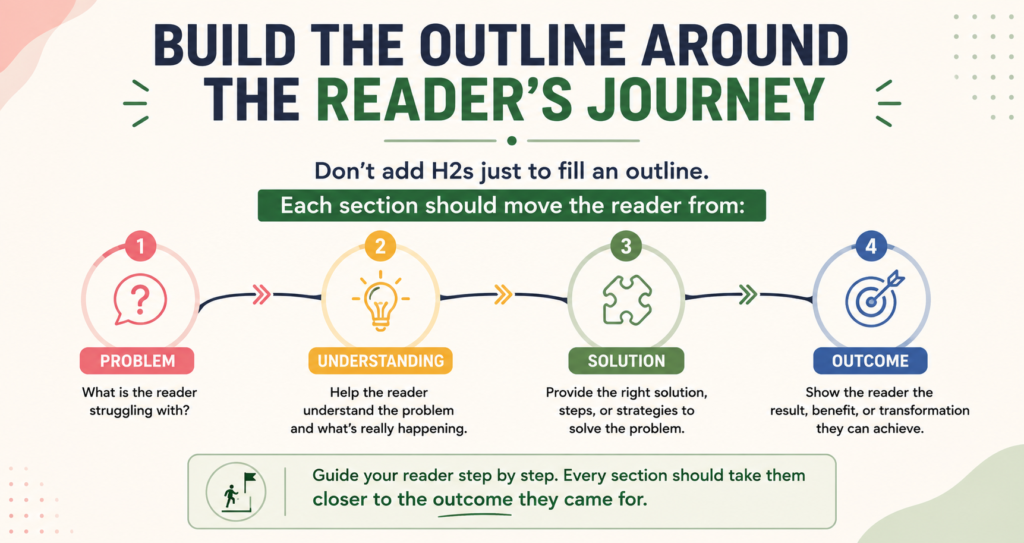
How do you usually begin writing a blog post? You choose a topic, check the keyword, do your research, prepare an outline, and then face the blank document. Yet, despite all that preparation, there are days when the opening just doesn’t come together. I’ve been there. The research is done and I know what I want to say, but I write a few lines, delete them, and start again. Recently, an Instagram post by copywriter Kristin made me look at this differently. Her advice was meant for social media: start with the CTA and reverse engineer the content from there. That got me thinking about blog writing. I wouldn’t start every blog with a sales CTA, but the idea of working backward made sense. Instead of asking, “What should I write?” what if we asked, “What should my reader get from this article?” That’s the thinking behind my Reader-First Blog Framework. Why a Topic Alone Doesn’t Give Your Article Direction Suppose you’ve decided to write an article about Meta Descriptions. You have your keyword, you’ve checked what people are searching for, and you’ve decided the article will be around 1,500 words. Technically, you’re ready to write. But what exactly are those 1,500 words supposed to accomplish? This is where writers, particularly those still learning how to structure long-form content, can get caught in the research trap. You begin reading about meta descriptions and soon have tabs open about character limits, click-through rates, Google’s guidelines, keywords, search results, SEO plugins, and whether Google rewrites descriptions. I’ve done this myself. Research has a strange way of convincing us that because something is related to our topic, it deserves a place in the article. Actually, it doesn’t. A reader searching for “how to write a meta description” probably isn’t asking us to tell them everything we know about meta descriptions. They want to know how to write one. They may want examples. They may want to know how long it should be or whether they should include their keyword. That difference may sound small, but it changes the direction of the article. Instead of telling myself, “I’m writing 1,500 words about meta descriptions,” I could decide: By the end of this article, my reader should be able to write a clear and useful meta description for their next blog post. Now I know where I’m going. More importantly, I know where I need to take the reader. That’s the starting point of the Reader-First Blog Framework. What Is the Reader-First Blog Framework The Reader-First Blog Framework has five parts: Outcome → Problem → Intent → Journey → Action I don’t see these as five boxes that must appear in the finished article. They’re questions I would answer before creating the outline. The idea is to understand the reader first and structure the article around what that person needs. Once you know that, it becomes much easier to decide what belongs in the article, what needs more explanation, and what can safely be left out. 1. Outcome: What Should the Reader Leave With Before worrying about your introduction, ask yourself what the reader should know, understand, or be able to do when they reach the end of the article. Try not to settle for a broad answer. If I’m writing about meta descriptions, saying “the reader should understand meta descriptions” doesn’t help me much. But saying “the reader should be able to write a meta description for their next article” gives me something concrete to work toward. The outcome will naturally change depending on what you’re writing. A how-to guide should help someone complete a task. A comparison article should give them enough information to make a choice. An explanatory article may help them understand a subject that previously confused them. A thought piece is different again. You may not be teaching the reader to do anything. Perhaps you want them to consider a familiar subject from another point of view. And this is worth remembering, particularly when you’re writing for a business website: not every reader outcome has to be a conversion. Sometimes a reader comes looking for an answer. Giving them a good answer is a perfectly valid outcome. 2. Problem: Why Did This Person Come Looking for an Answer? Once I know the outcome, I want to understand what happened before the reader arrived at my article. Why did they search for this? A person looking for help with meta descriptions might be confused about what to write. Someone else may be wondering why their SEO plugin keeps flagging the description. Another writer may have heard that Google sometimes rewrites meta descriptions and is questioning whether writing one is worth the effort. Those readers have arrived at the same broad topic from slightly different places. When we understand the problem, writing the introduction often becomes easier too. We no longer have to manufacture an opening simply because every article needs one. We can begin with a situation the reader recognizes. I find that far more natural than trying too hard to create a clever hook. Think about the articles you’ve continued reading because the first few paragraphs described exactly what you were dealing with. There’s a small moment of recognition: Yes, this is what I came here to find out. As writers, that’s a useful connection to create. 3. Intent: What Does the Reader Really Want? Writers who work with SEO hear about search intent all the time. But I think we sometimes treat it as another SEO item to tick off before writing. I prefer to think of it more simply: What does this person actually want from me? Someone who searches “how to write a meta description” is likely to have practical questions. How long should it be? Should the keyword be included? What should the description say? What makes one description better than another? Can they see a few examples? They probably don’t need a lengthy history of the meta tag before you answer those questions. This is something I’ve learned to remind myself while writing. Research can make you want to include
You Are My Princess by Tanushree Das

Not every train journey is about reaching a place. Sometimes, it quietly reminds us of how far we have come. That was the thought I was left with after reading You Are My Princess by Tanushree Das, one of the stories in Stories from Trains. The story follows Tanushree, or Tanu, who is traveling alone to Kolkata after a long gap. Somewhere along the journey, she hears two familiar voices calling out to her. They belong to Joshua and Arjun, children she had taught earlier. They are delighted to see her, and very soon, the train compartment fills with the kind of easy affection children bring with them. There are nursery rhymes, laughter, dancing, and conversations that take Tanu back to a part of her life she clearly holds close to her heart. Then comes an encounter she wasn’t expecting. Tanu sees Hemant, a man she had once quietly loved. There was a time when she had hoped he would notice her the way she noticed him. That never happened. Now, years later, she meets him again, this time with his wife and child. This was the point where I wanted the story to slow down. What happens inside you when you unexpectedly meet someone who once occupied so much space in your heart? Do you remember the person you were then? Does something still hurt? Or do you look at that person and wonder why you once wanted their attention so badly? I wanted to know what went through Tanu’s mind in those few seconds. Instead, the story moves past the encounter rather quickly and tells us about her earlier feelings for Hemant. I felt this was a missed opportunity. A small hesitation, an awkward exchange, a memory that surfaced without warning, or even Tanu’s surprise at realizing that she felt nothing anymore could have said far more than an explanation of their past. Hemant doesn’t need to become a major character, but his presence matters because he represents something Tanu once wanted very badly. The children, on the other hand, represent a very different kind of love. One of the sweetest moments in the story comes when Joshua looks at Tanu and says, “You are my princess Tanu.” His mother immediately corrects him and asks him to call her “Ma’am,” while Arjun joins in and calls her their princess. It is such an innocent exchange, but there is something deeper sitting beneath it. Tanu had once imagined herself as a princess. Perhaps, when she was younger, being someone’s princess meant being chosen, loved, and made to feel special. Yet here are two children offering her that affection without knowing anything about the disappointments she has carried. This was one of those moments where I wished the author had simply allowed the scene to breathe. I also wanted to know a little more about Joshua and Arjun. We know Tanu taught them and that they remember her fondly, but why do they share such a warm bond with her? Was there something she did as their teacher that stayed with them? Did Tanu remember something about them from their preschool days? Even one small shared memory could have made their reunion warmer and helped us understand why their affection touches her so deeply. There are also places where the dialogue could have been more natural. At times, characters seem to speak mainly to give the reader information. Real conversations are rarely that complete. People interrupt themselves, leave things unsaid, laugh, hesitate, change the subject, or communicate through a look. Bringing some of that into the conversations would have made the people inside that train compartment feel more real. I also found myself rereading a few sentences because the wording made the meaning difficult to follow. Some descriptions are imaginative, but they don’t always create a clear picture. A tighter edit for grammar, sentence structure, and word choice would have made the story much easier to read. This matters because when a reader has to stop to work out what a sentence means, they are pulled away from the emotion of the scene. And this is a story that depends heavily on emotion. For me, the strongest part comes after the train journey. Tanu goes alone to Flurys on Park Street. She orders the food she wants and sits in a restaurant she had once dreamed of visiting but couldn’t afford. There is something quietly satisfying about that moment. No grand achievement is required. She is simply sitting in a place that once felt beyond her reach, able to pay for her own meal and enjoy her own company. Then she tells herself: “Tanu, you are my princess.” I liked that moment. In fact, I liked it enough to wish the story had trusted it more. The long audio message that follows is where I felt the story said a little more than it needed to. Tanu talks about Hemant, self-love, healthy relationships, earning her own money, publishing her book, and learning to find a sense of safety within herself. I understand why the author wanted Tanu to say all of this. These are clearly important experiences, and they explain the woman she has become. But by then, I had already understood much of it. Seeing Hemant with his wife and child had brought her old hopes face-to-face with reality. Meeting Joshua and Arjun reminded her that love and affection had existed in her life in other forms. Sitting alone at Flurys showed us that she could now give herself something she once couldn’t. And that one sentence, “Tanu, you are my princess,” brought all those threads together. The story had already spoken. That is why the audio message felt more like an explanation of the ending than part of the ending itself. A shorter message might have worked. Perhaps even no message at all. I would have been happy to leave Tanu sitting at that table, remembering the little boy on the train who had called her a princess and
My Review of Nandini Gupta’s Mini Concert
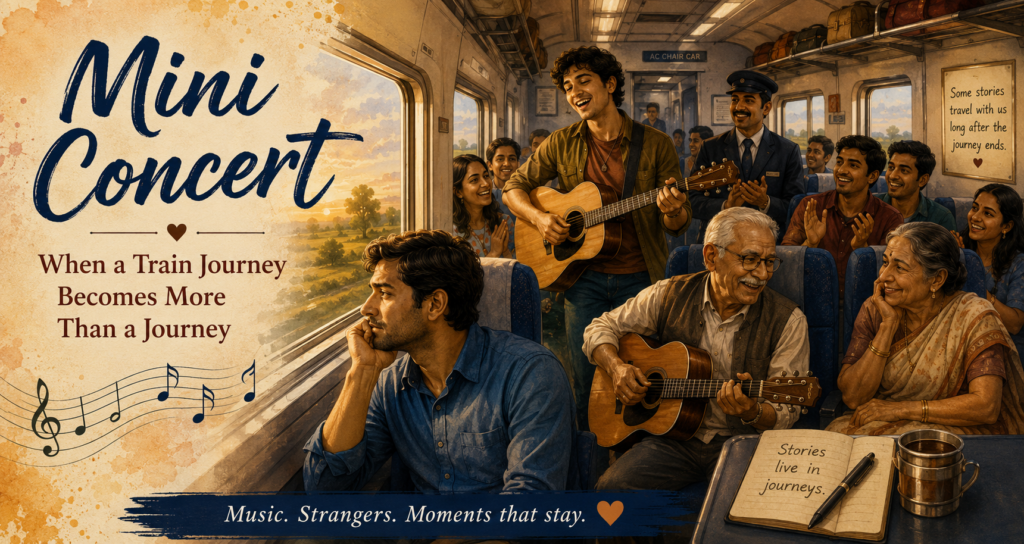
My review of Mini Concert by Nandini Gupta, a story from Stories of Trains, explores Jatin’s memorable journey filled with music, strangers, kindness, and a few important realizations.
My Review of Life on Tracks
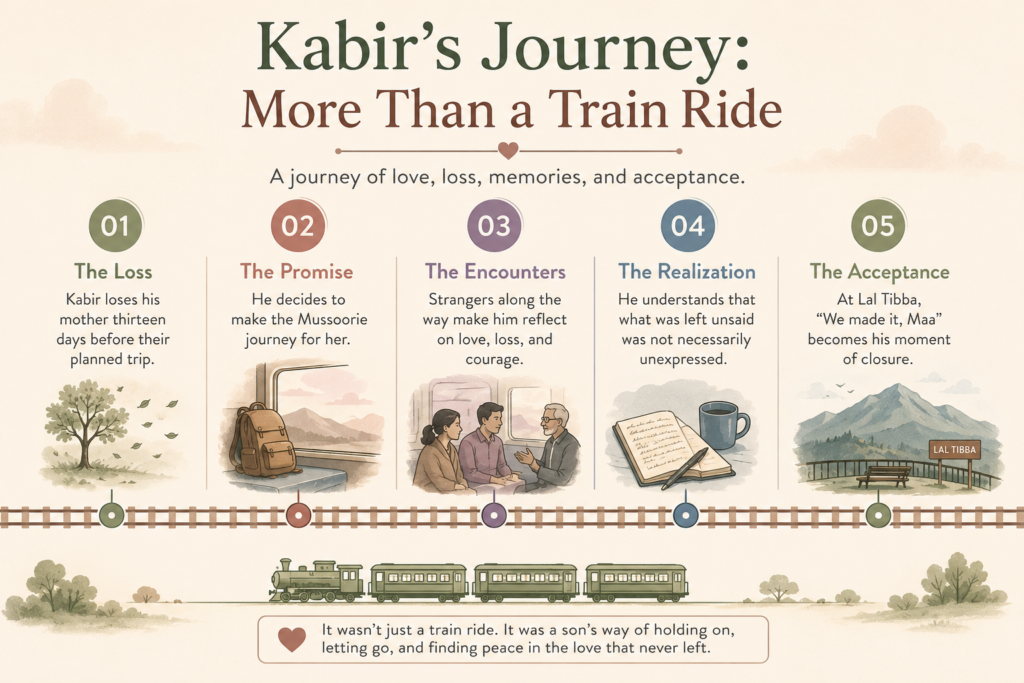
Life on Tracks by Kailash Chander Moryani is one of the stories from the anthology Stories from Trains. When I first saw the title, I had already imagined a very different story. I thought Life on Tracks would take me into the world of a locomotive pilot, perhaps telling the story of someone who had spent years travelling these tracks, watching stations, landscapes, and countless lives pass before him. I was wrong, and I am glad I was, because what Kailash gave me was something I hadn’t expected at all. This wasn’t a story about a life spent working on railway tracks. It was about a son taking a journey he was supposed to make with his mother and slowly coming to terms with the fact that she would never be sitting beside him. As I read further, I realised that the train journey was only one part of it. What stayed with me was Kabir’s journey through grief, his regret over things he never said, and his gradual understanding that losing someone doesn’t mean losing everything they gave you. Kabir loses his mother just thirteen days before they are supposed to travel together to Mussoorie. This was not a casually planned holiday. Mussoorie belonged to their past, to a photograph of three-year-old Kabir sitting on his mother’s lap against the Himalayas, a photograph she had kept beside her bed for thirty years. When Kabir sees the two confirmed berths they had booked for the journey, he makes a decision that becomes the heart of the story. If his mother cannot make the journey, he will make it for her. There was something about that decision that moved me immediately, perhaps because grief often leaves us holding on to plans that suddenly have nowhere to go. A ticket, a reservation, a promise, or even a conversation you thought you would have next week can become unbearably precious when the person connected to it is no longer there. What I liked most about Kailash’s writing is that he doesn’t try to make Kabir’s grief loud. Instead, he allows us to find it in the ordinary things left behind in his mother’s room. Her reading glasses are still on the side table, her cardigan is lying on the armchair, her prayer beads are beside the photograph, and the room still smells of her. These are such familiar, everyday things, yet after someone is gone, it is often these very things that hurt the most. The person is absent, but their presence seems to remain everywhere. The detail that affected me most in the early part of the story was the empty berth. Kabir had booked two berths, and both were confirmed, just as his mother had believed they would be. One would now remain empty. I could picture that empty space beside him, and somehow it said more about his loss than a long description of grief could have done. Kabir’s journey through the train also felt meaningful because the people he meets don’t seem to be there merely to move the plot forward. Each encounter touches a different part of what he is going through. In the crowded general compartment, he watches a mother holding her crying child close, quietly creating a safe space for him while people push and move around them. It reminds Kabir of something he had carried all his life without consciously thinking about it, the security of knowing that his mother was there and that, somehow, she had him. I found that thought very relatable. As children, and sometimes even as adults, we don’t always recognise everything our parents do for us while they are doing it. Their presence becomes so much a part of everyday life that we assume it will always be there, and sometimes we understand the depth of that presence only when it is missing. Then Kabir meets Tukaram, an army officer who has also recently lost someone he loves. His grandfather has died, but Tukaram is returning to duty because his orders remain. When he tells Kabir that it takes courage to show up for someone who is no longer there to see it, the journey to Mussoorie begins to feel different. Kabir is not simply going somewhere his mother wanted to visit. He is keeping a promise to her, even though she will never physically see him fulfil it. But the part that touched me most was Kabir’s conversation with the elderly man in S4. Until that point, Kabir has been carrying his grief, but beneath it is something even more painful: guilt. He finally admits that he never properly told his mother everything she had done for him or how much she meant to him. I think that regret is what made his grief feel so human to me, because many of us are guilty of leaving our deepest feelings unspoken with the people closest to us. We assume they know, or we tell ourselves that we will say it another day when there is more time and when the moment feels right. The old man’s answer, “Unsaid and unspoken are not the same thing,” was the line that stayed with me long after I had finished reading. There is so much comfort in those few words. We may not always say “I love you” or “thank you for everything you have done for me” as often as we should, but love has its own language. It is present in the way we show up for one another, in the small acts of care that become part of everyday life, and in the things we do without needing to explain why. Kabir may regret the words he never spoke, but the old man helps him see that his mother did not necessarily need those words to know that she was loved. At the same time, that part of the story made me think about something else. We shouldn’t always rely on the belief that the people we love