
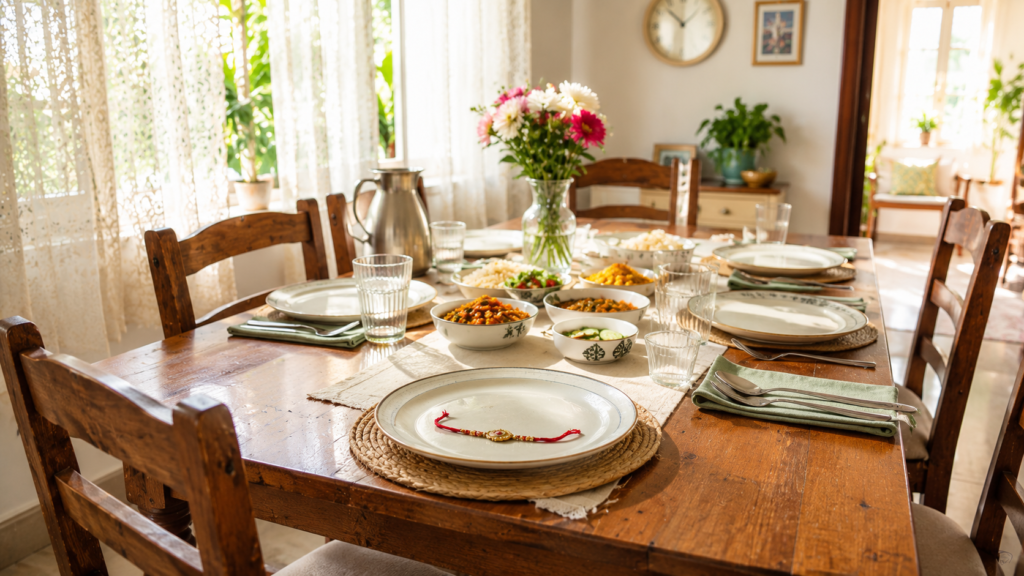
Every year, as Raksha Bandhan approaches, writing communities begin sharing story prompts. Anthology announcements appear on social media, writers start discussing ideas, and before long, the same themes begin to surface. A loving brother. A caring sister. A beautifully decorated thali. A heartfelt promise of protection. While there’s nothing wrong with these stories, many of them end up sounding alike because they begin with the festival instead of the people.
Over the years, I’ve realized that festivals don’t create memorable stories. Relationships do.
I don’t have a brother, so I don’t have childhood memories of tying a Rakhi or waiting excitedly for a gift. In Kerala, Raksha Bandhan is not celebrated. Yet I’ve always been drawn to stories about siblings. Perhaps that’s because affection between siblings has very little to do with rituals. It’s found in everyday moments that most people hardly notice. A sister quietly packs an extra snack because she knows her brother will forget his lunch. A brother pretending not to care, yet waiting outside his sister’s examination hall until she finishes. The teasing, the arguments, the unspoken understanding, and the comfort of knowing someone has known you since childhood. Those are the moments that stay with us.
And that’s exactly where a good Raksha Bandhan story begins.
When I read stories written around festivals, I rarely remember how beautifully the rituals were described. What I remember are the characters. I remember the elderly brother who travelled overnight just to spend a few hours with his sister. I remember the woman who found an old Rakhi while cleaning a cupboard after her mother’s passing. I remember the child who carefully saved pocket money for weeks to buy the simplest gift. None of these memories stayed with me because of the festival. They stayed because they felt like they could have belonged to someone I knew.
As writers, I think we sometimes put too much pressure on ourselves to come up with an unusual plot. We spend hours wondering what unexpected twist we can add, when perhaps we should be asking a different question altogether. What relationship am I trying to capture? Once you answer that honestly, the story usually finds its own direction.
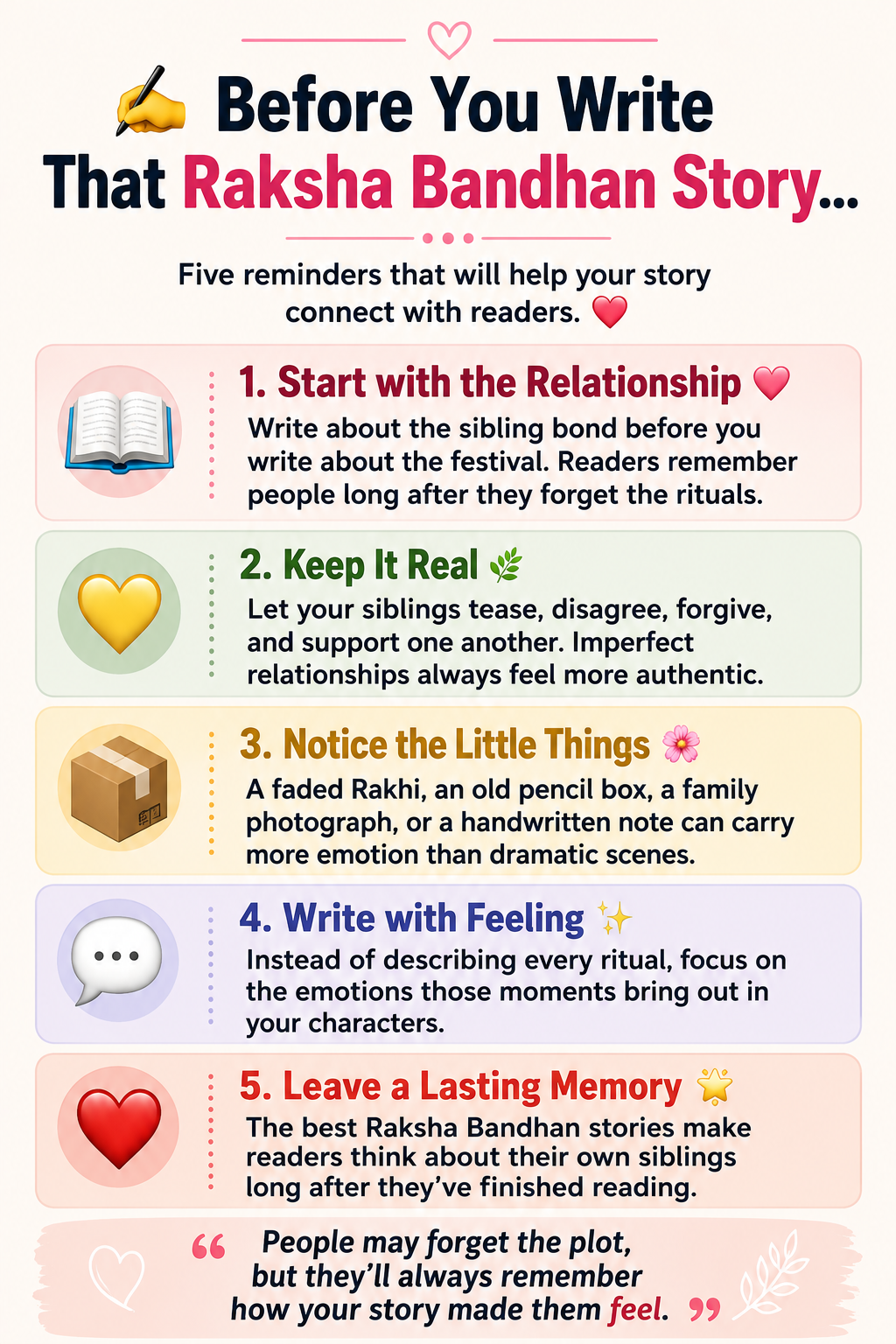
One thing I’ve noticed while observing families is that siblings rarely express affection in obvious ways. They interrupt each other, argue over the smallest things, borrow belongings without permission, and somehow still become each other’s strongest support during difficult times. That contradiction is what makes sibling relationships interesting. If every conversation between your characters is warm and affectionate, readers may admire them, but they probably won’t believe them.
The stories that touch us are usually the ones that allow their characters to be imperfect. A brother may forget an important date but remember exactly how his sister likes her tea. A sister may spend half the day complaining about her brother, yet be the first person he calls when life falls apart. These little contradictions make characters feel human because that’s how most of us are.
I’ve also learned that ordinary objects often carry more emotion than dramatic scenes. Whenever I’m searching for the heart of a story, I find myself thinking about things people hold on to rather than the events themselves. An old greeting card. A faded photograph. A train ticket. A lunch box. Even a pencil box with a forgotten Rakhi tucked inside. Objects quietly collect memories over the years. They become witnesses to lives being lived, and sometimes they tell a story without a single line of dialogue.
Readers notice these details because they’ve experienced something similar in their own lives. Most of us have opened an old drawer looking for one thing and unexpectedly found another that transported us back in time. That feeling is difficult to manufacture, but when it appears naturally in a story, it creates an instant connection.
Another mistake I often see is giving too much importance to the festival itself. We don’t need several paragraphs explaining how the thali was decorated or how every ritual was performed unless those details move the story forward. Your readers already know what Raksha Bandhan looks like. What they don’t know is how your characters will change because of that day.
Perhaps a brother returns home after years of working abroad. Perhaps two siblings meet after an argument that lasted longer than either of them expected. Perhaps an elderly woman ties a Rakhi to an old photograph because the brother she misses is no longer there. The festival becomes meaningful because of what it awakens in the characters, not because of the rituals themselves.
If there’s one piece of advice I’d offer any writer working on a Raksha Bandhan story, it’s this. Spend less time thinking about the festival and more time observing people. Listen to conversations at family gatherings. Watch how siblings tease each other across a dining table. Notice the little gestures that often go unnoticed. Someone serving food before being asked. Someone carrying an extra umbrella because they know the other person never remembers one. These moments may seem ordinary, but they often become the foundation of unforgettable stories.
I also believe we don’t talk enough about the many forms sibling relationships can take today. Not every Raksha Bandhan story has to revolve around a biological brother and sister. Some cousins grow up like siblings. Some sisters become each other’s greatest protectors. Some people celebrate the festival with friends who have become family over the years. And there are those who celebrate quietly through memories because the person they once tied a Rakhi to is no longer with them. These stories deserve to be told because they reflect the world we live in today.
Whenever I finish writing a story, I don’t ask myself whether readers will cry. Instead, I ask whether they’ll remember it. Those are two very different things. A story doesn’t have to be heartbreaking to stay with someone. Sometimes it only needs one honest moment, one familiar memory, or one relationship that reminds readers of their own lives.
If your story can make someone smile while thinking about a sibling, reach for an old photograph, or make a phone call they’ve been postponing for months, you’ve achieved something far more valuable than writing a festival story. You’ve written about human connection, and that’s what readers return for every single time.