

mayapillaiwrites.com

Voice Search Optimization in Search Engines: The Complete Guide for Content Writers

Search behavior has changed significantly over the last few years. People no longer rely only on typed searches to find information online. Instead, they increasingly use voice assistants and smart devices to ask questions naturally and conversationally. Whether someone is asking for nearby restaurants, product recommendations, weather updates, or detailed explanations, voice search has become part of everyday digital behavior.

Devices powered by Amazon Alexa, Apple Siri, and Google Assistant have changed how users interact with search engines. Instead of typing fragmented keywords like “best headphones under 5000,” users now ask complete questions such as, “What are the best wireless headphones under ₹5000 for daily use?”

This shift has changed modern SEO. Content writers can no longer rely only on traditional keyword placement and search engine optimization tactics. They now need to understand conversational search behavior, user intent, and natural language patterns. This is where voice search optimization becomes essential.

Voice search optimization is not simply another SEO trend. It reflects a broader change in how search engines understand language, context, and user expectations. Writers who adapt early can improve content visibility, user engagement, and search rankings while building stronger topical authority in their niche.

This guide explains everything content writers need to know about voice search SEO, including conversational content strategies, long-tail keywords, featured snippets, search intent, mobile optimization, local SEO, and AI-driven search behavior.

TL;DR

Voice search optimization is changing how content ranks in search engines. Modern voice search SEO focuses more on conversational language, user intent, long-tail keywords, and direct answers instead of traditional keyword-heavy strategies. For content writers, optimizing content for voice search now means creating natural, user-focused, and mobile-friendly content that aligns with how people actually speak and search online.

What Is Voice Search Optimization?

Voice Search Optimization is the process of creating and structuring content so it performs better for spoken search queries made through voice assistants, smartphones, smart speakers, and AI-powered devices.

Traditional SEO mainly focused on short typed queries. Voice search SEO focuses more on conversational phrasing, natural speech patterns, and direct answers.

For example, a typed query may look like this:

  • “best SEO tools”

A voice search query is more likely to sound like this:

  • “What are the best SEO tools for small businesses?”

This difference may appear small, but it changes how search engines process intent and rank content.

Modern search engines now rely heavily on natural language processing and semantic search to understand the meaning behind queries rather than simply matching keywords.

Because of this, optimizing content for voice search requires writers to think more about user behavior and less about keyword stuffing.

Why Voice Search Is Growing Rapidly

Voice search adoption continues to grow because of convenience, accessibility, and improvements in AI technology. According to a 2023 study by PwC, 71% of users prefer using voice search for simple tasks. This indicates a major behavioral shift in how people interact with search engines and digital platforms. Several factors are driving this growth. Four important ones are listed below.
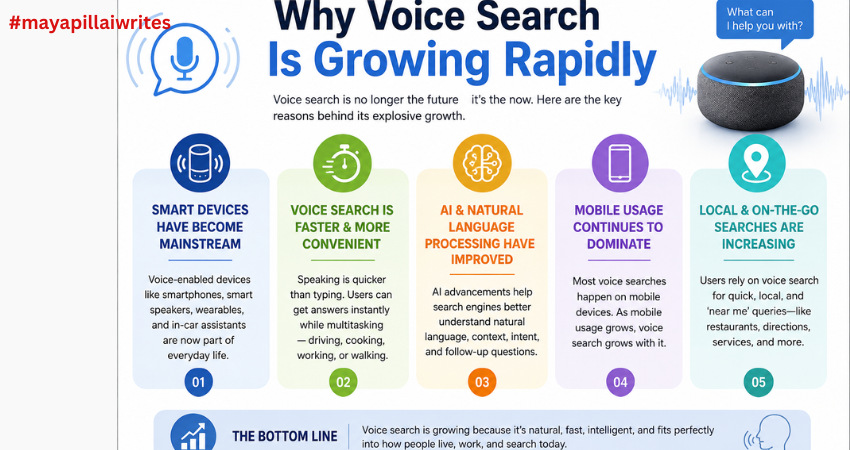
 

Why voice search is growing rapidly

Smart Devices Have Become Mainstream

Voice-enabled devices are now common in homes, workplaces, smartphones, cars, and wearable technology.

Users rely on voice assistants for tasks such as:

  • checking weather updates
  • finding nearby businesses
  • setting reminders
  • controlling smart home devices
  • searching for information
  • making online purchases

As smart devices continue expanding globally, voice search usage is expected to grow alongside them.

Voice Search Is Faster and More Convenient

Most people can speak significantly faster than they type on a mobile keyboard. Voice search allows users to multitask while driving, cooking, walking, or working. This convenience makes spoken queries more practical for everyday use. For mobile users especially, voice search reduces friction and improves accessibility.

AI and Natural Language Processing Have Improved

Search engines now understand conversational queries more accurately than before. Advancements in natural language processing help search systems interpret:

  • user intent
  • context
  • conversational phrasing
  • follow-up questions
  • semantic relationships between words

This allows search engines to provide more relevant answers instead of relying only on exact keyword matches.

Mobile Usage Continues to Dominate

Most voice searches happen on smartphones. Since mobile browsing already dominates internet usage globally, voice search naturally continues to grow within mobile-first experiences. This connection between mobile SEO and voice search optimization makes responsive design and page speed increasingly important.

How Voice Search Is Changing SEO

Voice search is changing both user behavior and the way search engines understand content. Earlier SEO strategies focused mainly on exact-match keywords and short typed queries. Today, users interact with search engines more conversationally through voice assistants and smart devices. Instead of typing fragmented phrases, people now ask complete questions in natural language. Because of this shift, search engines have become more focused on understanding user intent, context, relevance, and content quality rather than simply matching keywords.

Modern voice search SEO now prioritizes conversational content, direct answers, mobile-friendly experiences, and user-focused information that solves queries quickly and clearly. It has also increased the

  •  importance of long-tail keywords, 
  • featured snippets, local SEO, 
  • and natural language optimization. 

For content writers, this means SEO is no longer just about inserting keywords into articles. It now involves understanding how users speak, what information they expect, and how search engines interpret conversational queries to deliver accurate and relevant results.

Conversational Search Has Replaced Fragmented Keywords

One of the biggest changes in modern SEO is the shift from fragmented keyword searches to conversational search behavior. Earlier, users typically typed short and incomplete phrases into search engines because search algorithms relied heavily on keyword matching. Searches often looked like this:

  • “cheap hotels Goa”
  • “best laptop students”
  • “SEO company Bangalore”

Today, voice assistants and AI-powered search engines understand natural language much better. As a result, users now search in a more conversational and human way. Instead of typing isolated keywords, they ask complete questions such as:

“What are the best affordable hotels in Goa for families?”

This shift has changed how content should be written and optimized. Search engines are now focused more on understanding context, search intent, and conversational meaning rather than simply matching exact keywords. Because of this, content writers need to create articles that sound natural, answer real user questions clearly, and reflect how people actually speak during searches.

Modern SEO no longer rewards robotic keyword placement or unnatural phrasing. Instead, it favors content that uses conversational language while still naturally including relevant search terms. Writers who focus on readability, clarity, and user intent are more likely to perform well in both traditional and voice search results.

Long-Tail Keywords Are More Important

Voice searches are usually longer, more detailed, and more conversational than traditional typed searches. These longer search phrases are known as long-tail keywords. Unlike short keywords that are often broad and highly competitive, long-tail keywords reflect more specific user intent and natural speech patterns. 
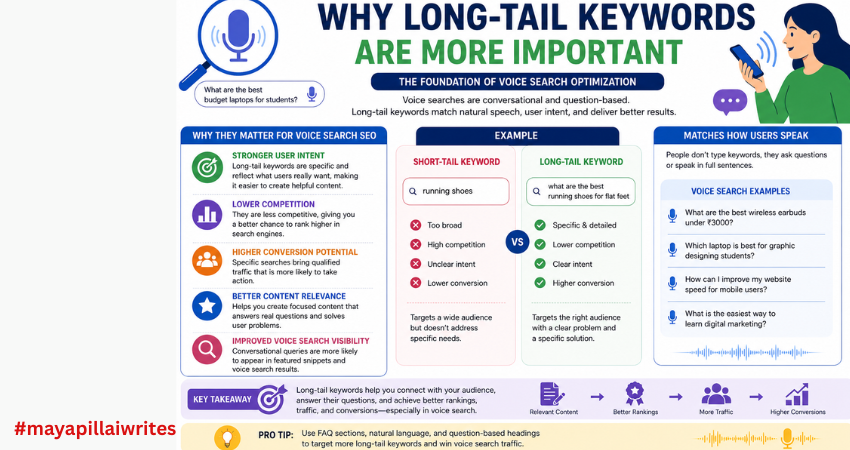
importance of Long-tail keyword

For example, instead of typing:

  • “best content writing tools”

a user may ask:

“What are the best content writing tools for freelance writers?”

This difference is important because voice search users tend to ask complete questions while looking for specific answers. Search engines now prioritize understanding the meaning and intent behind these searches rather than simply matching exact keywords.

Long-tail keywords have become more valuable in modern SEO because they often indicate stronger intent. Users searching with detailed queries usually know what they are looking for, which can lead to better engagement and higher conversion potential. These keywords also tend to face lower competition compared to short generic terms, making them easier to rank for.

For content writers, this means keyword strategies need to become more conversational and user-focused. Instead of forcing short keywords repeatedly into content, writers should naturally include question-based phrases, descriptive search terms, and conversational queries that reflect how people actually speak. This approach improves both voice search visibility and overall content relevance.

Search Intent Matters More Than Exact Keywords

Modern search engines have moved far beyond simple keyword matching. Today, they focus heavily on understanding the intent behind a search query rather than only identifying the exact words used. This shift has become even more important with the rise of voice search, where users ask more natural and detailed questions.

For example, a search query like:

  • “best running shoes”

can have multiple meanings depending on the user’s intent. One user may be researching beginner-friendly options, another may be comparing brands before purchasing, while someone else may simply want expert reviews or recommendations.

This means search engines now analyze context, behavior, and relevance to determine what type of content best satisfies the query. Instead of ranking pages only because they repeat a keyword multiple times, search engines prioritize content that directly answers the user’s needs.

For content writers, understanding search intent is now a critical part of SEO strategy. Before creating content, writers should ask questions such as:

  • What problem is the user trying to solve?
  • What kind of information are they expecting?
  • Are they researching, comparing, or planning to buy?

Answering these questions helps create more relevant and user-focused content.

Intent-driven writing performs better because it aligns with what users actually want. It improves engagement, increases time spent on the page, and helps search engines identify the content as useful and relevant. In modern SEO, satisfying user intent matters far more than simply inserting exact keywords repeatedly throughout an article.

Featured Snippets Have Become More Valuable

Featured snippets have become increasingly important in modern SEO, especially with the growth of voice search. Voice assistants often read answers directly from featured snippets because these results are designed to provide quick, concise, and relevant information to users.

Featured snippets are highlighted search results that appear above traditional organic listings on search engine result pages. They are commonly displayed in formats such as short paragraphs, bullet lists, numbered steps, or tables. Since voice assistants aim to deliver immediate answers, they frequently rely on featured snippets to respond to spoken queries.

For example, when a user asks:

“What is voice search optimization?”

the voice assistant may pull a direct answer from a featured snippet instead of reading an entire webpage.

Because of this, content writers now need to structure content in ways that improve snippet visibility. Search engines are more likely to select content that includes:

  • concise and direct answers
  • question-based headings
  • well-structured formatting
  • short explanatory paragraphs
  • bullet points and numbered lists

Content that quickly answers a question while remaining clear and informative has a better chance of appearing in featured snippets. This not only improves traditional search visibility but also increases the likelihood of being used in voice search responses.

For content writers and SEO professionals, optimizing for featured snippets is no longer optional. It has become an important strategy for improving visibility, authority, and user engagement in both voice and AI-driven search experiences. This makes snippet optimization an important part of voice search SEO.

How Content Writers Should Adapt to Voice Search

Voice search is changing the way content is written, structured, and optimized for search engines. As users increasingly rely on conversational queries through smartphones and voice assistants, content writers need to adapt their writing style to match how people naturally speak and search online. 
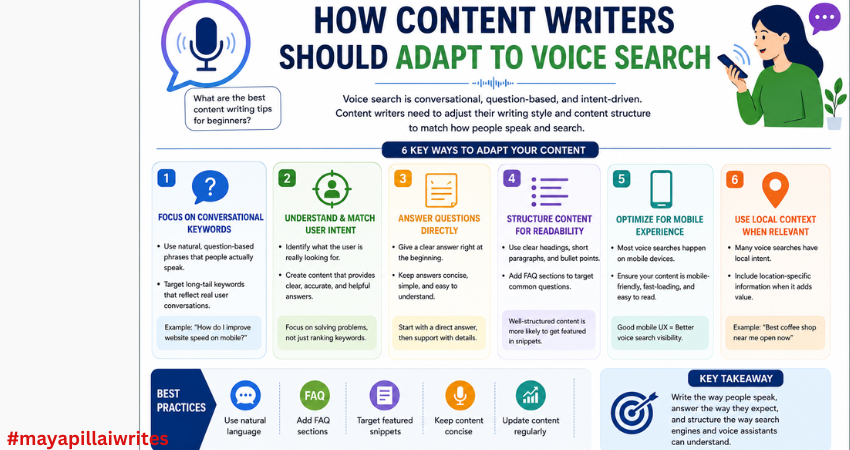
How Content Writers Should Adapt to Voice Search

Optimizing content for voice search does not mean abandoning traditional SEO practices completely. Instead, it involves refining existing strategies to focus more on readability, user intent, conversational language, and content clarity. Search engines are now prioritizing content that feels natural, answers questions directly, and provides useful information in a clear format.

Content writers should move away from robotic keyword placement and focus more on creating human-centered content. Instead of forcing keywords unnaturally into paragraphs, writers should integrate search terms naturally within conversational sentences and question-based headings. This helps content align better with how users phrase voice searches in real life.

Voice search optimization also requires stronger attention to content structure. Search engines prefer content that is easy to scan and understand quickly. Writers should use:

  • descriptive headings
  • shorter paragraphs
  • direct answers
  • FAQ sections
  • bullet points where necessary
  • clear content hierarchy

This structure improves both readability and the chances of appearing in featured snippets and voice search results.

Another important shift involves understanding user intent more deeply. Voice search users often expect immediate and specific answers. Because of this, writers need to think beyond keywords and focus on solving user problems clearly and efficiently.

For example, instead of targeting only a keyword like:

  • “best laptops”

writers should consider the actual questions users may ask, such as:

“What are the best laptops for students under ₹60,000?”

This approach helps create more targeted and useful content.

Content writers should also focus on mobile readability, since most voice searches happen on mobile devices. Clear formatting, fast-loading pages, and conversational writing all contribute to better user experience and stronger SEO performance.

As search engines become more AI-driven and context-aware, the role of content writers is also evolving. Writers are no longer just optimizing for algorithms. They are creating content that needs to satisfy both search engines and real human conversations.

To Sum Up

Voice search optimization is changing the way content is created, structured, and ranked in search engines. As users increasingly rely on conversational searches through smartphones, smart speakers, and AI-powered assistants, content writers need to move beyond traditional keyword-focused SEO strategies. Modern search engines now prioritize natural language, user intent, conversational phrasing, and direct answers that provide clear value to readers. This shift has made long-tail keywords, featured snippets, mobile optimization, local SEO, and structured content more important than ever. For content writers, successful voice search SEO now depends on creating human-centered content that sounds natural, answers real user questions clearly, and aligns with how people actually speak and search online.

Key Takeaways

  • Voice search optimization focuses on conversational queries and natural language instead of fragmented keyword searches.
  • Modern voice search SEO prioritizes user intent, relevance, and direct answers over exact keyword repetition.
  • Long-tail keywords are important because they reflect how users naturally speak during voice searches.
  • Featured snippets play a major role in optimizing content for voice search because voice assistants often pull answers from them.
  • Content writers should structure content using clear headings, FAQ sections, concise answers, and mobile-friendly formatting.
  • Optimizing content for voice search requires creating human-centered content that improves readability, engagement, and search visibility.

FAQs

What Is Voice Search Optimization?

Voice Search Optimization is the process of improving website content so it performs better for spoken search queries made through voice assistants, smartphones, and smart devices.

Why Is Voice Search Important for SEO?

Voice search is changing how users interact with search engines. It encourages conversational queries, natural language searches, and direct answers, which directly affect modern SEO strategies.

How Does Voice Search Affect Content Writing?

Voice search encourages content writers to create more conversational, user-focused, and easy-to-read content. Writers now need to focus on readability, question-based queries, and natural language optimization.

What Are Long-Tail Keywords in Voice Search SEO?

Long-tail keywords are longer and more detailed search phrases that reflect how users naturally speak during voice searches. These keywords often show stronger search intent and lower competition.

Why Are Featured Snippets Important for Voice Search?

Voice assistants frequently pull answers from featured snippets because they provide quick and concise responses to user queries. Optimizing content for featured snippets can improve both voice search visibility and traditional SEO rankings.

How Can Content Writers Optimize for Voice Search?

Content writers can optimize for voice search by using conversational language, focusing on user intent, targeting long-tail keywords, structuring content clearly, and answering user questions directly.

Does Voice Search Affect Local SEO?

Yes. Many voice searches are location-based, such as “restaurants near me” or “best coffee shop nearby.” This makes local SEO and accurate business information extremely important.

Why Is Mobile Optimization Important for Voice Search?

Most voice searches happen on mobile devices. Mobile-friendly websites with fast loading speed, responsive design, and readable formatting perform better in voice search results.

How Is AI Influencing Voice Search SEO?

AI and natural language processing help search engines better understand conversational queries, context, and user intent. This has made SEO more focused on relevance, semantic meaning, and content quality.

What Is the Future of Voice Search SEO?

The future of voice search SEO is becoming more conversational, AI-driven, and intent-focused. Content writers who create clear, user-focused, and naturally written content will be better positioned for future search trends.

Leave a Reply

Your email address will not be published. Required fields are marked *